
Introduction to Doubly Linked List
When you’re learning data structures, you’ll often hear about Linked Lists. A Doubly Linked List (DLL) is a powerful and flexible variation of the basic Singly Linked List that allows you to traverse in both directions — forward and backward.
In this beginner-friendly article, we’ll explore:
- What is a Doubly Linked List?
- How it works (with diagrams)
- Real-world uses
- Advantages over singly linked list
- Basic operations (insertion, deletion, traversal)
- Code example in C/C++
🚀 Whether you’re preparing for coding interviews or improving your DSA skills, understanding doubly linked lists is a must!
What is a Doubly Linked List?
A Doubly Linked List is a type of linear data structure made up of nodes, where each node contains:
- Data (the actual value)
- Pointer to the next node
- Pointer to the previous node
⚙️ Node Structure of Doubly Linked List:
+-------+----------+----------+
| prev  |   data   |   next   |
+-------+----------+----------+
Each node is connected to its previous and next node, unlike a singly linked list, which only has a next pointer.
Visual Representation of Doubly Linked List
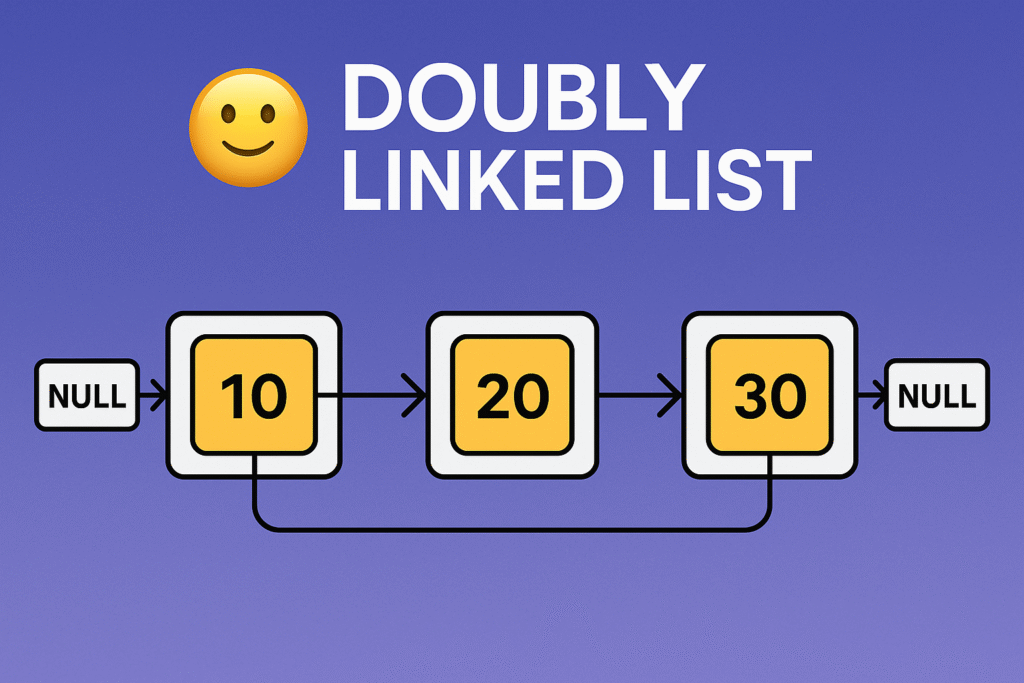
Let’s say we have 3 nodes with data: 10, 20, and 30.
NULL <- [10] <-> [20] <-> [30] -> NULL
Here:
- Node 10’s
previs NULL - Node 20’s
prevpoints to 10 andnextto 30 - Node 30’s
nextis NULL
Basic Operations on Doubly Linked List
1. Insertion
- At the beginning
- At the end
- At a specific position
2. Deletion
- From the beginning
- From the end
- Specific node
3. Traversal
- Forward traversal (left to right)
- Backward traversal (right to left)
C Code Example: Basic DLL Operations
#include <stdio.h>
#include <stdlib.h>

typedef struct Node {
    int data;
    struct Node* prev;
    struct Node* next;
} Node;

Node* head = NULL;

// Insert at end
void insertEnd(int value) {
    Node* newNode = (Node*)malloc(sizeof(Node));
    newNode->data = value;
    newNode->next = NULL;

    if (head == NULL) {
        newNode->prev = NULL;
        head = newNode;
        return;
    }

    Node* temp = head;
    while (temp->next != NULL)
        temp = temp->next;

    temp->next = newNode;
    newNode->prev = temp;
}

// Display forward
void displayForward() {
    Node* temp = head;
    printf("DLL (forward): ");
    while (temp != NULL) {
        printf("%d <-> ", temp->data);
        temp = temp->next;
    }
    printf("NULL\n");
}

// Display backward
void displayBackward() {
    Node* temp = head;
    if (!temp) return;

    // Go to last node
    while (temp->next != NULL)
        temp = temp->next;

    printf("DLL (backward): ");
    while (temp != NULL) {
        printf("%d <-> ", temp->data);
        temp = temp->prev;
    }
    printf("NULL\n");
}

int main() {
    insertEnd(10);
    insertEnd(20);
    insertEnd(30);

    displayForward();
    displayBackward();
    return 0;
}
Advantages of Doubly Linked List
- Two-way traversal: You can navigate forward and backward.
- Easier deletion: You can delete a node without needing the previous node pointer.
- More flexible: Especially useful in complex data structures like Deques, Undo/Redo systems, Music Playlists, etc.
Disadvantages of Doubly Linked List
- More memory: Each node requires extra space for the
prevpointer. - More complex: Handling pointers can be error-prone for beginners.
Real-Life Applications of Doubly Linked List
- Web browsers (backward and forward navigation)
- Music playlist apps
- Text editors (undo/redo operations)
- Task managers (circular doubly linked lists for round-robin)
Conclusion DLL
The Doubly Linked List is an essential topic in Data Structures and Algorithms (DSA). It offers a better way to manage dynamic data, especially when two-way traversal is needed. Though slightly more complex than a singly linked list, the benefits are powerful.
Whether you’re preparing for a coding interview, building a system-level application, or just learning C programming, mastering DLLs will give you a strong foundation in memory management and pointer logic.
FAQs of Doubly Linked List
Q1: Is doubly linked list faster than singly linked list?
Ans: DLL allows backward traversal and easier deletion, but it uses more memory. It’s more flexible, not necessarily faster.
Q2: Where is DLL used in real life?
Ans: Browser history, playlist navigation, undo/redo features, and memory management systems.
Q3: What is the main drawback of doubly linked list?
Ans: It uses extra memory due to the additional prev pointer and increases code complexity.
Q4: How is a doubly linked list different from a circular doubly linked list?
Ans: In a doubly linked list, the last node’s next pointer is NULL, whereas in a circular doubly linked list, the last node’s next points back to the head, forming a circle.
Q5: Can a doubly linked list be empty?
Ans: Yes, initially a doubly linked list can be empty with head pointing to NULL.
Q6: How do you insert a node at the beginning of a doubly linked list?
Ans: Create a new node, point its next to the current head, set the head’s prev to the new node, and then update head to the new node.
Q7: What happens when you delete the last node in a doubly linked list?
Ans: The second last node’s next pointer is set to NULL, and the last node is freed from memory.
Q8: Is it possible to implement a stack using a doubly linked list?
Ans: Yes, a doubly linked list can be used to implement a stack with push and pop operations.
Q9: How does traversal in a doubly linked list work?
Ans: You can traverse forward from head to NULL using next pointers or backward from the last node to head using prev pointers.
Q10: What are the memory requirements for a doubly linked list node?
Ans: Each node stores data plus two pointers (prev and next), so it uses more memory compared to a singly linked list node, which stores only one pointer.
Q11: Can doubly linked lists have cycles? How to detect them?
Ans: Yes, cycles can exist if nodes point back to earlier nodes. Cycle detection algorithms like Floyd’s Cycle-Finding Algorithm (tortoise and hare) can detect cycles.
Q12: Are doubly linked lists used in databases?
Ans: Yes, doubly linked lists are used to implement certain data structures like LRU caches, which are common in databases and operating systems.
Q13: How do you reverse a doubly linked list?
Ans: Swap the prev and next pointers for each node and update the head to the last node.
You can also Visit other tutorials of Embedded Prep
- Linked List Explained: Master Complete Guide for Beginners 2025
- Master Doubly Linked List in Data Structures (With Examples) 2025
- Multithreading in C++
- Multithreading Interview Questions
- Multithreading in Operating System
- Multithreading in Java
- POSIX Threads pthread Beginner’s Guide in C/C++
- Speed Up Code using Multithreading
- Limitations of Multithreading
- Common Issues in Multithreading
- Multithreading Program with One Thread for Addition and One for Multiplication
- Advantage of Multithreading
- Disadvantages of Multithreading
- Applications of Multithreading: How Multithreading Makes Modern Software Faster and Smarter”
Leave a Reply