Category: Interview Preparation

  • Master Android Automotive OS Interview Questions and Answers (2026)

    Imagine getting into your car on a Monday morning. As you press the start button, the infotainment system lights up—not just with music and navigation, but with personalized settings, climate control, and even reminders for your next meeting. None of this relies on your phone. Instead, it’s powered directly by Android Automotive OS (AAOS), a complete operating system built for vehicles.

    In this guide, we’ll explore what Android Automotive OS is, how its architecture works, how it differs from Android Auto, and what developers must consider when building apps for cars.

    1. What is Android Automotive OS?

    Android Automotive OS (AAOS) is Google’s version of Android designed specifically for in-vehicle infotainment (IVI) systems. Unlike Android Auto, which mirrors apps from a smartphone, AAOS runs natively on the car’s hardware. This deep integration enables automakers to offer features like navigation, media playback, climate control, and communication—without requiring a phone connection.

    In short: Android Auto depends on your smartphone, while Android Automotive OS powers the car itself.

    2. Android Automotive OS Architecture

    AAOS is a full-stack, open-source, highly customizable platform. Its architecture ensures seamless interaction between vehicle hardware, system services, and apps.

    Key components include:

    • HAL (Hardware Abstraction Layer): Interfaces between Android framework and car hardware.
    • Vehicle HAL: Extends HAL for automotive needs like sensors, engine data, and climate control.
    • Car Services: Provides APIs for navigation, media, and communication.
    • Apps: Pre-installed apps (Google Maps, Play Store, etc.) and user-installed apps.

    This layered design makes AAOS both powerful and flexible for automakers.

    3. Android Auto vs Android Automotive OS

    FeatureAndroid AutoAndroid Automotive OS
    Runs onSmartphoneCar hardware
    Phone Required?YesNo
    IntegrationLimited (projection only)Deep integration with vehicle systems
    CustomizationsMinimalOEM can fully customize
    ExamplesSpotify mirrored from phoneSpotify runs natively on IVI

    4. Optimizing Android Apps for Automotive

    Developing for cars is different from mobile. A well-optimized automotive app should:

    • Simplify the UI: Use large buttons, minimal distractions.
    • Leverage Voice: Integrate with Google Assistant.
    • Optimize Performance: Keep apps lightweight for car hardware.
    • Use Vehicle APIs: Access speed, fuel, climate data to enhance user experience.

    5. Designing UI for Android Automotive

    A car environment demands driver-first design. Best practices:

    • Avoid driver distraction (minimal text, large icons).
    • Support day/night modes for better visibility.
    • Enable voice commands to reduce screen interaction.
    • Build responsive layouts for different screen sizes.

    6. Vehicle HAL & Car APIs

    At the heart of AAOS lies the Vehicle HAL—the bridge between vehicle hardware and Android framework. Developers can use VehicleProperty API and CarService to access car data (speed, gear, fuel, HVAC).

    For example, a navigation app could adjust ETAs based on vehicle speed, while a music app could auto-pause when the car turns off.

    7. Safety & Performance Considerations

    Building apps for AAOS isn’t just about features—it’s about safety. Developers must ensure:

    • Minimal distractions through voice and simple UIs.
    • Fail-safe systems so infotainment crashes don’t affect driving.
    • Memory management to avoid freezes.
    • Stress testing in real-world driving scenarios.

    8. Over-The-Air (OTA) Updates

    AAOS supports OTA updates—a game-changer for cars. Best practices:

    • Use incremental updates to save bandwidth.
    • Validate thoroughly before release.
    • Provide a rollback mechanism in case updates fail.
    • Schedule updates when the car is idle.

    9. AAOS vs Automotive Grade Linux (AGL)

    Both AAOS and AGL (Automotive Grade Linux) power infotainment, but:

    • AAOS = Android ecosystem + Google services (Maps, Play Store)
    • AGL = Open Linux platform, customizable by OEMs

    Many automakers choose AAOS for its ready-to-use app ecosystem.

    10. Key Challenges in Android Automotive Development

    • Security: Protecting user and vehicle data.
    • Third-party apps: Ensuring compliance and performance.
    • Hardware variability: Different car makers = different setups.
    • Testing: Simulators vs real-world conditions.

    You can also visit : Building Android Automotive OS AAOS

    Conclusion: Android Automotive OS Interview Questions

    Android Automotive OS (AAOS) isn’t just an infotainment system—it’s the future of connected cars. From media streaming to real-time navigation and vehicle diagnostics, AAOS allows developers to shape a smarter, safer in-car experience.

    As adoption grows, developers who understand AAOS architecture, Vehicle HAL, and automotive design principles will be at the forefront of building tomorrow’s mobility solutions.

    FAQ: Android Automotive OS Interview Questions

    Q1: What are android-automotive-os-interview-questions?

    Ans: Android-automotive-os-interview-questions are commonly asked technical and conceptual queries related to Android Automotive OS (AAOS). They cover system architecture, AOSP, HAL, app development, and infotainment integration.

    Q2: Why should I prepare for android-automotive-os-interview-questions?

    Ans: Preparing for android-automotive-os-interview-questions helps candidates showcase knowledge in AAOS, debugging, performance optimization, and real-world automotive use cases, increasing chances of selection.

    Q3: What topics are included in android-automotive-os-interview-questions?

    Ans: Key topics include AOSP build system, Vehicle HAL, CAN bus, AAOS UI design, integration with car sensors, Android services, and performance tuning.

    Q4: Are android-automotive-os-interview-questions suitable for beginners?

    Ans: Yes, many android-automotive-os-interview-questions start with basic concepts like AOSP setup, repo sync, and app development before moving to advanced HAL integration and system services.

    Q5: How can I practice android-automotive-os-interview-questions?

    Ans: You can practice android-automotive-os-interview-questions by setting up an AAOS build environment, creating simple apps, exploring open-source projects, and reviewing past interview patterns.
    Android Automotive OS Interview Questions
    Master Android Automotive OS Interview Questions and Answers (2025)
  • Top Interview Questions on Interrupt Service Routine (ISR) | Master Embedded Interview Guide (2026)

    Interview Questions on Interrupt Service Routine : When preparing for embedded systems interviews, one of the most important topics is the Interrupt Service Routine (ISR). Recruiters often ask questions on ISR because it is a core concept in microcontrollers, operating systems, and real-time systems. In this guide, we’ll go through commonly asked ISR interview questions, explained in a simple way for beginners.

    What is an Interrupt Service Routine (ISR)?

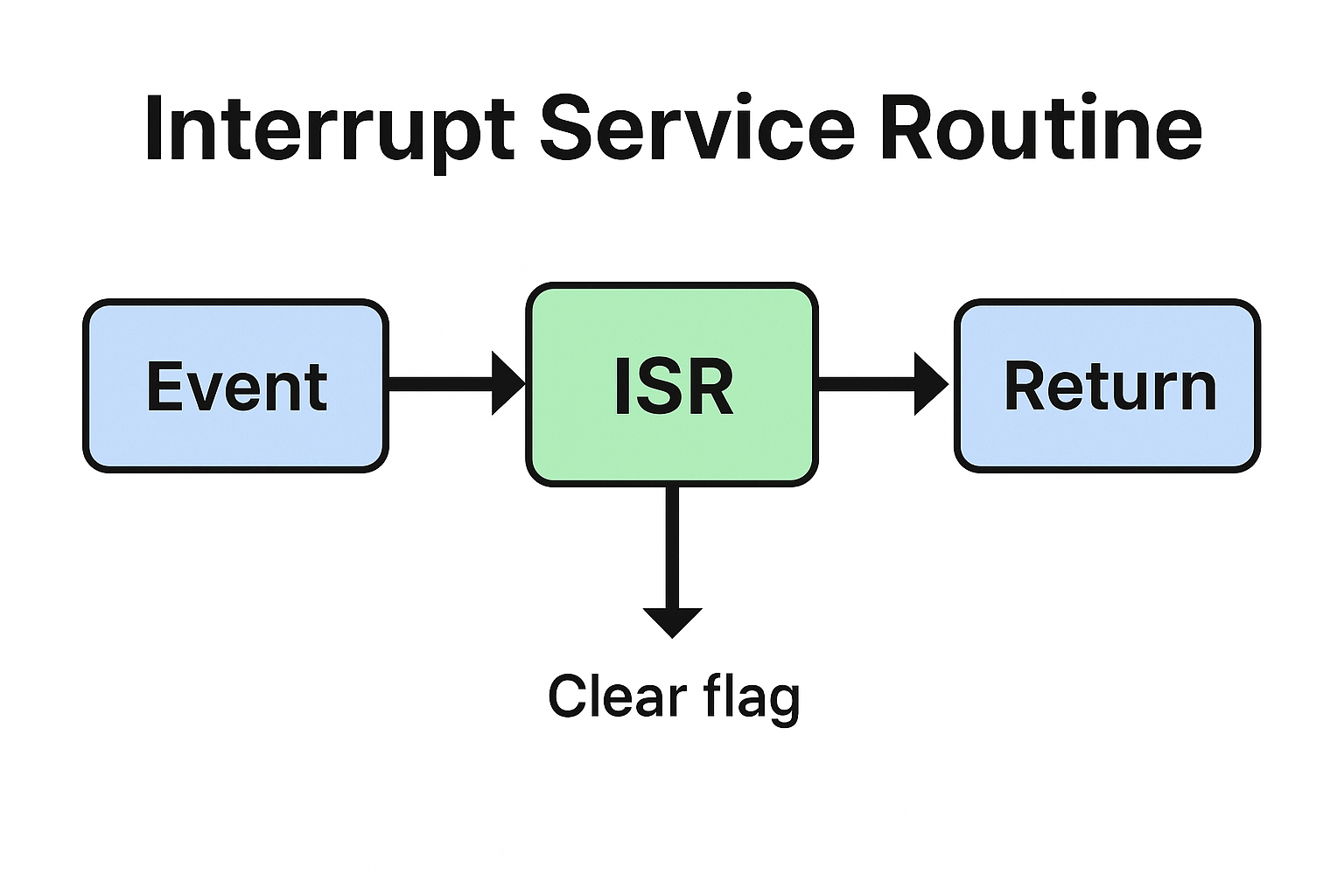
    An Interrupt Service Routine (ISR) is a special block of code that executes when a hardware or software interrupt occurs. Instead of continuously checking a condition (polling), the system pauses its normal execution and jumps to the ISR to handle the event immediately.

    Example: When you press a button on a microcontroller, an interrupt occurs, and the ISR handles the button press.

    Interview Questions on Interrupt Service Routine
    Top Interview Questions on Interrupt Service Routine (ISR) Master Embedded Interview Guide (2025)

    Common Interview Questions on Interrupt Service Routine (ISR)

    1. What is an ISR in embedded systems?

    Answer: An ISR is a function that handles interrupts. It is triggered automatically when an interrupt occurs, allowing the CPU to respond quickly to external or internal events.

    2. What are the characteristics of an ISR?

    Answer:

    • Fast execution : Should be short and efficient.
    • No return values : ISR does not return values.
    • No blocking calls : Avoid using functions like delay() inside ISR.
    • Context saving : CPU saves the current state before jumping to ISR.

    3. Can an ISR call another function?

    Answer: Yes, but it should only call lightweight functions. Heavy operations inside ISR may slow down the system and block other interrupts.

    4. What are nested interrupts?

    Answer: Nested interrupts occur when a higher-priority interrupt occurs while another ISR is still running. In such cases, the CPU pauses the current ISR and executes the higher-priority one.

    5. Why should we keep ISRs short?

    Answer: Long ISRs delay the processing of other interrupts. In real-time systems, this can cause missed events and system instability.

    6. What is the difference between ISR and a normal function?

    Answer:

    • ISR executes automatically when an interrupt occurs, while a normal function is called manually.
    • ISR does not return values, while functions can.
    • ISR runs in a special CPU context and must be as short as possible.

    7. Can we use global variables inside ISR?

    Answer: Yes, but they must be declared as volatile so that the compiler does not optimize them. This ensures real-time updates between the ISR and the main program.

    8. What is interrupt latency?

    Answer: Interrupt latency is the time delay between an interrupt request and the start of ISR execution. Low latency is important for real-time systems.

    9. How do you handle multiple interrupts?

    Answer:

    • Assign priority levels to interrupts.
    • Use interrupt vectors to map different ISRs.
    • Ensure critical ISRs are shorter and higher priority.

    10. What are some best practices for writing ISRs?

    Answer:

    • Keep ISRs short and simple.
    • Use global variables carefully (mark them as volatile).
    • Avoid using printf, malloc, or delay inside ISR.
    • Handle only critical tasks inside ISR and defer others to the main loop or task scheduler.

    List of Interview Questions on Interrupt Service Routine (ISR)

    Basic Questions of Interrupt Service Routine interview questions

    1. What is an Interrupt Service Routine (ISR)?
    2. Why do we need ISR in embedded systems?
    3. What are the main features of an ISR?
    4. What is the difference between polling and ISR?
    5. What happens when an interrupt occurs?

    Intermediate Questions of ISR in embedded systems

    1. What are the rules for writing an ISR?
    2. Why should an ISR be short and fast?
    3. Can we use global variables inside ISR?
    4. What is the role of the volatile keyword in ISR?
    5. What is interrupt latency?
    6. Can an ISR return a value? Why or why not?
    7. What is the difference between ISR and a normal function?
    8. Can ISRs be nested? What are nested interrupts?
    9. How does the CPU know which ISR to execute?
    10. What is an interrupt vector table?

    Advanced Questions of common ISR interview questions

    1. How are multiple interrupts handled in a system?
    2. What are interrupt priorities?
    3. What is the difference between maskable and non-maskable interrupts?
    4. What are reentrant and non-reentrant ISRs?
    5. Can we use dynamic memory allocation (malloc/free) inside ISR?
    6. Why is it not recommended to use printf() inside ISR?
    7. What are some common mistakes while writing ISRs?
    8. How do you handle critical tasks inside ISR?
    9. What happens if an ISR takes too long to execute?
    10. How do modern microcontrollers reduce interrupt latency?

    Practical/Implementation Questions of interrupt handling in embedded systems

    1. How do you declare an ISR in C/C++?
    2. How do you enable and disable interrupts in a microcontroller?
    3. What is the difference between hardware and software interrupts?
    4. Can an ISR call another ISR?
    5. How do you share data between ISR and the main program?
    6. What are best practices for writing ISRs?
    7. What tools or debuggers can be used to test ISR execution?
    8. Can an ISR cause a system crash? How?
    9. How does an operating system handle interrupts differently from bare-metal programming?
    10. What is the difference between vectored and non-vectored interrupts?

    1.What is an Interrupt Service Routine (ISR)?

    Ans: An ISR is a special function that executes automatically when an interrupt occurs, allowing the CPU to handle events quickly without polling.

    2.Why do we use ISR in embedded systems?

    Ans: ISR reduces CPU load, improves response time, and makes systems more efficient by handling events only when they occur.

    3. Can an ISR return a value?

    Ans: No, ISRs cannot return values because they are executed by hardware/OS, not called like regular functions.

    4. Why should ISR be short and fast?

    Ans: Long ISRs block other interrupts and can cause system delays or missed events.

    5. Can we use global variables in ISR?

    Ans: Yes, but they should be declared as volatile to ensure real-time updates between ISR and the main program.

    6. What is interrupt latency?

    Ans: Interrupt latency is the time delay between an interrupt request and the start of ISR execution.

    7. Can we use printf or delay inside ISR?

    Ans: No, functions like printf, malloc, or delay should be avoided inside ISR as they are slow and may cause system instability.

    8. What is the difference between ISR and normal function?

    Ans:
    a) ISR executes automatically when an interrupt occurs, while a normal function is called explicitly.
    b) ISR does not return values, while functions can.
    c) ISR runs in a special CPU context.

    9. What are nested interrupts?

    Ans: Nested interrupts occur when a higher-priority interrupt interrupts the execution of a lower-priority ISR.

    10. What are best practices for writing ISRs?

    Ans:
    a) Keep ISRs short and efficient.
    b) Use volatile for shared variables.
    c) Avoid blocking functions.
    d) Handle only critical tasks inside ISR, defer the rest to main loop or task scheduler.
    Interrupt Service Routine
    Interrupt Service Routine (ISR) Definition, Examples, Best Practices Embedded Interview Guide (2025)
  • Master CAN Bus Interview Questions 2026

    CAN Bus Interview Questions : If you are preparing for an embedded systems or automotive interview, chances are you’ll face questions on CAN bus, a widely-used communication protocol in vehicles. This article simplifies CAN bus interview questions for beginners and helps you understand the key concepts, architecture, message handling, and real-world applications in a friendly tone.

    Whether you’re a student, fresher, or experienced developer brushing up for an interview, this guide is a great place to start.

    CAN Bus Interview Questions

    CAN Bus Interview Questions
    CAN Bus Interview Questions

    Basic Concepts

    1. What does CAN stand for in CAN bus?
    2. What is CAN bus and why is it used in automotive systems?
    3. Describe the basic architecture of a CAN bus system.
    4. What are the primary components of a CAN bus network?
    5. Explain the difference between a CAN node and a CAN message.

    Message Format and Communication

    1. Can you explain the message format used in CAN bus?
    2. What is the purpose of the CAN identifier field in a CAN message?
    3. Describe the difference between standard and extended CAN identifiers.
    4. How does CAN bus support prioritization of messages?
    5. Describe the process of arbitration in CAN bus communication.

    Data Transmission & Reliability

    1. How does CAN bus ensure message integrity and reliability?
    2. How does CAN bus handle message collisions?
    3. How does CAN bus handle error detection and error handling?
    4. What is bit stuffing, and why is it used in CAN bus communication?
    5. What is the maximum data transfer rate supported by CAN bus?

    Filtering, Speed, and Configuration

    1. Can you explain the concept of message filtering in CAN bus?
    2. How does CAN bus handle communication between nodes with different bit rates?
    3. How does CAN bus support both high-speed and low-speed communication within a vehicle?
    4. What factors should be considered when designing a CAN bus network?

    Hardware & Physical Layer

    1. Explain the significance of termination resistors in a CAN bus network.

    Applications & Real-World Use Cases

    1. What are the advantages of using CAN bus over other communication protocols in automotive applications?
    2. What are the advantages of using CAN bus in automotive applications?
    3. Describe a scenario where you would choose CAN bus over other communication protocols for a specific application.
    4. How does CAN bus contribute to the overall reliability and safety of automotive systems?
    5. Describe a scenario where you encountered a communication issue on a CAN bus and how you resolved it.

    Suggested Additional Questions (Optional for Advanced Interviews)

    1. What is the function of ACK slot in CAN message frame?
    2. What happens if both nodes on a CAN bus transmit messages simultaneously with the same priority?
    3. What tools can be used to debug or monitor CAN bus activity?
    4. Can you explain the role of CAN transceivers?
    5. What’s the difference between CAN, LIN, and FlexRay protocols?

    Frequently Asked Questions | CAN Bus Interview Questions

    1.What is the CAN bus used for?

    Answer: CAN (Controller Area Network) is used for communication between multiple electronic control units (ECUs) in vehicles and other embedded systems without needing a central host. It ensures fast, reliable, and real-time data exchange.

    2.Is knowledge of CAN protocol important for embedded system engineers?

    Answer: Yes. CAN is widely used in automotive and industrial systems, so understanding it is essential for embedded developers working with microcontrollers, ECUs, or automation.

    3.What are the most common topics asked in CAN bus interviews?

    Answer: Key topics include:

    • CAN architecture
    • Message format and identifiers
    • Arbitration and prioritization
    • Bit timing and error handling
    • Termination resistors and filtering

    4.What’s the difference between standard and extended CAN identifiers?

    Answer: Standard identifiers are 11-bit long, while extended identifiers are 29-bit long, offering more unique message IDs and supporting complex systems.

    5.How can I prepare for CAN bus interviews?

    Answer:

    • Understand how CAN works at both physical and protocol layers
    • Study message structure, arbitration, and filtering
    • Practice interpreting CAN frames using tools like CANalyzer, PCAN View, or BusMaster
    • Review real-world issues and troubleshooting scenarios

    6.Is CAN bus only used in automotive systems?

    Answer: No. While it started in automotive, it’s also used in industrial automation, robotics, aerospace, and medical devices due to its robustness and fault tolerance.

    7.What tools are used for working with CAN bus?

    Answer: Common tools include:

    • CANalyzer
    • CANoe
    • PCAN View
    • BusMaster (open-source)
    • Logic analyzers with CAN decoders

    8.How can I explain a real-world CAN issue in an interview?

    Answer: Be honest. For example, explain a scenario where a node failed due to missing termination or noise interference, how you diagnosed it using a CAN tool, and how you fixed it.

  • Message Priority Using Identifiers in CAN Protocol | Master CAN Interview Questions (2026)

    Learn how message priority using identifiers in CAN protocol. This beginner-friendly guide explains message arbitration, why lower IDs have higher priority, and how real-time communication is managed in embedded systems.

    Master Message Priority Using Identifiers in CAN Protocol
    In communication systems, especially in embedded systems and real-time data networks like CAN (Controller Area Network), every message has something called an identifier. But why is this identifier important?

    A very common interview and exam question is:

    As the message carries the identifier, _______ is decided?

    • Parity
    • Stop Bit
    • Priority ✅
    • Constant

    The correct answer is: Priority

    Let’s break this down in a beginner-friendly way.

    What is a Message Identifier?

    In many communication protocols like CAN, each message that is transmitted carries a unique identifier. Think of it like a label or tag that tells:

    • What kind of data it is
    • Who is sending the message
    • How urgent or important the message is

    Why is Priority Decided by the Identifier?

    In systems like CAN, multiple devices (nodes) can try to send messages at the same time. But we can’t have all of them talk together — it would create a mess!

    Instead of sending them randomly, the identifier in the message is used to assign priority. Here’s how:

    • The lower the identifier number, the higher the priority
    • During transmission, if two messages compete, the one with the lowest identifier (highest priority) wins

    Real-Life Analogy

    Imagine you’re in a classroom, and everyone raises their hand to speak. The teacher says:

    “Whoever has the lowest roll number gets to speak first.”

    This is exactly how priority is decided using identifiers in communication protocols.

    Examples in Embedded Systems

    • In a car, the braking system message will have a higher priority than the music player message.
    • So, even if both try to send messages together, the brake message wins, because it has a higher priority identifier.

    What About the Other Options?

    Let’s understand why they’re incorrect:

    1. Parity:
      • Used for error checking, not for deciding priority.
      • It just helps detect if a bit has flipped during transmission.
    2. Stop Bit:
      • Used in serial communication to mark the end of a data packet.
      • It doesn’t influence message importance.
    3. Constant:
      • This is too vague.
      • Message identifiers can change depending on the system design and are not necessarily constant.

    Summary Table of Message Priority Using Identifiers in CAN Protocol
    TermRole in CommunicationPriority Related?
    IdentifierDetermines priority & identity✅ Yes
    ParityError detection mechanism❌ No
    Stop BitSignals end of message❌ No
    ConstantIrrelevant in this context❌ No

    Final Answer

    As the message carries the identifier, Priority is decided

    In CAN Bus, this system is called bitwise arbitration. When two nodes send a message at the same time, the dominant bits (0) override recessive bits (1). That’s how the one with the lowest ID wins transmission!

    FAQ – Message Priority Using Identifiers in CAN Protocol

    Q1. What is message priority in CAN protocol?

    Answer:
    In the CAN protocol, message priority determines which message is allowed to transmit first when multiple devices try to send messages simultaneously. The message with the lowest identifier (ID) is given the highest priority.

    Q2. How does the identifier affect priority in CAN?

    Answer:
    In CAN, each message has a unique identifier. During transmission, the CAN bus uses bitwise arbitration to compare identifiers. The message with more dominant bits (0) wins, meaning a lower numerical ID has higher priority.

    Q3. Why is priority important in embedded systems?

    Answer:
    Priority ensures that critical messages (like braking commands in vehicles) are transmitted before less important ones (like infotainment data), improving safety and performance in real-time systems.

    Q4. Is message priority in CAN fixed or changeable?

    Answer:
    The priority is based on the identifier value, which is usually defined at design time. However, in some systems, identifiers can be reassigned to change message priority dynamically.

    Q5. What happens when two CAN nodes transmit at the same time?

    Answer:
    The CAN protocol uses arbitration. Both messages are sent bit-by-bit, and if a node sends a recessive bit (1) but detects a dominant bit (0), it stops transmitting. The message with the lower ID wins arbitration and continues transmission.

    Q6. What’s the difference between message identifier and message content?

    Answer:
    The identifier determines the priority and type of message, while the content (data field) carries the actual information being sent. The identifier doesn’t describe the data itself, but how urgently it needs to be transmitted.

    Q7. Does CAN use any error checking while determining priority?

    Answer:
    No, error checking (like CRC, parity) happens after arbitration. Priority is determined solely by comparing identifiers, not by any form of error detection.

    Q8. Can two messages have the same identifier?

    Answer:
    In well-designed systems, each identifier should be unique to avoid conflicts. However, if two messages have the same ID and try to transmit together, it may lead to data collisions or system errors unless handled carefully.

  • Master Doubly Linked List in Data Structures (With Examples) 2026

    Introduction to Doubly Linked List

    When you’re learning data structures, you’ll often hear about Linked Lists. A Doubly Linked List (DLL) is a powerful and flexible variation of the basic Singly Linked List that allows you to traverse in both directions — forward and backward.

    In this beginner-friendly article, we’ll explore:

    • What is a Doubly Linked List?
    • How it works (with diagrams)
    • Real-world uses
    • Advantages over singly linked list
    • Basic operations (insertion, deletion, traversal)
    • Code example in C/C++

    🚀 Whether you’re preparing for coding interviews or improving your DSA skills, understanding doubly linked lists is a must!

    What is a Doubly Linked List?

    A Doubly Linked List is a type of linear data structure made up of nodes, where each node contains:

    • Data (the actual value)
    • Pointer to the next node
    • Pointer to the previous node

    ⚙️ Node Structure of Doubly Linked List:

    +-------+----------+----------+
    | prev  |   data   |   next   |
    +-------+----------+----------+
    

    Each node is connected to its previous and next node, unlike a singly linked list, which only has a next pointer.

    Visual Representation of Doubly Linked List

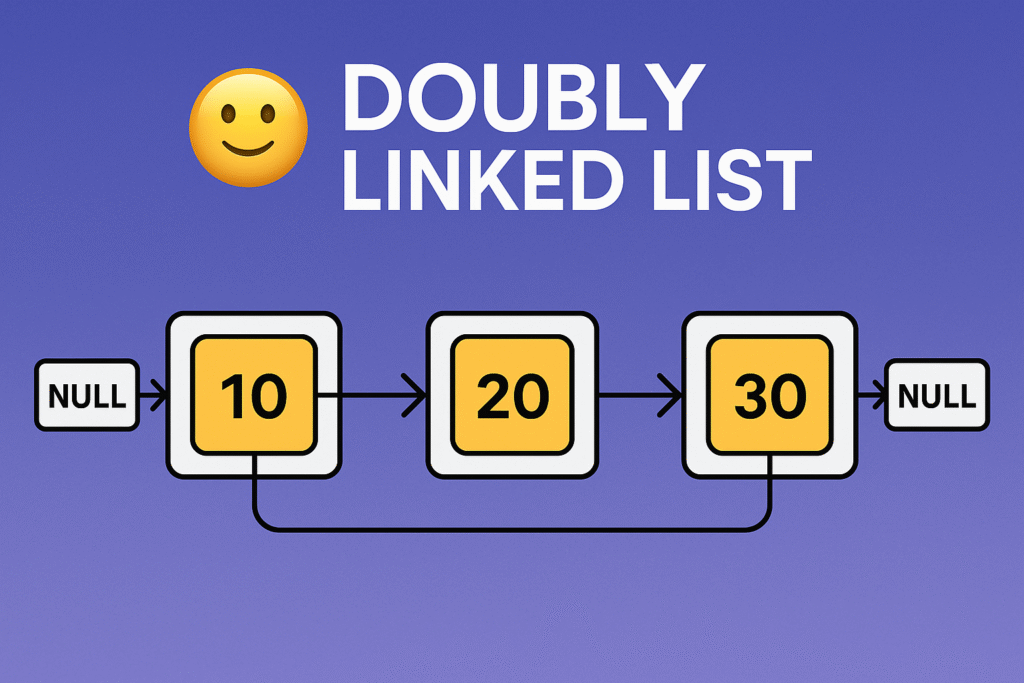
    Let’s say we have 3 nodes with data: 10, 20, and 30.

    NULL <- [10] <-> [20] <-> [30] -> NULL
    

    Here:

    • Node 10’s prev is NULL
    • Node 20’s prev points to 10 and next to 30
    • Node 30’s next is NULL

    Basic Operations on Doubly Linked List

    1. Insertion

    • At the beginning
    • At the end
    • At a specific position

    2. Deletion

    • From the beginning
    • From the end
    • Specific node

    3. Traversal

    • Forward traversal (left to right)
    • Backward traversal (right to left)

    C Code Example: Basic DLL Operations

    #include <stdio.h>
    #include <stdlib.h>
    
    typedef struct Node {
        int data;
        struct Node* prev;
        struct Node* next;
    } Node;
    
    Node* head = NULL;
    
    // Insert at end
    void insertEnd(int value) {
        Node* newNode = (Node*)malloc(sizeof(Node));
        newNode->data = value;
        newNode->next = NULL;
    
        if (head == NULL) {
            newNode->prev = NULL;
            head = newNode;
            return;
        }
    
        Node* temp = head;
        while (temp->next != NULL)
            temp = temp->next;
    
        temp->next = newNode;
        newNode->prev = temp;
    }
    
    // Display forward
    void displayForward() {
        Node* temp = head;
        printf("DLL (forward): ");
        while (temp != NULL) {
            printf("%d <-> ", temp->data);
            temp = temp->next;
        }
        printf("NULL\n");
    }
    
    // Display backward
    void displayBackward() {
        Node* temp = head;
        if (!temp) return;
        
        // Go to last node
        while (temp->next != NULL)
            temp = temp->next;
    
        printf("DLL (backward): ");
        while (temp != NULL) {
            printf("%d <-> ", temp->data);
            temp = temp->prev;
        }
        printf("NULL\n");
    }
    
    int main() {
        insertEnd(10);
        insertEnd(20);
        insertEnd(30);
        
        displayForward();
        displayBackward();
        return 0;
    }
    

    Advantages of Doubly Linked List

    • Two-way traversal: You can navigate forward and backward.
    • Easier deletion: You can delete a node without needing the previous node pointer.
    • More flexible: Especially useful in complex data structures like Deques, Undo/Redo systems, Music Playlists, etc.

    Disadvantages of Doubly Linked List

    • More memory: Each node requires extra space for the prev pointer.
    • More complex: Handling pointers can be error-prone for beginners.

    Real-Life Applications of Doubly Linked List

    • Web browsers (backward and forward navigation)
    • Music playlist apps
    • Text editors (undo/redo operations)
    • Task managers (circular doubly linked lists for round-robin)

    Conclusion DLL

    Doubly Linked List
    Master Doubly Linked List in Data Structures (With Examples) 2025

    The Doubly Linked List is an essential topic in Data Structures and Algorithms (DSA). It offers a better way to manage dynamic data, especially when two-way traversal is needed. Though slightly more complex than a singly linked list, the benefits are powerful.

    Whether you’re preparing for a coding interview, building a system-level application, or just learning C programming, mastering DLLs will give you a strong foundation in memory management and pointer logic.

    FAQs of Doubly Linked List

    Q1: Is doubly linked list faster than singly linked list?
    Ans: DLL allows backward traversal and easier deletion, but it uses more memory. It’s more flexible, not necessarily faster.

    Q2: Where is DLL used in real life?
    Ans: Browser history, playlist navigation, undo/redo features, and memory management systems.

    Q3: What is the main drawback of doubly linked list?
    Ans: It uses extra memory due to the additional prev pointer and increases code complexity.

    Q4: How is a doubly linked list different from a circular doubly linked list?
    Ans: In a doubly linked list, the last node’s next pointer is NULL, whereas in a circular doubly linked list, the last node’s next points back to the head, forming a circle.

    Q5: Can a doubly linked list be empty?
    Ans: Yes, initially a doubly linked list can be empty with head pointing to NULL.

    Q6: How do you insert a node at the beginning of a doubly linked list?
    Ans: Create a new node, point its next to the current head, set the head’s prev to the new node, and then update head to the new node.

    Q7: What happens when you delete the last node in a doubly linked list?
    Ans: The second last node’s next pointer is set to NULL, and the last node is freed from memory.

    Q8: Is it possible to implement a stack using a doubly linked list?
    Ans: Yes, a doubly linked list can be used to implement a stack with push and pop operations.

    Q9: How does traversal in a doubly linked list work?
    Ans: You can traverse forward from head to NULL using next pointers or backward from the last node to head using prev pointers.

    Q10: What are the memory requirements for a doubly linked list node?
    Ans: Each node stores data plus two pointers (prev and next), so it uses more memory compared to a singly linked list node, which stores only one pointer.

    Q11: Can doubly linked lists have cycles? How to detect them?
    Ans: Yes, cycles can exist if nodes point back to earlier nodes. Cycle detection algorithms like Floyd’s Cycle-Finding Algorithm (tortoise and hare) can detect cycles.

    Q12: Are doubly linked lists used in databases?
    Ans: Yes, doubly linked lists are used to implement certain data structures like LRU caches, which are common in databases and operating systems.

    Q13: How do you reverse a doubly linked list?
    Ans: Swap the prev and next pointers for each node and update the head to the last node.