Last Updated: 31 Aug, 2025
Beginner-friendly guide to Circular Linked List. Learn types, structure, advantages, disadvantages, applications, and C code examples. When learning data structures, most beginners start with arrays and linked lists. Among different types of linked lists, the Circular Linked List is an important concept that offers flexibility in memory management and traversal. In this article, we will explain what a circular linked list is, its types, advantages, and real-world applications in a beginner-friendly way.
A Circular Linked List is a special type of linked list in which the last node is connected back to the first node, forming a closed loop. Unlike arrays, circular linked lists are dynamic in nature, meaning they can grow or shrink during program execution.
What is a Circular Linked List?
A Circular Linked List is a type of linked list where the last node points back to the first node instead of pointing to NULL. This creates a circular connection, allowing continuous traversal of the list in a loop.
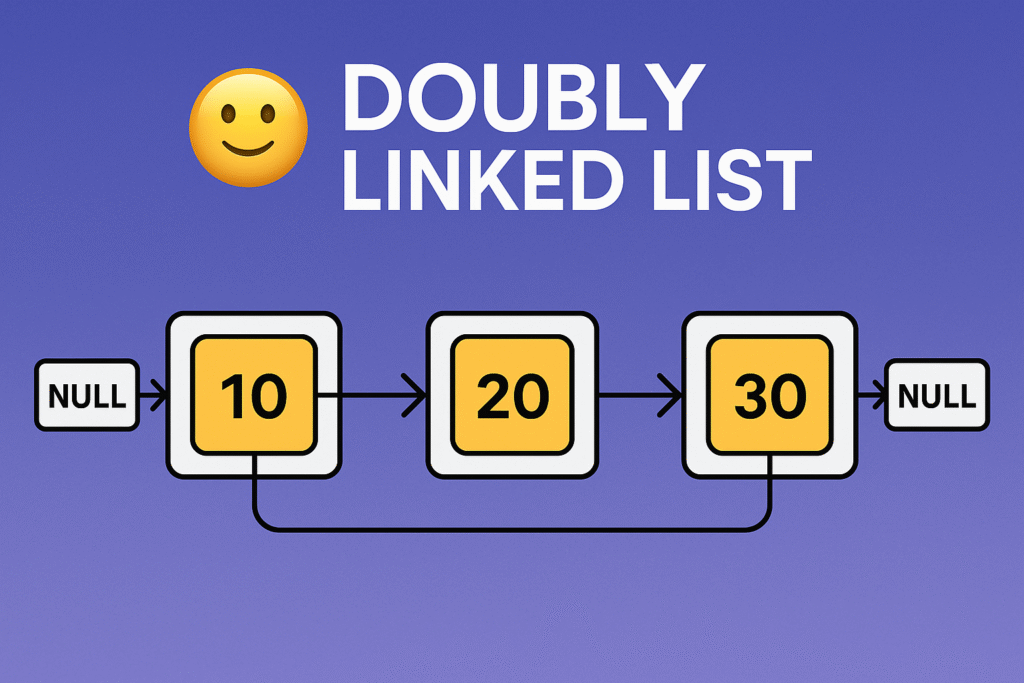
Unlike a Singly Linked List, which ends at NULL, or a Doubly Linked List, which has two pointers, the circular linked list makes navigation seamless without an endpoint.
Types of Circular Linked List
Singly Circular Linked List
A singly circular linked list is just like a normal singly linked list, but with one small twist. In this structure, every node has two parts: the data it stores and a pointer to the next node. The difference is that the last node doesn’t point to NULL; instead, it connects back to the very first node. This creates a circular chain where you can keep moving forward from one node to the next without ever reaching an end. Imagine it like kids standing in a circle holding hands—if you keep walking around, you’ll return to the starting point. This kind of list is useful when you need to repeatedly go through data, such as in round-robin scheduling or playlist management in music players.

Doubly Circular Linked List
A doubly circular linked list is an advanced version of the circular linked list. In this structure, every node contains three parts: the data, a pointer to the next node, and another pointer to the previous node. Unlike a simple doubly linked list, the last node doesn’t end with NULL. Instead, its next pointer connects back to the first node, and the first node’s previous pointer links to the last node. This creates a complete circular chain where you can move forward or backward through the list without ever reaching an endpoint. You can think of it like a train running on a circular track—you can travel clockwise or counterclockwise and always come back to where you started. This makes doubly circular linked lists very handy in situations like navigation menus, music or video playlists, and simulations where movement in both directions is needed.

Basic Structure of a Circular Linked List
Here’s a simple structure in C language:
struct Node {
    int data;
    struct Node* next;
};
For a Doubly Circular Linked List, we add a previous pointer:
struct Node {
    int data;
    struct Node* next;
    struct Node* prev;
};
What is Node Representation of Circular Linked List
C++ Example (Node Class):
class Node {
public:
    int data;
    Node* next;

    Node(int value) {
        data = value;
        next = nullptr;
    }
};
C Example (Struct):
struct Node {
    int data;
    struct Node* next;
};
Operations on Circular Linked List
- Insertion
- At the beginning
- At the end
- At a given position
- Deletion
- From the beginning
- From the end
- From a given position
- Traversal
- Visit all nodes continuously in a loop.
Circular Linked List Implementations
C++ Implementation of Circular Linked List
#include <iostream>
using namespace std;

class Node {
public:
    int data;
    Node* next;

    Node(int value) {
        data = value;
        next = nullptr;
    }
};

class CircularLinkedList {
private:
    Node* last;
public:
    CircularLinkedList() { last = nullptr; }

    void insertEnd(int value) {
        Node* newNode = new Node(value);
        if (last == nullptr) {
            last = newNode;
            last->next = last;
        } else {
            newNode->next = last->next;
            last->next = newNode;
            last = newNode;
        }
    }

    void display() {
        if (last == nullptr) return;
        Node* temp = last->next;
        do {
            cout << temp->data << " -> ";
            temp = temp->next;
        } while (temp != last->next);
        cout << "(back to start)" << endl;
    }
};

int main() {
    CircularLinkedList cll;
    cll.insertEnd(10);
    cll.insertEnd(20);
    cll.insertEnd(30);
    cll.display();
    return 0;
}
Output:
10 -> 20 -> 30 -> (back to start)
Java Implementation of Circular Linked List
class Node {
    int data;
    Node next;

    Node(int value) {
        data = value;
        next = null;
    }
}

class CircularLinkedList {
    private Node last;

    CircularLinkedList() {
        last = null;
    }

    void insertEnd(int value) {
        Node newNode = new Node(value);
        if (last == null) {
            last = newNode;
            last.next = last;
        } else {
            newNode.next = last.next;
            last.next = newNode;
            last = newNode;
        }
    }

    void display() {
        if (last == null) return;
        Node temp = last.next;
        do {
            System.out.print(temp.data + " -> ");
            temp = temp.next;
        } while (temp != last.next);
        System.out.println("(back to start)");
    }

    public static void main(String[] args) {
        CircularLinkedList cll = new CircularLinkedList();
        cll.insertEnd(10);
        cll.insertEnd(20);
        cll.insertEnd(30);
        cll.display();
    }
}
Output:
10 -> 20 -> 30 -> (back to start)
Python Implementation of Circular Linked List
class Node:
    def __init__(self, data):
        self.data = data
        self.next = None

class CircularLinkedList:
    def __init__(self):
        self.last = None

    def insert_end(self, value):
        new_node = Node(value)
        if self.last is None:
            self.last = new_node
            self.last.next = self.last
        else:
            new_node.next = self.last.next
            self.last.next = new_node
            self.last = new_node

    def display(self):
        if self.last is None:
            return
        temp = self.last.next
        while True:
            print(temp.data, end=" -> ")
            temp = temp.next
            if temp == self.last.next:
                break
        print("(back to start)")

# Example usage
cll = CircularLinkedList()
cll.insert_end(10)
cll.insert_end(20)
cll.insert_end(30)
cll.display()
Output:
10 -> 20 -> 30 -> (back to start)
JavaScript Implementation of Circular Linked List
class Node {
  constructor(data) {
    this.data = data;
    this.next = null;
  }
}

class CircularLinkedList {
  constructor() {
    this.last = null;
  }

  insertEnd(value) {
    let newNode = new Node(value);
    if (this.last === null) {
      this.last = newNode;
      this.last.next = this.last;
    } else {
      newNode.next = this.last.next;
      this.last.next = newNode;
      this.last = newNode;
    }
  }

  display() {
    if (this.last === null) return;
    let temp = this.last.next;
    let result = "";
    do {
      result += temp.data + " -> ";
      temp = temp.next;
    } while (temp !== this.last.next);
    console.log(result + "(back to start)");
  }
}

// Example usage
let cll = new CircularLinkedList();
cll.insertEnd(10);
cll.insertEnd(20);
cll.insertEnd(30);
cll.display();
Output:
10 -> 20 -> 30 -> (back to start)Advantages of Circular Linked List
- Efficient Memory Usage – No need for a
NULLpointer. - Continuous Traversal – Useful in applications where we need to cycle through data repeatedly.
- Dynamic Size – Unlike arrays, circular linked lists can grow and shrink easily.
- Queue Implementation – Particularly helpful in designing circular queues.
- Saves memory – No
NULLpointer - Uniform traversal in a loop.
Disadvantages of Circular Linked List
- Complex Implementation – Requires extra care while inserting and deleting nodes.
- Infinite Loops – Careless traversal may lead to infinite looping.
- More Memory Per Node – Extra pointers (in the case of a doubly circular linked list).
- Requires more memory in case of doubly circular list.
Applications of Circular Linked List
- Operating Systems – Used in CPU scheduling (Round-Robin Scheduling).
- Music or Video Playlists – When songs or videos repeat in a loop.
- Multi-Player Games – Switching turns between players in a continuous cycle.
- Data Buffers – Implementing circular queues and memory buffers.
- Traffic Systems → Repeated light cycles.
Traversing a Circular Linked List in C
#include <stdio.h>
#include <stdlib.h>

struct Node {
    int data;
    struct Node* next;
};

void traverse(struct Node* head) {
    struct Node* temp = head;
    if (head != NULL) {
        do {
            printf("%d -> ", temp->data);
            temp = temp->next;
        } while (temp != head);
    }
}

int main() {
    struct Node* head = malloc(sizeof(struct Node));
    struct Node* second = malloc(sizeof(struct Node));
    struct Node* third = malloc(sizeof(struct Node));

    head->data = 10; head->next = second;
    second->data = 20; second->next = third;
    third->data = 30; third->next = head;

    traverse(head);
    return 0;
}
Output:
10 -> 20 -> 30 ->
Insertion at the End of Circular Linked List
#include <iostream>
using namespace std;

class Node {
public:
    int data;
    Node* next;

    Node(int value) {
        data = value;
        next = nullptr;
    }
};

void insertEnd(Node*& last, int value) {
    Node* newNode = new Node(value);

    if (last == nullptr) {
        last = newNode;
        last->next = last; // Self loop
    } else {
        newNode->next = last->next;
        last->next = newNode;
        last = newNode;
    }
}

void display(Node* last) {
    if (last == nullptr) return;

    Node* temp = last->next;
    do {
        cout << temp->data << " -> ";
        temp = temp->next;
    } while (temp != last->next);
    cout << " (back to start)\n";
}

int main() {
    Node* last = nullptr;

    insertEnd(last, 10);
    insertEnd(last, 20);
    insertEnd(last, 30);

    display(last);
    return 0;
}
Why Learn Circular Linked List?
- It helps in CPU scheduling algorithms (Round Robin).
- Useful in repeated task execution like music playlists, traffic signal management, and multiplayer games.
- Provides constant time insertion at both ends.
Difference Between Circular Linked List and Regular Linked List
| Feature | Regular Linked List | Circular Linked List |
|---|---|---|
| Last Node | Points to NULL | Points to first node |
| Traversal | Stops at NULL | Never ends, continues in a loop |
| Memory Usage | Has a terminating pointer | Utilizes memory efficiently |
| Applications | Basic data storage | Scheduling, queues, buffers |
When to Use Circular Linked List Instead of Array?
| Use Case | Array | Circular Linked List |
|---|---|---|
| Fixed size | ✅ | ❌ |
| Dynamic growth | ❌ | ✅ |
| Random access | ✅ O(1) | ❌ O(n) |
| Continuous looping | ❌ | ✅ |
| Insertion at beginning | ❌ O(n) | ✅ O(1) |
Circular Linked List Interview Questions
Preparing for coding interviews? Here’s a categorized list of Circular Linked List interview questions suitable for beginners, intermediate learners, and experienced professionals.
Beginner-Level Questions
- What is a Circular Linked List?
- How does a Circular Linked List differ from a regular Linked List?
- What are the types of Circular Linked Lists?
- Write the structure of a node in a Circular Singly Linked List.
- Write the structure of a node in a Circular Doubly Linked List.
- What are the advantages of Circular Linked Lists over arrays?
- List some real-world applications of Circular Linked Lists.
- What is the time complexity of insertion at the beginning of a Circular Linked List?
- What is the time complexity of deletion at the end of a Circular Linked List?
- Explain how traversal works in a Circular Linked List.
Intermediate-Level Questions
- Why do we often maintain a pointer to the last node instead of the first node in Circular Linked Lists?
- Explain insertion at the beginning, end, and a specific position in a Circular Linked List.
- Explain deletion at the beginning, end, and a specific position in a Circular Linked List.
- How do you implement a Circular Queue using a Circular Linked List?
- How would you check if a linked list is circular?
- What is the difference between a Circular Singly Linked List and a Circular Doubly Linked List?
- Write pseudocode for traversing a Circular Linked List.
- How can you implement Round Robin Scheduling using a Circular Linked List?
- Compare time complexities of insertion and deletion in Circular Linked Lists vs Arrays.
- What challenges arise while debugging a Circular Linked List?
Experienced-Level Questions
- How do you detect an infinite loop in a Circular Linked List?
- How would you reverse a Circular Linked List?
- How can a Circular Linked List be used to implement a deque (double-ended queue)?
- In which scenarios is a Circular Linked List better than a Doubly Linked List?
- How would you merge two Circular Linked Lists into one?
- Design an algorithm to split a Circular Linked List into two halves.
- How do you handle memory management issues in large Circular Linked Lists?
- What are the potential pitfalls in pointer manipulation when inserting nodes into a Circular Linked List?
- How does a Circular Linked List improve CPU scheduling performance?
- Design a Circular Linked List to handle a real-time system scenario (e.g., traffic light control).
Conclusion
A Circular Linked List is a powerful data structure for situations requiring continuous traversal and dynamic memory allocation. Though slightly more complex than singly linked lists, its applications in operating systems, games, and memory management make it worth learning.
If you are a beginner, start by understanding the structure, then practice insertion, deletion, and traversal operations in circular linked lists. With time, you’ll find this data structure highly useful in real-world applications.
If you are a beginner, start with circular singly linked lists and then move on to doubly circular linked lists. With practice, you’ll understand how this structure outperforms arrays and regular linked lists in certain scenarios.
FAQs on Circular Linked List
1.What is the main difference between singly and circular singly linked list?
NULL. In circular singly linked list, traversal loops back to the first node.2.Why is circular linked list used in OS scheduling?
3.Can we implement queues using circular linked list?
4.Which is faster — array or circular linked list?
5.Why is it better to keep a pointer to the last node instead of the first node in a Circular Linked List?
6.How do you detect an infinite loop in a Circular Linked List?
7.What is the time complexity for insertion and deletion in Circular Linked List?
Insertion at specific position → O(n)
Deletion at beginning/end → O(1)
Deletion at specific position → O(n)
8.What are the challenges in debugging a Circular Linked Lis
Requires extra care in insertion/deletion to maintain circular structure.
9.Compare Circular Linked List with Doubly Linked List in terms of memory usage and traversal.
NULL pointers.Doubly Circular Linked List requires more memory but supports two-way traversal.
10.How does a Circular Linked List improve CPU scheduling in an Operating System?
You can also Visit other tutorials of Embedded Prep
- Multithreading in C++
- Multithreading Interview Questions
- Multithreading in Operating System
- Multithreading in Java
- POSIX Threads pthread Beginner’s Guide in C/C++
- Speed Up Code using Multithreading
- Limitations of Multithreading
- Common Issues in Multithreading
- Multithreading Program with One Thread for Addition and One for Multiplication
- Advantage of Multithreading
- Disadvantages of Multithreading
- Applications of Multithreading: How Multithreading Makes Modern Software Faster and Smarter”
- Master CAN Bus Interview Questions 2025
- What Does CAN Stand For in CAN Bus?
- CAN Bus Message Filtering Explained
- CAN Bus Communication Between Nodes With Different Bit Rates
- How Does CAN Bus Handle Message Collisions
- Message Priority Using Identifiers in CAN Protocol