
QNX Operating System vs Linux : Discover the difference between the QNX Operating System and Linux in this beginner-friendly guide. Learn how BlackBerry QNX delivers real-time performance, safety, and reliability for automotive, medical, and industrial applications compared to Linux’s flexibility and open-source power.
When it comes to choosing an operating system for embedded systems and mission-critical applications, two popular options are the QNX Operating System and Linux. Both have their strengths, but they are designed for different purposes.
This article will help beginners understand what the QNX Operating System vs Linux is, how it compares to Linux, and where each one is best used.
What is the QNX Operating System?
The QNX Operating System is a real-time operating system (RTOS) developed by BlackBerry Limited. It is known for its high reliability, safety, and deterministic performance, making it ideal for environments where failure is not an option.
Main features of the QNX Operating System:
- Microkernel architecture — only essential services (like scheduling and interprocess communication) run in the kernel for improved stability.
- Real-time capabilities — guarantees predictable responses within strict deadlines.
- POSIX compliance — allows easier porting of software from other Unix-like systems.
- Fault resilience — if one component fails, the rest of the system remains unaffected.
Where the QNX Operating System is used:
- Automotive infotainment and safety systems
- Aerospace and defense equipment
- Medical devices
- Industrial automation systems
What is Linux?
Linux is a general-purpose, open-source operating system used on everything from smartphones to servers and IoT devices. Unlike the QNX Operating System, Linux uses a monolithic kernel and is maintained by a global open-source community.
Main features of Linux:
- Monolithic kernel — all core OS services run in kernel space.
- Highly customizable — hundreds of distributions to suit different needs.
- Large developer community — constant updates and support.
- Wide hardware compatibility — runs on small IoT boards to large data centers.
QNX Operating System vs Linux : Key Differences
| Feature | QNX Operating System | Linux Operating System |
|---|---|---|
| Type | Real-Time Operating System (RTOS) | General-Purpose Operating System |
| Kernel Architecture | Microkernel | Monolithic kernel |
| Real-Time Capability | Hard real-time, deterministic | Not hard real-time (PREEMPT_RT patch adds soft real-time) |
| Licensing | Commercial (BlackBerry QNX) | Open-source (GPL and others) |
| Reliability | Extremely high, fault-tolerant | Stable but less fault isolation |
| Customization | Safety-critical focus | Broad customization options |
| Typical Use Cases | Automotive, aerospace, medical, industrial | Servers, desktops, IoT, embedded devices |
| Community Support | Vendor-provided | Large open-source community |
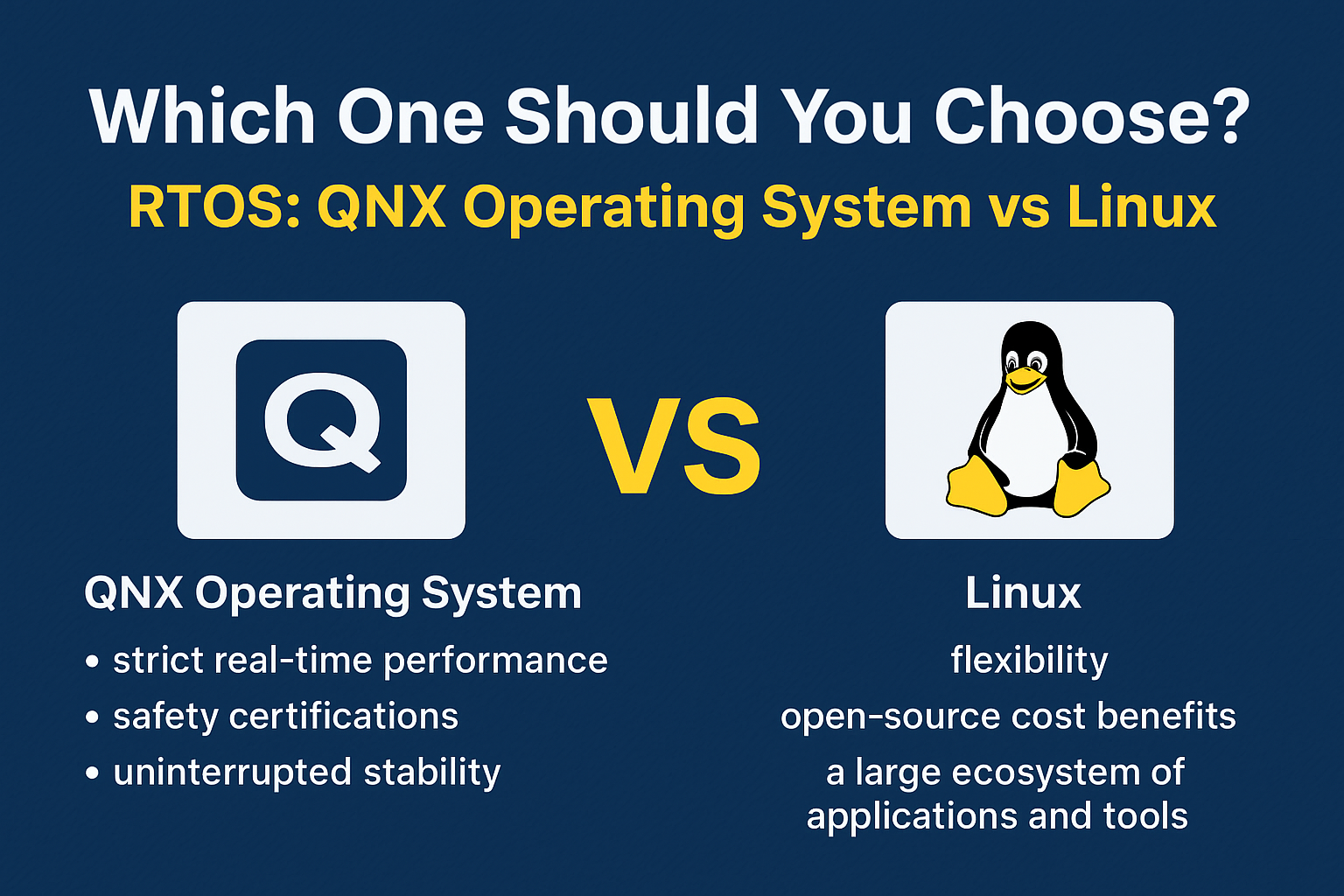
Which One Should You Choose QNX & LINUX ?
Choosing between the QNX Operating System and Linux depends on your project’s requirements, performance goals, and safety needs. Both are powerful, but they shine in different areas.
When to Choose the QNX Operating System
The QNX Operating System, developed by BlackBerry QNX, is the right choice when:
- Your project demands strict real-time performance with predictable response times.
- You are working on safety-critical systems that require certifications such as ISO 26262 (automotive), IEC 62304 (medical devices), or DO-178C (aerospace).
- You need uninterrupted stability — if one software component crashes, the rest of the system should remain unaffected thanks to QNX’s microkernel architecture.
- You’re developing for industries like automotive infotainment, industrial automation, aerospace, or defense, where downtime is unacceptable.
In short, BlackBerry QNX is designed for environments where failure is not an option and real-time precision is critical.
When to Choose Linux
Linux is the right choice when:
- You need flexibility and the freedom to customize the OS for different purposes.
- You want the cost benefits of open-source software without paying licensing fees.
- Your application benefits from a large ecosystem of tools, libraries, and developer support.
- Real-time precision is not your top priority, or you can manage with soft real-time capabilities by using the PREEMPT_RT patch.
- Your focus is on building servers, IoT devices, development platforms, or consumer electronics.
Linux is ideal when you need versatility, fast development, and broad hardware compatibility rather than strict safety certifications.
Bottom line:
- Choose the QNX Operating System if you’re building mission-critical, real-time, and safety-certified applications.
- Choose Linux if you want open-source flexibility, community support, and broad use cases.
Conclusion QNX Operating System vs Linux
The QNX Operating System and Linux both serve important roles in the world of technology.
- QNX shines in real-time, safety-critical applications.
- Linux excels in general-purpose and flexible environments.
Your choice will depend on whether you prioritize deterministic performance or flexibility and cost-efficiency.
Frequently Asked Questions (FAQ) – QNX Operating System vs Linux
1. What is the QNX Operating System used for?
2. Is the QNX Operating System open source?
3. How is the QNX Operating System different from Linux?
4. Can Linux replace the QNX Operating System?
5. Why do automotive companies prefer the QNX Operating System?
6. Is the QNX Operating System better than Linux?
You can also Visit other tutorials of Embedded Prep
- Multithreading in C++
- Multithreading Interview Questions
- Multithreading in Operating System
- Multithreading in Java
- POSIX Threads pthread Beginner’s Guide in C/C++
- Speed Up Code using Multithreading
- Limitations of Multithreading
- Common Issues in Multithreading
- Multithreading Program with One Thread for Addition and One for Multiplication
- Advantage of Multithreading
- Disadvantages of Multithreading
- Applications of Multithreading: How Multithreading Makes Modern Software Faster and Smarter”
- Master CAN Bus Interview Questions 2025
- What Does CAN Stand For in CAN Bus?
- CAN Bus Message Filtering Explained
- CAN Bus Communication Between Nodes With Different Bit Rates
- How Does CAN Bus Handle Message Collisions
- Message Priority Using Identifiers in CAN Protocol
Leave a Reply