
Tag: QNX vs Linux

  • Mater How is QNX different from Linux or other RTOS 7 Key Ways.

    How is QNX different from Linux or other RTOS . Learn about kernel design, real-time performance, safety certifications, and use cases.

    When you first hear about QNX, you might think, “Isn’t it just another operating system like Linux or other RTOS (Real-Time Operating Systems)?” The truth is, QNX stands out in some very unique ways. If you are working in automotive, medical devices, or mission-critical embedded systems, understanding how QNX differs from Linux or other RTOS is super important. Let’s break it down in a simple, human way.

    1. QNX is a Microkernel, Linux is a Monolithic Kernel

    One of the biggest differences is in the kernel design.

    • QNX uses a microkernel architecture, meaning only the most essential services (like scheduling, IPC, and interrupt handling) run in the kernel space. Everything else, such as device drivers, file systems, and networking, runs in user space.
    • Linux, on the other hand, is monolithic. Almost everything runs in kernel space, which makes it powerful but harder to isolate faults.

    Result? QNX offers better reliability and fault isolation. If a driver crashes in QNX, it won’t take down the entire system.

    2. Real-Time Capabilities

    • QNX is designed from the ground up as a true RTOS. It guarantees hard real-time performance, meaning tasks are executed within strict deadlines.
    • Linux wasn’t originally designed for real-time, though there are Real-Time Linux patches (PREEMPT-RT) to improve it. Still, it doesn’t match QNX when ultra-low latency and predictability are required.
    • Other RTOS like FreeRTOS or VxWorks also provide real-time features, but QNX’s microkernel plus POSIX compliance make it more robust for industrial use.

    If you’re building a system where safety and timing are non-negotiable, QNX is the go-to choice.

    3. Safety Certifications

    • QNX shines in industries like automotive (ISO 26262), medical devices (IEC 62304), and aerospace (DO-178C) because it already comes with safety-certified versions.
    • Linux and many other RTOS options are not safety-certified by default. Achieving certifications with Linux usually requires heavy customization and additional effort.

    This makes QNX a favorite for companies that build autonomous vehicles, ventilators, or train control systems.

    4. Resource Usage

    • QNX is lightweight. The microkernel can run with minimal resources, making it ideal for embedded devices with limited memory and CPU power.
    • Linux generally needs more resources, especially if you’re running a full Linux distribution.
    • Other RTOS like FreeRTOS are even smaller than QNX, but they lack the rich features QNX provides (like a full POSIX environment).

    With QNX, you get the best of both worlds: small footprint and powerful features.

    5. Use Cases

    • QNX is popular in cars (digital clusters, ADAS), medical devices, industrial automation, and aerospace.
    • Linux powers servers, desktops, IoT devices, and smartphones (Android is based on Linux).
    • Other RTOS like FreeRTOS or VxWorks are more common in small embedded devices without the complexity of QNX.

    Quick Comparison Table

    FeatureQNX (Microkernel RTOS)Linux (Monolithic OS)Other RTOS (e.g., FreeRTOS, VxWorks)
    Kernel TypeMicrokernelMonolithicVaries
    Real-Time SupportTrue hard real-timeSoft real-time (with patches)Hard real-time
    Safety CertificationsBuilt-in (ISO, IEC, DO)Limited/Custom effortSome available (e.g., VxWorks)
    Resource UsageLightweightHeavyVery lightweight
    Main Use CasesAutomotive, medical, aerospaceServers, IoT, smartphonesSmall embedded devices

    Final Thoughts

    So, how is QNX different from Linux or other RTOS? In simple words:

    • QNX is like the safety-first, highly reliable pilot designed for real-time missions.
    • Linux is the all-rounder athlete, powerful and flexible but not always punctual.
    • Other RTOS are the minimalist specialists, great for simple, resource-limited systems.
    FAQ: How is QNX Different from Linux or Other RTOS?

    Q1. What makes QNX different from Linux?

    QNX uses a microkernel architecture, offering better fault isolation and real-time guarantees, while Linux is a monolithic kernel designed for general-purpose computing.

    Q2. Is QNX faster than Linux for real-time tasks?

    Yes. QNX provides hard real-time performance, ensuring tasks run within strict deadlines. Linux, even with real-time patches, is usually better for soft real-time applications.

    Q3. Why is QNX popular in automotive systems?

    QNX is ISO 26262 safety-certified and reliable for digital clusters, ADAS, and infotainment systems, making it a trusted OS in the automotive industry.

    Q4. How does QNX compare to FreeRTOS or VxWorks?

    QNX offers a full POSIX environment, strong fault tolerance, and safety certifications. FreeRTOS is lightweight but limited, while VxWorks is powerful but less modular than QNX’s microkernel design.

    Q5. Can Linux replace QNX in safety-critical projects?

    Not easily. Linux requires significant customization to achieve safety certifications, while QNX comes pre-certified for industries like automotive, medical, and aerospace.

    Q6. Is QNX open source like Linux?

    No. QNX is a commercial RTOS from BlackBerry, while Linux is open-source. QNX provides evaluation versions and strong commercial support for critical systems.

    Q7. Which is better: QNX or Linux?

    It depends on your project.


  • QNX Operating System vs Linux | Master QNX RTOS A Beginner’s Guide (2026)

    QNX Operating System vs Linux : Discover the difference between the QNX Operating System and Linux in this beginner-friendly guide. Learn how BlackBerry QNX delivers real-time performance, safety, and reliability for automotive, medical, and industrial applications compared to Linux’s flexibility and open-source power.

    When it comes to choosing an operating system for embedded systems and mission-critical applications, two popular options are the QNX Operating System and Linux. Both have their strengths, but they are designed for different purposes.
    This article will help beginners understand what the QNX Operating System vs Linux is, how it compares to Linux, and where each one is best used.

    What is the QNX Operating System?

    The QNX Operating System is a real-time operating system (RTOS) developed by BlackBerry Limited. It is known for its high reliability, safety, and deterministic performance, making it ideal for environments where failure is not an option.

    Main features of the QNX Operating System:

    • Microkernel architecture — only essential services (like scheduling and interprocess communication) run in the kernel for improved stability.
    • Real-time capabilities — guarantees predictable responses within strict deadlines.
    • POSIX compliance — allows easier porting of software from other Unix-like systems.
    • Fault resilience — if one component fails, the rest of the system remains unaffected.

    Where the QNX Operating System is used:

    • Automotive infotainment and safety systems
    • Aerospace and defense equipment
    • Medical devices
    • Industrial automation systems

    What is Linux?

    Linux is a general-purpose, open-source operating system used on everything from smartphones to servers and IoT devices. Unlike the QNX Operating System, Linux uses a monolithic kernel and is maintained by a global open-source community.

    Main features of Linux:

    • Monolithic kernel — all core OS services run in kernel space.
    • Highly customizable — hundreds of distributions to suit different needs.
    • Large developer community — constant updates and support.
    • Wide hardware compatibility — runs on small IoT boards to large data centers.

    QNX Operating System vs Linux : Key Differences

    FeatureQNX Operating SystemLinux Operating System
    TypeReal-Time Operating System (RTOS)General-Purpose Operating System
    Kernel ArchitectureMicrokernelMonolithic kernel
    Real-Time CapabilityHard real-time, deterministicNot hard real-time (PREEMPT_RT patch adds soft real-time)
    LicensingCommercial (BlackBerry QNX)Open-source (GPL and others)
    ReliabilityExtremely high, fault-tolerantStable but less fault isolation
    CustomizationSafety-critical focusBroad customization options
    Typical Use CasesAutomotive, aerospace, medical, industrialServers, desktops, IoT, embedded devices
    Community SupportVendor-providedLarge open-source community

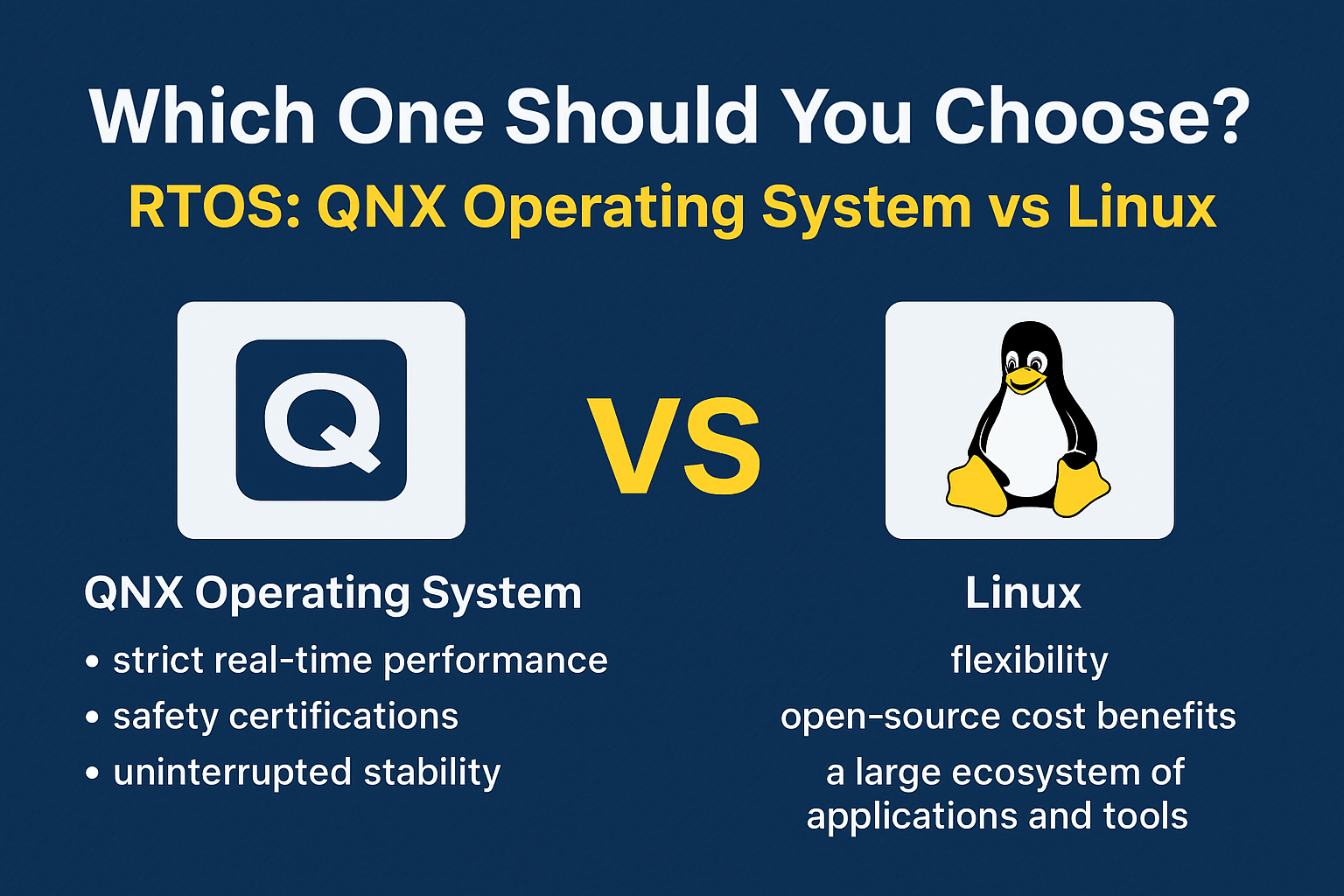
    Which One Should You Choose QNX & LINUX ?

    Choosing between the QNX Operating System and Linux depends on your project’s requirements, performance goals, and safety needs. Both are powerful, but they shine in different areas.

    When to Choose the QNX Operating System

    The QNX Operating System, developed by BlackBerry QNX, is the right choice when:

    • Your project demands strict real-time performance with predictable response times.
    • You are working on safety-critical systems that require certifications such as ISO 26262 (automotive), IEC 62304 (medical devices), or DO-178C (aerospace).
    • You need uninterrupted stability — if one software component crashes, the rest of the system should remain unaffected thanks to QNX’s microkernel architecture.
    • You’re developing for industries like automotive infotainment, industrial automation, aerospace, or defense, where downtime is unacceptable.

    In short, BlackBerry QNX is designed for environments where failure is not an option and real-time precision is critical.

    When to Choose Linux

    Linux is the right choice when:

    • You need flexibility and the freedom to customize the OS for different purposes.
    • You want the cost benefits of open-source software without paying licensing fees.
    • Your application benefits from a large ecosystem of tools, libraries, and developer support.
    • Real-time precision is not your top priority, or you can manage with soft real-time capabilities by using the PREEMPT_RT patch.
    • Your focus is on building servers, IoT devices, development platforms, or consumer electronics.

    Linux is ideal when you need versatility, fast development, and broad hardware compatibility rather than strict safety certifications.

    Bottom line:

    • Choose the QNX Operating System if you’re building mission-critical, real-time, and safety-certified applications.
    • Choose Linux if you want open-source flexibility, community support, and broad use cases.

    Conclusion QNX Operating System vs Linux

    The QNX Operating System and Linux both serve important roles in the world of technology.

    • QNX shines in real-time, safety-critical applications.
    • Linux excels in general-purpose and flexible environments.

    Your choice will depend on whether you prioritize deterministic performance or flexibility and cost-efficiency.

    1. What is the QNX Operating System used for?

    The QNX Operating System is mainly used in safety-critical and real-time applications such as automotive systems, aerospace equipment, medical devices, and industrial control systems. It is chosen for its high reliability, fault tolerance, and deterministic performance.

    2. Is the QNX Operating System open source?

    No, the QNX Operating System is a commercial product owned by BlackBerry Limited. It requires licensing for use, unlike Linux, which is open source and free to download.

    3. How is the QNX Operating System different from Linux?

    The QNX Operating System is a real-time microkernel-based OS, while Linux is a general-purpose monolithic kernel OS. QNX focuses on predictable execution and fault isolation, whereas Linux emphasizes flexibility, customization, and community support.

    4. Can Linux replace the QNX Operating System?

    In most real-time, safety-critical environments, Linux cannot fully replace the QNX Operating System because Linux does not provide the same level of hard real-time guarantees. However, with the PREEMPT_RT patch, Linux can handle some real-time workloads.

    5. Why do automotive companies prefer the QNX Operating System?

    Automotive companies use the QNX Operating System because it meets strict safety and reliability standards such as ISO 26262. It ensures that vehicle systems like infotainment, navigation, and driver assistance run without unexpected delays or failures.

    6. Is the QNX Operating System better than Linux?

    Neither is universally “better” — the QNX Operating System is better for time-sensitive, safety-critical applications, while Linux is better for general-purpose and cost-effective solutions.
    QNX Operating System vs Linux | Master QNX RTOS
    QNX Operating System vs Linux Master QNX RTOS A Beginner’s Guide (2025)