SPI Interview Questions : In this article, we will explore key interview questions and answers related to the SPI (Serial Peripheral Interface) protocol. SPI is a synchronous serial communication protocol widely used in embedded systems for data exchange between microcontrollers and peripheral devices such as sensors, memory modules, and displays. Understanding SPI and being able to answer interview questions on this topic is crucial for candidates applying for embedded systems or hardware engineering roles.
In this article, we will explore commonly asked SPI (Serial Peripheral Interface) interview questions, designed specifically for beginners in embedded systems. You’ll learn:
By the end of this article, you will be well-prepared for SPI Interview Questions, with a deep understanding of the protocol, its application, and potential challenges.
SPI Interview Questions :
- What SPI is and how it works
- Key SPI signals (MOSI, MISO, SCLK, CS)
- Differences between SPI and other protocols like I2C
- SPI modes, configurations, and data flow
- Commonly used terms (master-slave, full-duplex, CPOL/CPHA)
- Real-world examples and easy-to-understand answers to interview questions
- Bonus: Simple C code and practical tips
Whether you’re a student, fresher, or embedded enthusiast, this guide will help you build confidence for your interviews and give you a clear understanding of SPI.SPI (Serial Peripheral Interface) is a widely used communication protocol in embedded systems. If you’re preparing for an embedded software or hardware interview, understanding SPI is a must!
1. What is SPI?
SPI stands for Serial Peripheral Interface. It is a synchronous, full-duplex communication protocol used for short-distance communication between a master device and one or more slave devices.
🧠 Think of SPI like a conversation between a boss (master) and employees (slaves), where everyone speaks in sync and data flows both ways.
2. What are the main signals in SPI?
SPI uses four main lines:
| Signal | Name | Direction | Description |
|---|---|---|---|
| SCLK | Serial Clock | Master → Slave | Clock signal generated by the master |
| MOSI | Master Out Slave In | Master → Slave | Data from master to slave |
| MISO | Master In Slave Out | Slave → Master | Data from slave to master |
| SS/CS | Slave Select / Chip Select | Master → Slave | Used to select the active slave |
🔄 SPI is full-duplex, so MOSI and MISO transfer data at the same time!
3. Is SPI master-slave or peer-to-peer?
SPI is master-slave based. One device (master) controls the communication and clock. Slaves only respond when selected.
4. What is the difference between SPI and I2C?
| Feature | SPI | I2C |
|---|---|---|
| Speed | Faster | Slower |
| Wires | 4 wires | 2 wires |
| Complexity | Simple | Complex |
| Number of Slaves | Limited (uses one SS per slave) | Multiple using addressing |
| Full-Duplex | Yes | No (half-duplex) |
🧩 SPI is great for speed, I2C is great for simplicity and fewer wires.
5. How does SPI select the slave device?
The master pulls the CS (Chip Select) line LOW to activate a slave. Only the selected slave responds. If multiple slaves are connected, each needs its own CS line.
6. What is SPI clock polarity (CPOL) and phase (CPHA)?
These settings define how data is sampled with respect to the clock:
- CPOL (Clock Polarity):
- 0 → Idle state of clock is LOW
- 1 → Idle state of clock is HIGH
- CPHA (Clock Phase):
- 0 → Data is sampled on the first clock edge
- 1 → Data is sampled on the second clock edge
There are 4 SPI modes:
| Mode | CPOL | CPHA |
|---|---|---|
| 0 | 0 | 0 |
| 1 | 0 | 1 |
| 2 | 1 | 0 |
| 3 | 1 | 1 |
⚙️ Both master and slave must be set to the same mode.
7. Is SPI synchronous or asynchronous?
SPI is synchronous because it uses a clock signal to coordinate data transmission.
Synchronous communication means:
- Data is sent with a clock signal
- Both sender and receiver are timed by the same clock
So, everyone knows exactly when to read and write data
8. What is the maximum speed of SPI?
It depends on the hardware. SPI can run from a few kHz up to tens of MHz, and in some systems, even up to 100 MHz or more.
9. Can we connect multiple slaves in SPI?
Yes. The master needs separate CS lines for each slave. Only one slave is selected at a time.
10. What are the limitations of SPI?
- More pins needed (especially CS lines)
- No error checking
- No support for multi-master
- Short-distance communication only
11. What is full-duplex in SPI?
Full-duplex means data can be sent and received at the same time. In SPI, while the master sends data via MOSI, it can receive data from the slave via MISO.
12. How do you implement SPI in C or C++?
You typically use registers or drivers provided by the microcontroller SDK. Here’s a pseudocode example:
void SPI_send(uint8_t data) {
    while (!(SPI_STATUS & TX_READY));  // Wait for transmitter ready
    SPI_DATA = data;                   // Send data
    while (!(SPI_STATUS & RX_READY));  // Wait for response
    uint8_t received = SPI_DATA;       // Read received data
}
Each microcontroller will have its own SPI API or register-level configuration.
13. What is daisy-chaining in SPI?
In daisy-chaining, SPI devices are connected in series rather than using multiple CS lines. Only one CS is used, and data flows through each device to the next.
Useful when you have many SPI devices but want to save pins.
14. Is SPI communication reliable?
Yes, SPI is reliable at high speeds for short distances, especially with good PCB design. However, it lacks built-in error checking, unlike I2C or UART with parity.
15. Can SPI work without MISO?
Yes, in some cases (e.g., when only writing to a display), MISO is not needed, and SPI becomes half-duplex or write-only.
Final Tips:
- Learn real SPI driver code from STM32, Arduino, or ESP32 SDKs.
- Practice questions like:
- “Explain SPI communication with a sensor”
- “Write an SPI init function in C”
- “Compare SPI and UART”
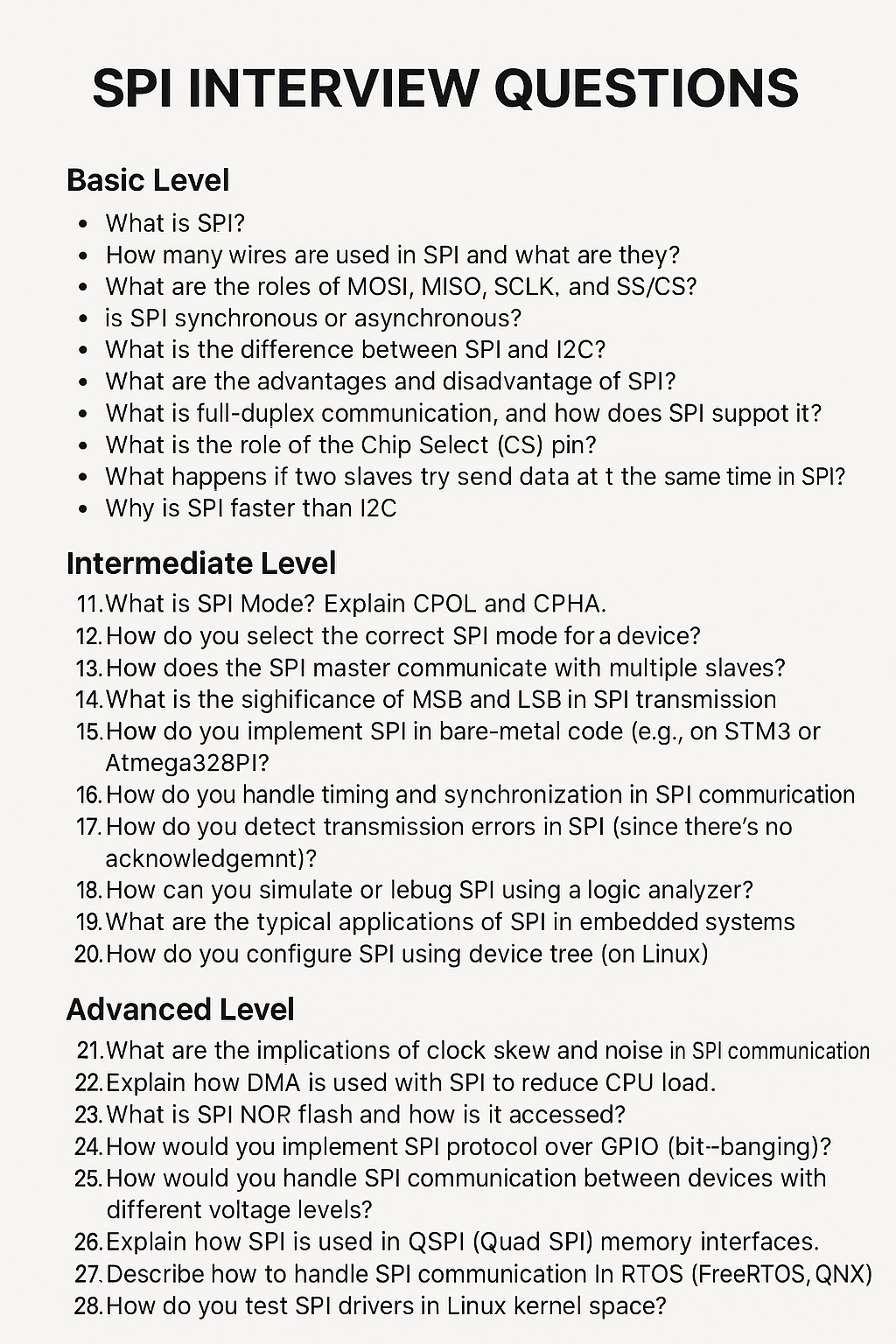
SPI (Serial Peripheral Interface) interview questions
🟢 Basic Level SPI Interview Questions
- What is SPI?
- How many wires are used in SPI and what are they?
- What are the roles of MOSI, MISO, SCLK, and SS/CS?
- Is SPI synchronous or asynchronous?
- What is the difference between SPI and I2C?
- What are the advantages and disadvantages of SPI?
- What is full-duplex communication, and how does SPI support it?
- What is the role of the Chip Select (CS) pin?
- What happens if two slaves try to send data at the same time in SPI?
- Why is SPI faster than I2C?
🟡 Intermediate Level SPI Interview Questions
- What is SPI Mode? Explain CPOL and CPHA.
- How do you select the correct SPI mode for a device?
- How does the SPI master communicate with multiple slaves?
- What is the significance of MSB and LSB in SPI transmission?
- How do you implement SPI in bare-metal code (e.g., on STM32 or Atmega328P)?
- How do you handle timing and synchronization in SPI communication?
- How do you detect transmission errors in SPI (since there’s no acknowledgment)?
- How can you simulate or debug SPI using a logic analyzer?
- What are the typical applications of SPI in embedded systems?
- How do you configure SPI using device tree (on Linux)?
🔴 Advanced Level SPI Interview Questions
- What are the implications of clock skew and noise in SPI communication?
- Explain how DMA is used with SPI to reduce CPU load.
- What is SPI NOR flash and how is it accessed?
- How would you implement SPI protocol over GPIO (bit-banging)?
- How would you handle SPI communication between devices with different voltage levels?
- Explain how SPI is used in QSPI (Quad SPI) memory interfaces.
- Describe how to handle SPI communication in RTOS (FreeRTOS, QNX).
- How do you test SPI drivers in Linux kernel space?
- What is the difference between SPI master and slave implementation from software point of view?
- How would you debug a case where SPI communication is corrupted intermittently?
Here’s a FAQ-style list of common SPI interview questions and their answers:
FAQ – SPI Interview Questions
1. What is SPI (Serial Peripheral Interface)?
Answer:
SPI is a synchronous serial communication protocol used for data exchange between a master device and one or more peripheral devices. It uses a full-duplex communication method, meaning data is sent and received simultaneously. SPI operates using four primary lines:
- MISO (Master In Slave Out)
- MOSI (Master Out Slave In)
- SCK (Serial Clock)
- SS (Slave Select)
2. What are the main differences between SPI and I2C?
Answer:
- Number of wires: SPI uses four wires, while I2C uses only two.
- Speed: SPI generally offers higher data transfer speeds than I2C.
- Communication: SPI supports full-duplex communication, while I2C is half-duplex.
- Master-Slave Configuration: SPI is typically point-to-point (one master, multiple slaves), while I2C allows multiple masters and slaves.
- Complexity: SPI is simpler in terms of protocol, while I2C requires more sophisticated addressing and control.
3. What are the different modes in SPI communication?
Answer:
SPI operates in four different modes based on the combination of clock polarity (CPOL) and clock phase (CPHA). These modes are:
- Mode 0: CPOL = 0, CPHA = 0
- Mode 1: CPOL = 0, CPHA = 1
- Mode 2: CPOL = 1, CPHA = 0
- Mode 3: CPOL = 1, CPHA = 1
The clock polarity and phase determine when data is sampled and shifted on the clock signal.
4. What is the role of the Slave Select (SS) pin in SPI?
Answer:
The Slave Select (SS) pin is used by the master device to select the active slave. The master asserts the SS pin low to initiate communication with the corresponding slave device. When SS is deasserted (high), the slave is not selected and does not communicate with the master.
5. How does SPI ensure data integrity during communication?
Answer:
SPI ensures data integrity through its synchronous nature, where the data is synchronized to the clock signal (SCK). The data bits are shifted out and sampled on the rising or falling edge of the clock, ensuring that both devices are aligned in terms of timing. However, SPI doesn’t inherently provide error-checking mechanisms (like CRC or parity), so additional error-detection methods are often implemented in higher-layer protocols.
6. What is full-duplex communication in SPI?
Answer:
Full-duplex communication means that data can be sent and received simultaneously. In SPI, the master can send data to the slave via the MOSI line while simultaneously receiving data from the slave via the MISO line. This enables efficient communication, as both operations happen concurrently.
7. Can multiple SPI devices share the same bus?
Answer:
Yes, multiple SPI devices can share the same bus, but they require individual Slave Select (SS) lines. The master device selects which slave to communicate with by activating the respective SS line. This allows the SPI bus to be shared among multiple devices without interference.
8. What is the maximum clock frequency for SPI communication?
Answer:
The maximum clock frequency in SPI communication depends on the specific hardware and the capabilities of the master and slave devices. Typically, SPI supports clock frequencies in the range of several MHz, with some systems capable of reaching speeds up to tens of MHz. The actual speed is also influenced by factors such as signal integrity, bus capacitance, and the devices’ capabilities.
9. What is the difference between SPI and UART?
Answer:
- SPI: SPI is a synchronous protocol, meaning data is transferred with the help of a clock signal. It supports full-duplex communication and requires multiple wires (MISO, MOSI, SCK, and SS).
- UART: UART (Universal Asynchronous Receiver-Transmitter) is an asynchronous protocol, meaning it does not require a clock signal. It supports half-duplex communication and typically requires only two wires (TX and RX).
10. How do you handle clock polarity and phase mismatches between devices?
Answer:
If the master and slave devices have mismatched clock polarity or phase, communication will be misaligned, leading to incorrect data. To resolve this, ensure that both devices are configured to use the same SPI mode (clock polarity and phase). Typically, the clock polarity and phase can be adjusted in the configuration registers of both devices.
11. What are some common issues with SPI communication and how can they be resolved?
Answer:
- Signal Integrity Issues: High-frequency signals may lead to noise, causing data corruption. Ensure proper grounding, and use shorter cables or proper shielding.
- Clock Speed Mismatch: If the master and slave have incompatible clock speeds, communication may fail. Ensure that both devices support the same clock speed.
- Slave Select Timing: Incorrect timing of the Slave Select (SS) line can cause the slave to misinterpret the data. Ensure that SS is correctly asserted and deasserted.
- Data Loss: In high-speed communication, data might be lost if the buffer overflows. Increase the baud rate or use buffers to avoid this.
12. What is the maximum number of devices that can be connected to an SPI bus?
Answer:
Theoretically, an SPI bus can support many devices, limited only by the number of available GPIO pins and the complexity of routing multiple SS lines. Practically, however, the number of devices is constrained by factors such as signal quality, power requirements, and system complexity. Each slave needs its own SS line, so the number of slaves is limited by the number of available GPIO pins on the master device.
13.Why is SPI faster than I2C?
Ans: SPI is faster than I²C mainly because SPI is simpler, more direct, and has less overhead. Let’s break it down in clear, beginner-friendly terms, then I’ll give you an interview-ready answer.
SPI has no addressing overhead
I²C:
- Every transfer includes:
- Slave address (7/10 bits)
- Read/Write bit
- ACK/NACK bits
- This adds extra clock cycles before real data starts.
SPI:
- No addressing
- Slave is selected using CS (Chip Select)
- Data starts flowing immediately
Less overhead = faster transfer
SPI uses full-duplex communication
SPI:
- MOSI and MISO work at the same time
- Data is sent and received simultaneously
I²C:
- Half-duplex
- Data goes one direction at a time
SPI effectively transfers more data per clock
SPI supports much higher clock speeds
Typical speeds:
| Protocol | Max Speed |
|---|---|
| I²C Standard | 100 kHz |
| I²C Fast | 400 kHz |
| I²C Fast+ | 1 MHz |
| I²C High-Speed | 3.4 MHz |
| SPI | 10–50+ MHz |
SPI clocks are much faster
No pull-up resistors in SPI
I²C:
- Uses open-drain
- Needs pull-up resistors
- Rising edges are slow
SPI:
- Uses push-pull outputs
- Sharp signal edges
- Works better at high speed
Simpler protocol = less processing
I²C:
- Arbitration
- Clock stretching
- ACK/NACK checking
- Error handling
SPI:
- No arbitration
- No ACK bits
- Very little protocol logic
Less CPU work = faster response
Dedicated lines reduce waiting
- SPI uses separate lines for:
- Clock
- Data in
- Data out
- I²C shares data on one line
Less contention, more speed
Quick comparison table
| Feature | SPI | I²C |
|---|---|---|
| Clock speed | Very high | Lower |
| Duplex | Full | Half |
| Addressing | No | Yes |
| Pull-ups | No | Yes |
| Overhead | Low | High |
One-line interview answer
SPI is faster than I²C because it uses higher clock speeds, full-duplex communication, no addressing overhead, and push-pull signaling with minimal protocol overhead.
When to still use I²C?
- Many devices on same bus
- Fewer pins available
- Lower speed is acceptable
14. What happens if two slaves try to send data at the same time in SPI?
In SPI, this situation is not supposed to happen by design and if it does, it causes problems.
Normal SPI behavior (why it doesn’t happen)
- SPI uses Chip Select (CS / SS) lines.
- Only one slave’s CS is LOW at a time.
- Only that slave is allowed to drive the MISO line.
- All other slaves keep their MISO pins in high-impedance (Hi-Z).
So under correct operation, only one slave can send data at any moment.
If two slaves send data at the same time (by mistake)
This happens if two CS lines are active simultaneously.
Consequences:
- Bus contention
- Both slaves drive the MISO line.
- Corrupted data
- Master reads garbage or unstable values.
- Possible hardware damage
- If one slave drives HIGH and the other LOW, large current flows.
- Can overheat or damage output drivers.
Why SPI has no protection for this
- SPI has no arbitration mechanism.
- No collision detection like CAN.
- No multi-master safety like I²C.
The master is fully responsible for correct CS control.
Special case: Daisy-chain SPI
- Slaves are connected in series.
- Data passes through each slave.
- Still no collision, because only one data path exists.
Interview-ready answer
In SPI, only one slave is allowed to transmit at a time. If two slaves are selected simultaneously, both may drive the MISO line, causing bus contention, corrupted data, and possible hardware damage. Proper chip-select control prevents this.
One-line takeaway
SPI is fast because it’s simple — but that simplicity means the master must prevent collisions.
15. What is SPI Mode? Explain CPOL and CPHA and How do you select the correct SPI mode for a device?
What is SPI Mode?
SPI mode defines how data is sampled and shifted relative to the clock signal.
SPI mode is decided by two bits:
- CPOL → Clock Polarity
- CPHA → Clock Phase
There are 4 SPI modes (Mode 0 to Mode 3).
1.CPOL (Clock Polarity)
CPOL decides what level the clock stays at when idle.
| CPOL | Clock idle state |
|---|---|
| 0 | Clock is LOW when idle |
| 1 | Clock is HIGH when idle |
So:
- CPOL = 0 → SCLK rests at 0
- CPOL = 1 → SCLK rests at 1
2.CPHA (Clock Phase)
CPHA decides when data is sampled relative to the clock edge.
| CPHA | Data is sampled on |
|---|---|
| 0 | First clock edge |
| 1 | Second clock edge |
“First edge” means the first transition away from idle.
Combining CPOL and CPHA → SPI Modes
| SPI Mode | CPOL | CPHA | Data sampled on |
|---|---|---|---|
| Mode 0 | 0 | 0 | Rising edge |
| Mode 1 | 0 | 1 | Falling edge |
| Mode 2 | 1 | 0 | Falling edge |
| Mode 3 | 1 | 1 | Rising edge |
Simple visualization (Mode 0 example)
- Clock idle = LOW
- Data is captured on rising edge
- Data changes on falling edge
This is the most common SPI mode.
Why SPI mode matters
If master and slave use different SPI modes:
- Data is sampled at the wrong time
- Bits get shifted
- Communication fails or data becomes garbage
How do you select the correct SPI mode?
Step-by-step method:
- Check the slave device datasheet
- Look for:
- “SPI timing diagram”
- “Clock polarity and phase”
- “SPI mode”
- Look for:
- Datasheet will say something like:
- “Data is latched on rising edge, clock idle low”
- That directly maps to Mode 0
- Configure the SPI master with that mode
- Test communication (read device ID or known register)
Quick mapping from datasheet text
| Datasheet says | SPI Mode |
|---|---|
| Clock idle low, sample on rising edge | Mode 0 |
| Clock idle low, sample on falling edge | Mode 1 |
| Clock idle high, sample on falling edge | Mode 2 |
| Clock idle high, sample on rising edge | Mode 3 |
Interview-ready answer
SPI mode defines the clock polarity and clock phase used during communication. CPOL sets the idle clock level, and CPHA decides on which clock edge data is sampled. The correct SPI mode is selected based on the slave device’s datasheet timing requirements.
One-line memory trick
- CPOL → clock level
- CPHA → capture edge
- Match datasheet or it won’t work
You can also Visit other tutorials of Embedded Prep
- What is eMMC (Embedded MultiMediaCard) memory ?
- Top 30+ I2C Interview Questions
- Bit Manipulation Interview Questions
- Structure and Union in c
- Little Endian vs. Big Endian: A Complete Guide
- Merge sort algorithm
Special thanks to @mr-raj for contributing to this article on Embedded Prep

Mr. Raj Kumar is a highly experienced Technical Content Engineer with 7 years of dedicated expertise in the intricate field of embedded systems. At Embedded Prep, Raj is at the forefront of creating and curating high-quality technical content designed to educate and empower aspiring and seasoned professionals in the embedded domain.
Throughout his career, Raj has honed a unique skill set that bridges the gap between deep technical understanding and effective communication. His work encompasses a wide range of educational materials, including in-depth tutorials, practical guides, course modules, and insightful articles focused on embedded hardware and software solutions. He possesses a strong grasp of embedded architectures, microcontrollers, real-time operating systems (RTOS), firmware development, and various communication protocols relevant to the embedded industry.
Raj is adept at collaborating closely with subject matter experts, engineers, and instructional designers to ensure the accuracy, completeness, and pedagogical effectiveness of the content. His meticulous attention to detail and commitment to clarity are instrumental in transforming complex embedded concepts into easily digestible and engaging learning experiences. At Embedded Prep, he plays a crucial role in building a robust knowledge base that helps learners master the complexities of embedded technologies.