How Does CAN Bus Handle Message Collisions : is a key feature of the Controller Area Network (CAN) protocol that ensures reliable communication between multiple devices on the same bus. When two or more nodes attempt to transmit messages simultaneously, the CAN protocol uses a non-destructive method called bitwise arbitration to decide which message gets priority.
This mechanism compares message identifiers bit-by-bit, where a dominant bit (0) always overrides a recessive bit (1). The message with the lowest ID (highest priority) wins the arbitration and continues transmission, while the others automatically back off and retry once the bus is idle again. This ensures zero data loss, smooth communication, and real-time message prioritization—making CAN ideal for automotive, industrial, and embedded systems.
Understanding how CAN bus handles message collisions helps developers design efficient communication between Electronic Control Units (ECUs) and avoid network congestion.
Let’s understand how it works:
Step-by-Step: How Does CAN Bus Handle Message Collisions
All devices listen before talking:
Every node waits until the bus is idle.
Then it starts transmitting its message.
Messages have priorities:
Each CAN message has an identifier (ID) — a lower number means higher priority.
Example: ID 0x100 has lower priority than ID 0x080.
Bitwise Arbitration Begins:
CAN transmits the message bit-by-bit (starting with the ID).
As each bit is sent, the node also listens to the bus.
Dominant vs Recessive Bits:
Dominant (0) wins over Recessive (1).
If a node sends a recessive bit but sees a dominant bit, it knows another node has higher priority and stops transmitting.
The highest-priority message wins:
The node with the lowest ID (highest priority) continues transmission.
The others wait and try again after the bus becomes idle.
Example
Let’s say two nodes try to send:
Node A: ID 0x100 → binary 0001 0000 0000
Node B: ID 0x080 → binary 0000 1000 0000
Arbitration:
Both start sending at the same time.
Bit-by-bit comparison:
Bit 1: Both send 0 → OK
Bit 2: Both send 0 → OK
Bit 4: Node A sends 1 (recessive), Node B sends 0 (dominant)
Node A detects this and backs off.
👉 Node B wins and continues transmission. Node A retries later.
Why is this Useful?
No data loss during collision.
No time wasted — no delay or error recovery needed.
Ensures real-time priority — critical messages always go through first.
FAQs – CAN Bus Message Collisions
Q1: What happens when two CAN nodes send messages at the same time?
Answer: Both nodes start transmitting their message and enter an arbitration process using the identifier bits. The node with the lowest numerical ID (highest priority) continues, while the other stops and retries later.
Q2: How does CAN determine which message gets priority?
Answer: CAN uses the message identifier (ID) for arbitration. Lower ID numbers have higher priority. The priority is resolved bit-by-bit, where a dominant bit (0) overrides a recessive bit (1).
Q3: Is any data lost during a collision?
Answer: No, no data is lost. The message with lower priority simply stops transmitting as soon as it detects that a higher priority message is being sent. It then retries automatically once the bus is free.
Q4: What are dominant and recessive bits in CAN?
Answer: In CAN protocol:
Dominant bit (0) = stronger signal, overrides others on the bus.
Recessive bit (1) = weaker signal, gets overridden by dominant bit.
This behavior is key to the arbitration mechanism.
Q5: Does CAN use time-based collision detection like Ethernet?
Answer: No, CAN does not use time-based or random backoff methods like Ethernet. Instead, it uses bitwise arbitration which allows collisions to be resolved non-destructively and instantly.
Q6: What happens to the message that lost arbitration?
Answer: The losing node simply waits for the bus to become idle again and then retries sending its message. It does not need to recreate or repackage the data.
Q7: Can two messages with the same ID be sent at the same time?
Answer: Technically yes, but it’s not recommended because they would appear identical on the bus. This could cause data inconsistencies or confusion in the receiving nodes. CAN systems are typically designed to avoid duplicate IDs.
Q8: Is arbitration visible to the user or application?
Answer: No, arbitration is handled entirely by the CAN controller hardware. From the software’s perspective, it only sees whether the message was sent successfully or needs to be retried.
Summary
Feature
CAN Bus Collision Handling
Method
Bitwise arbitration
Key Concept
Dominant (0) wins over recessive (1)
Result
Only the highest-priority message is sent
Benefit
No data corruption or retransmission needed
You can also Visit other tutorials of Embedded Prep
Learn how message priority using identifiers in CAN protocol. This beginner-friendly guide explains message arbitration, why lower IDs have higher priority, and how real-time communication is managed in embedded systems.
Master Message Priority Using Identifiers in CAN Protocol
In communication systems, especially in embedded systems and real-time data networks like CAN (Controller Area Network), every message has something called an identifier. But why is this identifier important?
A very common interview and exam question is:
As the message carries the identifier, _______ is decided?
Parity
Stop Bit
Priority ✅
Constant
The correct answer is: Priority
Let’s break this down in a beginner-friendly way.
What is a Message Identifier?
In many communication protocols like CAN, each message that is transmitted carries a unique identifier. Think of it like a label or tag that tells:
What kind of data it is
Who is sending the message
How urgent or important the message is
Why is Priority Decided by the Identifier?
In systems like CAN, multiple devices (nodes) can try to send messages at the same time. But we can’t have all of them talk together — it would create a mess!
Instead of sending them randomly, the identifier in the message is used to assign priority. Here’s how:
The lower the identifier number, the higher the priority
During transmission, if two messages compete, the one with the lowest identifier (highest priority) wins
Real-Life Analogy
Imagine you’re in a classroom, and everyone raises their hand to speak. The teacher says:
“Whoever has the lowest roll number gets to speak first.”
This is exactly how priority is decided using identifiers in communication protocols.
Examples in Embedded Systems
In a car, the braking system message will have a higher priority than the music player message.
So, even if both try to send messages together, the brake message wins, because it has a higher priority identifier.
What About the Other Options?
Let’s understand why they’re incorrect:
Parity:
Used for error checking, not for deciding priority.
It just helps detect if a bit has flipped during transmission.
Stop Bit:
Used in serial communication to mark the end of a data packet.
It doesn’t influence message importance.
Constant:
This is too vague.
Message identifiers can change depending on the system design and are not necessarily constant.
Summary Table of Message Priority Using Identifiers in CAN Protocol
Term
Role in Communication
Priority Related?
Identifier
Determines priority & identity
✅ Yes
Parity
Error detection mechanism
❌ No
Stop Bit
Signals end of message
❌ No
Constant
Irrelevant in this context
❌ No
Final Answer
As the message carries the identifier, Priority is decided
In CAN Bus, this system is called bitwise arbitration. When two nodes send a message at the same time, the dominant bits (0) override recessive bits (1). That’s how the one with the lowest ID wins transmission!
FAQ – Message Priority Using Identifiers in CAN Protocol
Q1. What is message priority in CAN protocol?
Answer: In the CAN protocol, message priority determines which message is allowed to transmit first when multiple devices try to send messages simultaneously. The message with the lowest identifier (ID) is given the highest priority.
Q2. How does the identifier affect priority in CAN?
Answer: In CAN, each message has a unique identifier. During transmission, the CAN bus uses bitwise arbitration to compare identifiers. The message with more dominant bits (0) wins, meaning a lower numerical ID has higher priority.
Q3. Why is priority important in embedded systems?
Answer: Priority ensures that critical messages (like braking commands in vehicles) are transmitted before less important ones (like infotainment data), improving safety and performance in real-time systems.
Q4. Is message priority in CAN fixed or changeable?
Answer: The priority is based on the identifier value, which is usually defined at design time. However, in some systems, identifiers can be reassigned to change message priority dynamically.
Q5. What happens when two CAN nodes transmit at the same time?
Answer: The CAN protocol uses arbitration. Both messages are sent bit-by-bit, and if a node sends a recessive bit (1) but detects a dominant bit (0), it stops transmitting. The message with the lower ID wins arbitration and continues transmission.
Q6. What’s the difference between message identifier and message content?
Answer: The identifier determines the priority and type of message, while the content (data field) carries the actual information being sent. The identifier doesn’t describe the data itself, but how urgently it needs to be transmitted.
Q7. Does CAN use any error checking while determining priority?
Answer: No, error checking (like CRC, parity) happens after arbitration. Priority is determined solely by comparing identifiers, not by any form of error detection.
Q8. Can two messages have the same identifier?
Answer: In well-designed systems, each identifier should be unique to avoid conflicts. However, if two messages have the same ID and try to transmit together, it may lead to data collisions or system errors unless handled carefully.
You can also Visit other tutorials of Embedded Prep
Functor in Cpp : This comprehensive beginner-friendly guide explains Functor in Cpp in the simplest terms. Learn what a functor is, how it works, and why it’s useful in real-world programming. Explore different types of functors including arithmetic, relational, logical, and bitwise functors, each with clear code examples. Whether you’re a C++ beginner or brushing up on STL and object-oriented concepts, this tutorial will help you understand how function objects (functors) can make your code reusable, modular, and STL-ready.
What is a Functor in Cpp ?
In simple terms, a functor in C++ (also known as a function object) is any object that can be used like a function. It is a class or struct that overloads the operator(), which is the function call operator.
This means you can call an object as if it were a function.
Why Use a Functor in Cpp
You might wonder: “Why use a functor when I can just use a function or a lambda?”
Here’s why functors are useful:
✅ They can store state or data.
✅ They allow custom logic to be wrapped in objects.
✅ They are often used in STL algorithms.
✅ They can offer better performance than virtual functions.
Syntax: How to Create a Functor in Cpp
Let’s understand with a simple example:
#include <iostream>
using namespace std;

// Define a functor
class Add {
public:
    int operator()(int a, int b) {
        return a + b;
    }
};

int main() {
    Add add;               // Create object
    cout << add(5, 3);     // Call like a function
    return 0;
}
Output:
8
Yes, you’re calling the object add just like a function!
Functor vs Function vs Lambda in Cpp
Feature
Function
Functor
Lambda
Stores State
❌
✅
✅
Reusability
✅
✅
✅
OOP Friendly
❌
✅
✅
Complexity
Simple
Medium
Simple to Medium
Use in STL
✅
✅
✅
Types of Functors in Cpp with Examples
In C++, the Standard Library provides ready-made functors (also called function objects) through the <functional> header. These functors act like functions and help perform common operations like addition, comparison, logic checks, and bitwise operations.
Let’s explore the types of functors with examples:
1. Arithmetic Functors in Cpp
These functors perform basic math operations. They work just like normal arithmetic operators but in functor form.
Imagine you want to sort a list of employees based on salary, but in descending order. Functors help here.
#include <iostream>
#include <vector>
#include <algorithm>
using namespace std;

class Descending {
public:
    bool operator()(int a, int b) {
        return a > b;
    }
};

int main() {
    vector<int> salaries = {50000, 30000, 40000};
    sort(salaries.begin(), salaries.end(), Descending());

    for (int salary : salaries) {
        cout << salary << " ";
    }
    return 0;
}
Output:
50000 40000 30000
Here, the Descending functor helps customize the sorting logic!
When to Use Functor in Cpp?
When you need custom behavior in algorithms
When you want to maintain state across calls
When working with STL containers and algorithms
When building reusable and modular code
Can Functors Be Replaced with Lambdas?
Yes, in many cases. Lambdas are simpler and used more frequently in modern C++. However, functors are still powerful, especially in legacy systems or when stateful behavior is needed in object-oriented code.
Fun Facts about Functor in Cpp
You can pass functors like functions.
Functors can be templated for generic behavior.
Many STL components like std::greater, std::less, etc., are functors!
Summary
A functor in C++ is a class/struct object that acts like a function.
It overloads the operator().
Functors can store data, customize logic, and are widely used in STL.
They are a powerful part of object-oriented programming in C++.
FAQ: Functor in Cpp
Q1. What is the purpose of a functor in C++? A functor allows you to use objects like functions and store state within them.
Q2. Is a functor faster than a function pointer? Yes, in many cases. Because functors allow inline expansion by the compiler.
Q3. Can functors replace lambdas in modern C++? Yes, but lambdas are more concise. Functors are more suitable when you need to maintain complex state.
Q4. Are functors used in STL? Absolutely! For example, std::sort, std::for_each, and std::transform can all use functors.
Interview questions on Functors in C++
Basic Level
What is a functor in C++? Explain that a functor is a class or struct that overloads the operator() allowing instances to be called like functions.
How is a functor different from a regular function or a function pointer? Mention that functors can maintain state via member variables, unlike regular functions, and can be passed where functions are expected.
Give an example of a simple functor. Write a small code example with a class having operator() overloaded.
Why and when would you use a functor instead of a function pointer? Talk about advantages like maintaining internal state, inline expansion by the compiler, and more flexibility.
Intermediate Level
Can functors be used with STL algorithms? Give an example. Explain how functors are often used with algorithms like std::sort, std::for_each.
Explain how you can store state inside a functor and why that might be useful. Discuss how member variables can be used to keep track of information across calls.
How do lambda functions relate to functors in C++? Explain that lambdas are syntactic sugar and internally implemented as functors with overloaded operator().
What are the advantages of functors over function pointers in terms of performance? Mention inlining, avoidance of indirect function calls, and potential compiler optimizations.
Advanced Level
Explain how to create a templated functor to work with different data types. Show a template class with operator().
Can functors be used with std::function? How? Explain how std::function can hold functors, function pointers, lambdas, etc.
How do you implement a functor with stateful behavior that counts how many times it was called? Provide code. Demonstrate a functor with an internal counter.
What is the difference between a stateless and a stateful functor? Give examples. Stateful functors hold data; stateless do not.
Can you overload operator() with different signatures in the same functor? How does it work? Yes, overloads are possible, and compiler picks based on call.
Sample Functor Code for Reference
#include <iostream>

// A simple functor that adds a fixed value
class AddValue {
    int value;
public:
    AddValue(int v) : value(v) {}
    int operator()(int x) {
        return x + value;
    }
};

int main() {
    AddValue add5(5);
    std::cout << add5(10);  // Output: 15
}
You can also Visit other tutorials of Embedded Prep
When you’re learning object-oriented programming in C++, two important concepts you’ll come across are Abstract Class and Interface in Cpp. These might sound a bit technical at first, but don’t worry — we’ll break everything down in a simple way.
Are you new to object-oriented programming and trying to understand the difference between an Abstract Class and Interface in Cpp? This beginner-friendly guide on Abstract Class and Interface in C++ is exactly what you need! In this detailed article, we explain what abstract classes are, how pure virtual functions work, and how C++ uses abstract classes to simulate interface behavior.
You’ll learn:
The definition and purpose of abstract classes in C++
How to declare and use pure virtual functions
The concept of interfaces in C++ and how to implement them
Key differences between abstract classes and interfaces
Real-world examples and code snippets for hands-on learning
Whether you’re a student, a programming beginner, or someone preparing for C++ interviews, this comprehensive explanation of Abstract Class and Interface in C++ will strengthen your understanding and help you write clean, modular, and reusable code.
Abstract Class and Interface in Cpp
What is an Abstract Class?
An abstract class is a class that cannot be directly used to create objects. It’s like a blueprint that other classes must follow.
It is mainly used when:
You want to define a common structure or behavior for all derived classes.
You want to force derived classes to implement some specific functions.
How to define an abstract class?
In C++, a class becomes abstract if it has at least one pure virtual function.
class Animal {
public:
    virtual void makeSound() = 0; // Pure virtual function
};
What is a Pure Virtual Function?
A pure virtual function is a function that has no body in the base class and must be overriddenin derived classes.
Syntax:
virtual returnType functionName() = 0;
Example of Abstract Class:
#include <iostream>
using namespace std;

class Animal {
public:
    virtual void makeSound() = 0;  // pure virtual function
};

class Dog : public Animal {
public:
    void makeSound() {
        cout << "Woof!" << endl;
    }
};

int main() {
    Dog d;
    d.makeSound();  // Output: Woof!
}
🔸 You can’t create an object of Animal because it’s an abstract class. 🔸 You must overridemakeSound() in the derived class.
What is an Interface?
In C++, interface is not a keyword like in Java or C#. But we can achieve interface-like behavior using abstract classes.
An interface:
Only contains pure virtual functions.
Doesn’t have any data members or function definitions.
Example of Interface in C++:
class Printable {
public:
    virtual void print() = 0;  // pure virtual function
};
Any class that implements Printable must define the print() function.
Full Example of Interface:
#include <iostream>
using namespace std;

class Printable {
public:
    virtual void print() = 0;
};

class Document : public Printable {
public:
    void print() {
        cout << "Printing Document..." << endl;
    }
};

int main() {
    Document doc;
    doc.print();  // Output: Printing Document...
}
Key Differences: Abstract Class and Interface in cpp
Feature
Abstract Class
Interface-like (in C++)
Can have data members?
Yes
No
Can have function body?
Yes (non-pure virtual functions)
No (only pure virtual functions)
Can have constructors?
Yes
No (interfaces don’t need them)
Used for
Shared code + enforcing rules
Only enforcing rules (contract)
When to Use What?
Use abstract class when you want to share code and behavior among related classes.
Use an interface-style class when you want to define a contract (a set of rules that must be followed) without any implementation.
Summary of Abstract Class and Interface in cpp
Abstract class = class with at least one pure virtual function.
You can’t create objects of abstract classes.
Interfaces in C++ are implemented using abstract classes with only pure virtual functions.
Abstract classes can have both complete and incomplete functions; interfaces only have incomplete ones.
Frequently Asked Questions (FAQ) – Abstract Class and Interface in cpp
Q1: What is an abstract class in C++? A: An abstract class in C++ is a class that contains at least one pure virtual function. It cannot be used to create objects directly and is meant to be inherited by other classes that implement its pure virtual functions.
Q2: What is a pure virtual function? A: A pure virtual function is a function declared in a base class with no definition. It uses the = 0 syntax and must be overridden by derived classes. Example:
virtual void speak() = 0;
Q3: Can we create an object of an abstract class in C++? A: No, you cannot create an object of an abstract class. You must inherit it in a derived class and implement all pure virtual functions before creating an object.
Q4: What is an interface in C++? A: C++ does not have a built-in interface keyword like Java, but you can create interface-like behavior using an abstract class that contains only pure virtual functions and no data members.
Q5: What is the difference between an abstract class and an interface in C++? A:
An abstract class can have both pure and non-pure (regular) member functions and can include data members.
An interface (in C++ terms) contains only pure virtual functions and no data or implementation.
Q6: Can an abstract class have constructors in C++? A: Yes, abstract classes can have constructors. However, since you can’t create an object of an abstract class, the constructor is only called when a derived class is instantiated.
Q7: Can a class implement multiple interfaces in C++? A: Yes, C++ supports multiple inheritance, so a class can inherit from multiple abstract classes (interfaces), allowing it to implement multiple sets of behaviors.
Q8: When should I use an abstract class vs. an interface in C++? A:
Use an abstract class when you want to provide default/shared implementation along with rules.
Use an interface-style abstract class when you only want to enforce certain function definitions (pure contract).
Q9: Can an abstract class have a destructor in C++? A: Yes, and it’s good practice to declare the destructor as virtual in an abstract class to ensure proper cleanup when deleting derived objects.
Q10: Is it possible to inherit an abstract class without implementing all pure virtual functions? A: Yes, but then the derived class also becomes abstract. To make it concrete (instantiable), all pure virtual functions must be implemented.
You can also Visit other tutorials of Embedded Prep
When learning C++, one of the key concepts you’ll come across is static method and member in C++. These are essential tools that allow you to manage class-level data and behavior, instead of instance-level. In this article, we’ll break down this topic in a simple way, perfect for beginners.
Static Variable
What is a Static Variable in a Function?
Usually, when you create a variable inside a function, it’s created fresh every time you call the function, and it’s destroyed when the function ends. But if you declare the variable as static, something different happens:
The static variable is created only once.
It retains its value between multiple function calls.
It stays in memory for the entire duration of the program, not just while the function runs.
Simple Example of Static Variable in a Function
Let’s understand this with an example:
#include <iostream>
using namespace std;

void displayCount() {
    static int count = 0; // This variable is created only once
    count++;              // It keeps increasing on each call
    cout << count << " ";
}

int main() {
    for (int i = 0; i < 5; i++) {
        displayCount();
    }
    return 0;
}
Output:
1 2 3 4 5
Explanation:
The first time displayCount() is called, count is set to 0, then increased to 1.
On the next call, count starts from 1, not 0, because it remembers its value.
This continues, so we see the numbers increasing in each call.
How is Static Variable Different from Normal Variable?
Feature
Normal Variable
Static Variable
Created when
Function is called
First time function is called
Destroyed when
Function ends
Program ends
Keeps previous value
No
Yes
Stored in memory
Stack
Data segment (static memory)
What is a Static Member in C++?
In C++, a static member is a variable that belongs to the class, not to any specific object. This means:
All objects of the class share the same copy of the static variable.
It is initialized only once and exists for the lifetime of the program.
You can access it even without creating an object.
Syntax:
class MyClass {
public:
    static int count;  // Declaration
};
int MyClass::count = 0; // Definition and Initialization
Key Points:
Declared inside the class using the static keyword.
Defined outside the class using the class name and scope resolution (::) operator.
Shared among all instances of the class.
What is a Static Method in C++?
A static method (also known as a static function) is a function that belongs to the class rather than an object. You can call it without creating an instance of the class.
Does not have access to this pointer (because it’s not tied to any instance).
Useful for utility functions or managing static data.
Static Method and Member in C++ Example
Let’s look at a complete example to understand how both work together:
#include <iostream>
using namespace std;

class Counter {
public:
    static int count;

    Counter() {
        count++;
    }

    static void showCount() {
        cout << "Object count: " << count << endl;
    }
};

int Counter::count = 0;

int main() {
    Counter c1, c2, c3;

    Counter::showCount(); // Accessing static method without object

    return 0;
}
Output:
Object count: 3
Why Use Static Members and Methods?
Here are some common reasons:
To keep track of information shared across all objects.
To create utility or helper functions (e.g., Math::add()).
To implement Singleton design patterns.
For factory methods that return new instances.
Global Static Variable
When you’re working on larger C++ projects, you may want a variable that is accessible in multiple functions but not visible outside the current file. This is where a global static variable in C++ becomes useful.
What is a Global Static Variable in C++?
A global static variable is a variable declared outside of all functions and marked with the static keyword. It behaves like a global variable within the file, but it cannot be accessed from other files.
Key Characteristics:
Declared outside of any function or class.
Has file-level scope (also called internal linkage).
Retains its value throughout the program execution.
Cannot be accessed from other source files, unlike normal global variables.
Example: Global Static Variable in C++
#include <iostream>
using namespace std;

// Global static variable
static int count = 0;

void increment() {
    count++;
    cout << count << " ";
}

int main() {
    increment(); // Output: 1
    increment(); // Output: 2
    return 0;
}
Output:
1 2
Explanation:
The variable count is declared as static at the global level.
It keeps its value between function calls.
Even though it’s global to this file, it won’t conflict with a variable of the same name in another file.
Why Use Global Static Variables in C++?
Using global static variables helps in managing scope and avoiding naming conflicts in large codebases.
Common Use Cases:
Use Case
Description
Avoid naming conflicts
Limits the scope to the current file only.
Global flags or counters
Track state or events throughout the file.
Shared resources in a file
Store reusable objects like buffers, config values, or status indicators.
Improved modularity
Keeps internal details hidden from other parts of the program.
Better memory efficiency
Prevents frequent allocation and deallocation for shared values.
Global Static vs Normal Global Variable
Feature
Global Variable
Global Static Variable
Scope
Accessible from any file
Only accessible in current file
Linkage
External linkage
Internal linkage
Risk of name conflict
High
Low
Ideal for
Shared data across files
Private data for one file
Differences Between Static and Non-static Members
Feature
Static Member
Non-static Member
Belongs to
Class
Object
Shared Across
All objects
Unique to each object
Access
ClassName::member
object.member
Memory Allocation
Once (for all objects)
Every time an object is created
Can access
Only static members
All members of the class
Static Data Member
If you’re learning modern C++, you might have heard about a new feature introduced in C++17: the inline definition of static data members. This feature makes working with static variables inside a class much simpler than before.
What is a Static Data Member in C++?
In C++, a static data member is a variable that belongs to the class, not to individual objects. This means:
All objects share the same static variable.
It is created only once in memory.
Its value is shared and can be accessed without creating objects.
What Changed in C++17?
Before C++17, if you declared a static data member in a class, you had to define it again outside the class.
But in C++17, you can now define and initialize static variables inside the class using the new keyword inline.
This makes your code cleaner and shorter!
Syntax of Inline Static Data Member (C++17)
class MyClass {
public:
    static inline int count = 0;  // inline static data member
};
Explanation:
static – makes it a class-level variable.
inline – allows definition inside the class (new in C++17).
int count = 0; – initializes the variable.
How to Access a Static Data Member?
You can access a static data member in two simple ways – even without creating an object.
1. Using Class Name and Scope Resolution (::)
You can directly use the class name to access the variable:
MyClass::count;
2. Using Object of the Class
You can also use an object and the dot (.) operator:
MyClass obj;
cout << obj.count;
✅ Both methods work, but using the class name is preferred when no object is needed.
Just like regular class members, you can control who can access the static member by using:
public – accessible from outside the class
private – accessible only inside the class
protected – accessible in derived classes
Benefits of Inline Static Data Members in C++17
Benefit
Description
Cleaner code
Define and initialize inside class directly
Fewer lines
No need for separate definition outside the class
Modern feature
Encouraged in modern C++ coding practices
Easier to read and maintain
Everything is declared and defined in one place
Real-World Use Cases of Static Variables in Functions
Here are some common scenarios where static local variables are useful:
1. Keeping Track of Function Calls
You can count how many times a function was called without using global variables.
2. Storing Previous State
If you want to remember something from the previous call (like position, score, or status), static variables help.
3. Memoization in Recursion
In recursive functions, you can use static variables to save results and avoid repeated calculations.
4. Returning Address of Local Variables
Normal local variables are destroyed after the function ends, but static ones are not. So you can return their address safely.
Best Practices
Use static members when the data should be consistent across all instances.
Use static methods when the behavior is not tied to any specific object.
Keep static methods minimal and focused.
Avoid overusing statics to maintain modularity and testability.
Conclusion
Understanding static method and member in C++ is crucial for writing efficient and clean object-oriented code. These features allow you to handle shared data and behavior at the class level, reducing redundancy and improving performance. Whether you’re building utility functions, tracking object creation, or managing shared resources, static members and methods are powerful tools in your C++ toolbox.
Frequently Asked Questions (FAQ)
Static Methods in C++
Q1: Can a static method access non-static members? A: No, because static methods are not tied to any object instance and don’t have access to the this pointer.
Q2: Can a static method be virtual? A: No, static methods cannot be virtual because they are not associated with any object and cannot be overridden.
Static Variables in Functions
Q3: How many times is a static variable initialized in a function? A: Only once — during the first call to the function.
Q4: Is a static variable destroyed when the function ends? A: No, it stays in memory for the lifetime of the program.
Q5: Can I use static variables in recursive functions? A: Yes, they’re helpful for saving intermediate results or tracking state between recursive calls.
Global Static Variables
Q6: Can a global static variable be used in another file? A: No, it is limited to the file where it is defined (file-level scope).
Q7: Does a global static variable keep its value across function calls? A: Yes, it retains its value for the entire duration of the program.
Q8: What is the main difference between a global and a global static variable? A: A global variable is accessible across multiple files, while a global static variable is restricted to one file.
Inline Static Members (C++17)
Q9: What is the use of the inline keyword with static variables? A: It allows static members to be defined and initialized directly inside the class definition (starting from C++17).
Q10: Can I still define static members outside the class in C++17? A: Yes, but defining them inline inside the class is more modern and convenient.
Q11: Do all objects share the same static member? A: Yes, static members are shared across all instances of the class.
You can also Visit other tutorials of Embedded Prep
25 OOPs Interview Questions : Are you preparing for your next Embedded Software Engineer interview? A strong foundation in Object-Oriented Programming (OOPs) is critical, especially when working in C++ for embedded systems. In this article, we will explore 25 frequently asked OOPs interview questions, each explained in-depth with examples tailored for embedded systems. These questions are crafted to help you crack interviews at companies like Bosch, Continental, KPIT, Qualcomm, and more.
25 OOPs Interview Questions
Why OOPs in Embedded Software?
Object-Oriented Programming helps embedded developers to:
Organize complex code
Promote reusability and modularity
Simplify maintenance and debugging
Support real-time performance with modern C++ features
Top 25 OOPs Interview Questions for Embedded Software Engineers
1. What is Object-Oriented Programming (OOP)?
Object-Oriented Programming is a programming paradigm based on the concept of objects. Each object is an instance of a class, which encapsulates data and functions. OOP promotes reusability, modularity, and encapsulation — all essential for embedded systems where code efficiency and scalability matter.
Polymorphism: Allows function overloading and overriding
3. How is OOP different in embedded systems compared to desktop systems?
Embedded systems have limited memory and processing power, so OOP features must be used judiciously. For example, virtual functions and dynamic memory allocation can impact performance and are often avoided or replaced with static polymorphism (CRTP).
4. What is a class and object?
Class: A blueprint defining data members and member functions
Object: A runtime instance of a class
class LED {
  int pin;
public:
  LED(int p): pin(p) {}
  void on() { digitalWrite(pin, HIGH); }
};
LED led1(13);
5. What is encapsulation? How is it useful in embedded?
Encapsulation hides implementation details, making code safer and modular. In embedded systems, it helps to limit direct hardware access and prevent bugs.
protected: Accessible in class and its derived classes
7. What is constructor and destructor in C++?
Constructor: Automatically invoked when an object is created
Destructor: Automatically called when object goes out of scope Used in embedded for initializing hardware and releasing resources.
8. What is constructor overloading?
You can define multiple constructors with different parameters:
class Timer {
public:
  Timer() {}
  Timer(int delay) { /* Init with delay */ }
};
9. What is a copy constructor?
It creates a copy of an object. Useful in embedded when passing objects by value.
10. What is inheritance and how is it used?
Inheritance allows creating new classes from existing ones, improving code reuse.
class Sensor { /* Base */ };
class TempSensor: public Sensor { /* Derived */ };
11. What is function overloading vs overriding?
Overloading: Same function name, different parameters
Overriding: Redefining a base class method in a derived class using virtual
12. What are virtual functions?
Used for runtime polymorphism. In embedded systems, they should be used cautiously due to the added vtable overhead.
13. What is pure virtual function and abstract class?
A pure virtual function makes a class abstract. It’s used to enforce interfaces.
class Interface {
public:
  virtual void init() = 0;
};
14. What is static polymorphism?
Also known as compile-time polymorphism, achieved using templates or function overloading. Preferred in embedded to avoid runtime overhead.
15. What are friend functions and classes?
They bypass encapsulation. Use only when needed in embedded code to access private data (e.g., during low-level hardware debugging).
16. What is the ‘this’ pointer?
Points to the current object. Used for object chaining or distinguishing between member and local variables.
17. What are static data members and static functions?
Shared across all objects
Useful in embedded for tracking hardware state or shared resources
18. What is the difference between composition and inheritance?
Inheritance: “is-a” relationship
Composition: “has-a” relationship
Prefer composition in embedded to keep class hierarchy shallow and manageable.
19. What is multiple inheritance and why is it risky?
A class inherits from more than one base class. Risky in embedded due to ambiguity and complexity. Use interfaces or composition instead.
20. What is object slicing?
Occurs when an object of a derived class is assigned to a base class object, losing the derived part. Avoid this in embedded systems by using pointers or references.
21. What is the role of constructors in embedded hardware abstraction?
Constructors are used to initialize hardware resources, such as pins, registers, or peripherals, when objects are created.
22. How do you implement state machines using OOPs in embedded systems?
Using inheritance and polymorphism, each state can be a class, and transitions can be managed via function calls — clean and scalable.
23. What is CRTP (Curiously Recurring Template Pattern)?
Used in embedded systems for static polymorphism without runtime cost.
template<typename Derived>
class Base {
  void doSomething() {
    static_cast<Derived*>(this)->impl();
  }
};
24. How does OOP help in hardware abstraction?
You can abstract hardware modules (UART, SPI, ADC) as classes with clean interfaces. This decouples application logic from hardware-specific code.
25. What OOP features should be avoided or used carefully in embedded C++?
Avoid:
Heap allocation (new, delete)
Virtual functions in performance-critical paths
RTTI and exceptions (not always supported in embedded toolchains)
Final Thoughts
Understanding OOPs concepts in C++ for embedded systems is vital to writing clean, maintainable, and scalable code. While embedded software places some constraints on typical OOP usage, modern C++ (especially C++17 and C++20) enables powerful yet efficient patterns suitable for real-time applications.
If you are preparing for an embedded systems interview, these 25 OOPs interview questions will strengthen your understanding and help you ace your technical rounds.
You can also Visit other tutorials of Embedded Prep
Socket Programming Multithreading : socket programming and multithreading in C++, Python, and Java. Learn how to build real-time apps using socket.io, TCP/UDP, and multithreaded client-server models with examples.
Explore the power of real-time communication with this complete guide to Socket Programming and Multithreading in 2025. Whether you’re a beginner developer or an advanced programmer, mastering sockets is essential for building high-performance, networked applications.
Socket programming allows systems to communicate with each other over a network using IP addresses and ports. It’s the foundation of real-time communication and is widely used in building chat applications, gaming platforms, IoT solutions, and enterprise-level software. In today’s digital world, the demand for efficient, low-latency systems makes socket programming more relevant than ever.
What You’ll Learn in Socket Programming Multithreading Guide
How socket programming works in C++, Java, and Python
Real-world use cases of TCP and UDP sockets
Writing a multithreaded server to handle multiple clients simultaneously
Building real-time web apps using socket.io
Understanding the difference between socket, socket.io, and WebSocket
Writing scalable, thread-safe socket code for production
Performance tips for multi threading in socket applications
Why Learn Socket Programming in 2025?
With more applications depending on real-time communication—like video conferencing, online collaboration tools, and IoT devices—learning how to build systems with multithreaded sockets gives you a serious edge. Whether you’re working with socket Python, socket Java, or C++, this skill unlocks the potential to build lightning-fast and responsive applications.
In addition to programming languages, this guide dives into socket.io, a high-level JavaScript library used for real-time web applications. You’ll understand the role of socket-io in powering chat apps, notifications, multiplayer games, and collaborative dashboards.
Who Is This Guide For?
🔰 Beginners looking for a clear path into networking concepts
👩💻 Developers aiming to scale apps using multi-threaded socket handling
🧠 Students and Engineers preparing for system-level interviews
📡 IoT and Embedded Developers needing efficient data transmission
🌍 Web Developers implementing socket.io for real-time communication
What is Socket Programming?
Socket programming is a method used to enable communication between computers across a network using IP and port numbers. It allows real-time data exchange, which is critical in today’s interconnected world.
Whether you’re building:
A chat app 🗨️
A multiplayer game 🎮
An IoT platform 🌐
A web-based dashboard 🖥️
You need to understand sockets and how they send and receive data.
Components of Socket Programming
1. What is a Socket?
A socket is like a virtual plug that helps your computer connect to another device over the internet or local network. Think of it as the combination of an IP address (like your device’s address) and a port number (like a specific room inside your house). Together, they form a complete communication endpoint.
Example: 192.168.1.1:8080 Here:
192.168.1.1 is the IP address
8080 is the port number
This combination is used to identify where data should go and where it comes from during communication.
2. Client-Server Model in Socket Programming
In socket programming, communication usually follows a structure called the client-server model.
How It Works:
Client: Starts the conversation. It sends a request.
Server: Waits for incoming connections. It receives the request and sends a response back.
This model is used everywhere—from your browser connecting to websites, to chat apps like WhatsApp connecting users.
Example Use Cases:
Sending a message from one device to another
Uploading/downloading a file
Streaming audio/video content
Client-Server Communication Flow
Although the full state diagram can get technical, here’s a simple version of how it typically works:
Server Flow:
Create a socket
Bind it to an IP address and port
Listen for incoming connections
Accept connection and communicate
Close the socket when done
Client Flow:
Create a socket
Connect to the server’s IP and port
Send or receive data
Close the connection
These steps are mostly the same in languages like C, Python, Java, and C++.
Types of Sockets You Should Know
1.TCP (Transmission Control Protocol)
Reliable, connection-based
Used for applications where data accuracy is crucial
E.g., file transfer, login authentication
2.UDP (User Datagram Protocol)
Fast, connectionless
Ideal for real-time apps (e.g., gaming, VoIP)
No error-checking overhead
What is Multithreading in Networking?
Multithreading enables multiple threads to run concurrently, making socket programs more efficient.
import java.io.*;
import java.net.*;

public class Server {
    public static void main(String[] args) throws IOException {
        ServerSocket server = new ServerSocket(5000);
        while (true) {
            Socket client = server.accept();
            new ClientHandler(client).start();
        }
    }
}

class ClientHandler extends Thread {
    private Socket socket;
    public ClientHandler(Socket socket) {
        this.socket = socket;
    }
    public void run() {
        try {
            BufferedReader in = new BufferedReader(new InputStreamReader(socket.getInputStream()));
            String msg = in.readLine();
            System.out.println("Received: " + msg);
            socket.close();
        } catch (IOException e) {
            e.printStackTrace();
        }
    }
}
How to Create a Server Using Socket Programming
If you’re learning socket programming, understanding how to build the server-side process is a critical step. This process helps your server wait for and respond to client requests, whether you’re using TCP socket, UDP socket, or working with socket in Python or Java.
Let’s break down the steps involved in creating a server-side socket in an easy way.
Step 1: Create the Socket
The first step in setting up a socket server is to create a socket.
Think of a socket as a doorway that your server opens to listen for incoming connections. In code, we use a function to create this socket.
💡 You’ll choose:
Type of communication:
SOCK_STREAM for TCP (reliable)
SOCK_DGRAM for UDP (faster, less reliable)
Domain: Usually AF_INET (for IPv4) or AF_INET6 (for IPv6)
Step 2: Set Socket Options (Optional but Useful)
Before the socket starts listening, you can use a helper function to adjust settings—like reusing the same port quickly after restarting the server.
This helps avoid the common error: ❗ "Address already in use"
This step is optional but improves performance and flexibility.
Step 3: Bind the Socket to an IP and Port
The next step is to tell the socket where to listen for connections.
You bind it to:
A specific IP address (e.g., localhost or 0.0.0.0)
A port number (like 8080 or 5000)
This is how the operating system knows which app is waiting for incoming messages on that address.
Step 4: Start Listening for Connections
Now the server is ready to accept clients—but it needs to listen.
This step:
Puts the server into passive mode
Prepares a queue to handle multiple connection requests
You can set a “backlog” value, which defines how many pending clients can wait in line while the server handles requests.
Step 5: Accept a Client Connection
When a client tries to connect, the server uses the accept function.
This:
Pulls the first client from the queue
Creates a new socket dedicated to this client
Returns a new file descriptor to continue communication
At this point, the server and client are connected and can exchange data.
Step 6: Send and Receive Data
Once connected, the server can:
Use send() to send data to the client
Use recv() to receive data from the client
This is where real-time communication happens. You can exchange messages, files, or any kind of data.
When you’re done communicating, always close the socket.
This:
Frees up system resources
Ends the session with the client
It’s good practice to close both the client and server sockets after the communication ends.
Creating a Client-Side Process Socket Programming
If you’re getting started with client-side socket programming in C, this guide will walk you through the key steps. A socket allows your program to communicate with other systems over a network — just like how a browser connects to a website.
Let’s break down the essential steps for building a TCP client in C:
1. Create a Socket
The first step in socket programming is to create a socket on the client side. This socket acts as a communication endpoint.
int sockfd = socket(AF_INET, SOCK_STREAM, 0);
AF_INET: Specifies IPv4.
SOCK_STREAM: Specifies TCP (connection-based).
0: Use default protocol (TCP in this case).
This is similar to how a server socket is created — the only difference is the client will initiate the connection.
2. Connect to the Server
Use the connect() function to establish a connection to the server.
This exchange happens using TCP/IP communication, making it reliable.
4.Close the Socket
Once the data exchange is complete, it’s important to close the socket and release system resources:
close(sockfd);
This ends the session gracefully, just like the server side would.
Chat Application Using Socket Programming in C++ (TCP Based)
Socket programming in C++ allows you to build real-time communication between devices. In this tutorial, you’ll create a basic terminal-based chat app using TCP socket programming in C++, where one system will act as the server and the other as the client.
chat application using socket programming in C++
TCP socket in C++
client server communication in C++
real-time chat app using C++ sockets
Requirements for Chat Application Using Socket Programming
A Linux system or terminal (tested with GCC)
Basic knowledge of C++ and networking
Overview of Client-Server Model in Chatting App
The server waits for connections and handles messages.
The client connects to the server and exchanges messages.
Both use TCP sockets for reliable delivery.
Server Code: chat_server.cpp
// chat_server.cpp
#include <iostream>
#include <string>
#include <unistd.h>
#include <sys/socket.h>
#include <netinet/in.h>
#include <cstring>

#define PORT 8080
#define BUFFER_SIZE 1024

int main() {
    int server_fd, new_socket;
    struct sockaddr_in address;
    int addrlen = sizeof(address);
    char buffer[BUFFER_SIZE] = {0};
    std::string message;

    // Create TCP socket
    server_fd = socket(AF_INET, SOCK_STREAM, 0);
    if (server_fd == 0) {
        std::cerr << "Socket creation failed\n";
        return -1;
    }

    address.sin_family = AF_INET;
    address.sin_addr.s_addr = INADDR_ANY; // Accept connections from any IP
    address.sin_port = htons(PORT);

    // Bind socket to IP/Port
    if (bind(server_fd, (struct sockaddr *)&address, sizeof(address)) < 0) {
        std::cerr << "Bind failed\n";
        return -1;
    }

    // Listen for connections
    listen(server_fd, 3);
    std::cout << "Server listening on port " << PORT << "\n";

    // Accept a connection
    new_socket = accept(server_fd, (struct sockaddr *)&address, (socklen_t*)&addrlen);
    if (new_socket < 0) {
        std::cerr << "Accept failed\n";
        return -1;
    }

    while (true) {
        memset(buffer, 0, BUFFER_SIZE);
        read(new_socket, buffer, BUFFER_SIZE);
        std::cout << "Client: " << buffer << "\n";

        std::cout << "Server: ";
        std::getline(std::cin, message);
        send(new_socket, message.c_str(), message.length(), 0);

        if (message == "exit") {
            break;
        }
    }

    close(new_socket);
    close(server_fd);
    return 0;
}
Q4. What’s the difference between TCP and UDP sockets?
TCP is connection-based and reliable, while UDP is connectionless and faster, ideal for time-sensitive data.
Q5. Is socket.io the same as traditional socket programming?
No. socket.io is a higher-level abstraction for real-time web apps, often built over traditional sockets.
Conclusion
Socket programming is the backbone of real-time communication in modern apps. Combined with multithreading, it enables scalable, responsive, and robust systems across platforms. Whether you’re developing in Python, Java, or C++, mastering sockets is essential in 2025.
You can also Visit other tutorials of Embedded Prep
Mastering Namespace in C++: A Complete Beginner’s Guide (2025)” is a comprehensive, beginner-friendly tutorial designed to help you understand the concept of namespaces in C++. This guide covers everything from the basics of the global namespace to user-defined namespaces, nested namespaces, using directives, and best practices to avoid naming conflicts in large-scale projects. Whether you’re just starting with C++ or looking to strengthen your foundation, this updated 2025 guide will simplify complex concepts with clear examples, practical tips, and real-world use cases.
Introduction to Namespace in C++
As C++ projects grow in size, the chances of naming conflicts between functions, variables, and classes increase. This is where namespace in C++ comes to the rescue.
A namespace is a container that allows you to group identifiers (like variables, functions, classes) under a unique name, thus avoiding name clashes.
Why Use a Namespace in C++?
Without namespaces, your global identifiers could conflict with others — especially in large codebases or when integrating third-party libraries.
When working with larger C++ projects, organizing code and avoiding name conflicts becomes crucial. This is where the concept of a namespace in C++ comes in.
🔎 Note: Unlike class or struct definitions, a namespace does not require a semicolon (;) after its closing brace.
Example: Defining a Simple Namespace
Let’s create a namespace called first_space that contains a simple function:
#include <iostream>

// Define a namespace named 'first_space'
namespace first_space {
    void func() {
        std::cout << "Inside first_space" << std::endl;
    }
}
In the above code:
A namespace first_space is declared.
Inside it, a function func() is defined.
Accessing Namespace Members in C++
To access any function, variable, or class defined inside a namespace, you use the scope resolution operator (::).
Syntax:
namespace_name::member_name;
Example: Accessing a Function Inside a Namespace
#include <iostream>

// Define a namespace named 'first_space'
namespace first_space {
    void func() {
        std::cout << "Inside first_space" << std::endl;
    }
}

int main() {
    // Access the function using scope resolution operator
    first_space::func();
    return 0;
}
Output:
Inside first_space
Using the namespace Directive in C++
In C++, instead of constantly prefixing your functions or variables with the namespace name, you can simplify your code using the using directive. This tells the compiler that the names used afterward refer to a specific namespace — reducing redundancy.
Example: Using the using namespace Directive
#include <iostream>

// Define a namespace called 'first_space'
namespace first_space {
    void func() {
        std::cout << "Inside first_space" << std::endl;
    }
}

// Use the namespace
using namespace first_space;

int main() {
    func();  // No need for first_space::func()
    return 0;
}
Output:
scssCopyEditInside first_space
Scope Rule for using Directive
Names introduced by a using directive follow normal scope rules. They remain accessible from the point of the directive until the end of the scope where it’s declared. If a name from an outer scope conflicts, the inner declaration takes precedence.
Using a Specific Member from a Namespace (Using Declaration)
If you want to access only one specific function or variable from a namespace instead of everything, you can use the using declaration.
// Use only 'func' from first_space using first_space::func;
int main() { func(); // Direct access without prefix return 0; }
Output:
Inside first_space
This approach is safer in large projects where importing an entire namespace might lead to naming conflicts.
Nested Namespaces in C++
Namespaces can also be defined inside other namespaces. These are called nested namespaces, and they help organize code into logical modules or hierarchies.
The std namespace (short for standard) is the most commonly used built-in namespace in C++. It contains standard library functions, classes, and objects like cout, cin, endl, vector, and more.
Example: Using the std Namespace
#include <iostream>
using namespace std;

int main() {
    int a = 3, b = 7;

    // 'cout' and 'endl' are part of std
    cout << "Sum: " << a + b << endl;
    return 0;
}
Output:
Sum: 10
⚠️ Best Practice: Avoid using using namespace std; in headers or large files. Instead, prefer std::cout and std::endl to maintain clarity and avoid clashes.
Advanced Tip: Argument-Dependent Lookup (ADL)
Argument-Dependent Lookup, or ADL, is a C++ feature where the compiler automatically searches the appropriate namespace for a function or operator based on the argument types passed to it.
This means that if a function is defined in a namespace, and you’re calling it using an object from that namespace, the compiler may implicitly find and call the right function — even without a using directive.
Example: Basic Usage of Namespace in C++
#include <iostream>

namespace MathUtils {
    int add(int a, int b) {
        return a + b;
    }

    int subtract(int a, int b) {
        return a - b;
    }
}

int main() {
    std::cout << "Addition: " << MathUtils::add(5, 3) << std::endl;
    std::cout << "Subtraction: " << MathUtils::subtract(5, 3) << std::endl;
    return 0;
}
Output:
Addition: 8
Subtraction: 2
Types of Namespace in C++
1. Named Namespace
A user-defined named namespace (as shown above).
2. Unnamed (Anonymous) Namespace
Used when you want to restrict access to identifiers within a single file.
using namespace MathUtils;

int main() {
    std::cout << add(3, 2); // No need to prefix with MathUtils::
    return 0;
}
⚠️ Use with caution in large projects, as it can cause name conflicts.
2. Using Specific Member
using MathUtils::add;

int main() {
    std::cout << add(4, 5);  // Only `add` is imported
}
Global, Extended, Alias, Inline & Anonymous Namespaces in C++
Learn everything about namespace in C++, including global namespace, namespace extension, namespace aliasing, inline namespace, and anonymous namespace with examples and outputs. Write cleaner and conflict-free C++ code using these powerful namespace features
What is the Global Namespace in C++?
In C++, the global namespace refers to the default namespace where all identifiers (functions, variables, and classes) are placed when they are not explicitly wrapped in any custom namespace.
Every entity you define outside of any named namespace belongs to the global scope automatically.
Accessing Global Namespace
To access variables or functions from the global namespace when there’s a naming conflict, use the scope resolution operator (::).
Example: Access Global Variable
#include <bits/stdc++.h>
using namespace std;

int n = 3;  // Global variable

int main() {
    int n = 7;  // Local variable

    cout << ::n << endl;  // Access global 'n'
    cout << n;            // Access local 'n'
    return 0;
}
Output:
3
7
Extending an Existing Namespace in C++
One of the advantages of namespace in C++ is that you can extend it — even if it was defined in a different file or library. This is known as namespace extension.
This feature allows you to add more members (functions, variables, or classes) to a previously defined namespace.
Example: Extend a Namespace
#include <bits/stdc++.h>
using namespace std;

namespace nmsp {
    void func() {
        cout << "You can extend me" << endl;
    }
}

// Add more functionality
namespace nmsp {
    void func2() {
        cout << "Adding new feature";
    }
}

int main() {
    nmsp::func();
    nmsp::func2();
    return 0;
}
Output:
You can extend me
Adding new feature
Creating an Alias for a Namespace in C++
To make long or complex namespace names easier to work with, C++ allows namespace aliasing. It helps simplify code readability and usability.
Syntax for Namespace Alias
namespace original_namespace {
    // members
}

// Create alias
namespace alias_name = original_namespace;
Now you can use alias_name::member instead of original_namespace::member.
Inline Namespace in C++ (C++11 and Later)
Introduced in C++11, an inline namespace allows its members to be accessed as if they were part of the outer namespace, providing backward compatibility in API versioning.
Example: Using Inline Namespace
#include <iostream>
using namespace std;

// Define inline namespace
inline namespace inline_space {
    void display() {
        cout << "Inside inline namespace";
    }
}

int main() {
    display();  // No need for inline_space::display()
    return 0;
}
Output:
Inside inline namespace
Why Use Inline Namespace? They allow older code to work with new versions without changing function calls.
Anonymous Namespace in C++
An anonymous namespace is a namespace with no name. It restricts the visibility of its members to the file in which it’s declared — making them internal to that translation unit.
This is useful when you want to limit the scope of a function or variable only to the current file.
Example: Anonymous Namespace in Action
#include <iostream>
using namespace std;

// Anonymous namespace
namespace {
    int value = 10;
}

int main() {
    cout << value;  // Direct access
    return 0;
}
Output:
10
Tip: Use anonymous namespaces instead of static keyword for internal linkage in modern C++.
Key Takeaways About Namespace in C++
The namespace keyword is used to define a named scope.
Scope resolution operator :: is used to access members inside a namespace.
No semicolon is required after the closing brace of a namespace.
Namespaces help avoid name clashes in larger programs or when using multiple libraries.
Best Practices for Using Namespace in C++
✅ Prefer named namespaces over global scope.
✅ Use using directive only inside functions, not in headers.
✅ Use inline namespaces for API versioning.
✅ Avoid polluting global namespace in libraries.
Difference Between Namespace and Class in C++
Aspect
Namespace
Class
Definition
A logical container to group identifiers like functions, variables, classes
A blueprint to define objects with data members and functions
Primary Use
Avoiding name conflicts and organizing code
Modeling real-world entities and implementing object-oriented design
Instantiation
❌ Cannot be instantiated
✅ Can be instantiated to create objects
Contains
Functions, variables, classes, other namespaces
Data members (variables) and member functions
Access Syntax
NamespaceName::identifier
object.memberFunction() or ClassName::staticMember
Memory Allocation
No memory is allocated for namespace itself
Memory is allocated when an object is created
Access Specifiers
No public, private, or protected — all are accessible
Supports public, private, and protected
Inheritance
❌ Not possible
✅ Fully supports inheritance and polymorphism
Scope Control
Controls naming scope but not encapsulation
Provides encapsulation, abstraction, and access control
Supports Constructors
❌ Constructors/Destructors not allowed
✅ Can have constructors and destructors
Common Use Case
Avoiding conflicts between libraries or modules
Creating reusable, modular, and organized object-oriented components
Master namespace in C++ | A Complete Beginner’s Guide (2025)
Frequently Asked Questions (FAQs)
Understanding the Basics of C++ Namespace
Q1. What is a namespace in C++? A namespace in C++ is a container that lets you group identifiers like classes, functions, and variables under a unique name to avoid naming conflicts.
Q2. Why should I use a namespace? To avoid collisions between identifiers from different libraries or modules and improve code organization.
Q3. Can I define multiple namespaces in a file? Yes, C++ allows multiple named or unnamed namespaces in the same file.
Q4. What happens if two namespaces have a function with the same name? They won’t conflict as long as you access them using the namespace prefix (e.g., A::func() vs B::func()).
Q5. Is using namespace std; a good practice? It’s okay in small examples but not recommended in production code as it can lead to conflicts, especially in large projects.
Q6. What is an inline namespace? An inline namespace allows you to define a default version of a namespace, making it easier to maintain backward compatibility.
Q7. Can I nest namespaces? Yes, C++ allows nested namespaces. From C++17 onwards, you can use compact syntax like: namespace A::B::C { }
Q8. Are namespaces only for functions? No. You can group variables, classes, structs, enums, and even other namespaces.
Q9. How to restrict access to a namespace within a single file? Use an anonymous namespace, which makes members internal to that translation unit.
Q10. Can I alias a namespace? Yes, using a namespace alias like:
namespace utils = MathUtils;
utils::add(3, 4);
Global Namespace and Advanced Concepts in C++
Q11. What is the global namespace in C++? It’s the default namespace where all global declarations live if they are not enclosed in any user-defined namespace.
Q12. How do you access the global namespace in C++? By using the scope resolution operator ::, like ::variable_name.
Q13. Can I add new members to an existing namespace? Yes, C++ allows extending a namespace across multiple files or blocks.
Q14. What is the purpose of an inline namespace? It enables backward compatibility by making the members accessible as part of the enclosing namespace.
Q15. What is a namespace alias in C++? A shortcut name for an existing namespace to reduce code verbosity.
Q16. Are anonymous namespaces better than static variables? Yes, they provide the same internal linkage and are preferred in modern C++.
Practical Usage and Best Practices for Namespace in C++
Q17. What is the purpose of using namespace in C++? It allows you to access all the members of a namespace without prefixing them with the namespace name every time.
Q18. Should I always use using namespace std;? No, avoid using it in header files or large codebases. It can lead to naming conflicts.
Q19. What is the difference between using namespace and using declaration?
using namespace: imports everything from the namespace.
using declaration: imports only a specific member.
Q20. How do nested namespaces help in C++? They help organize complex systems by grouping related code hierarchically.
Q21. What are built-in namespaces in C++? The most common is std, which includes standard input/output, containers, algorithms, and other utilities.
You can also Visit other tutorials of Embedded Prep
Complete guide to mastering Circular Linked Lists in 2025 with this beginner-to-advanced tutorial! Learn how circular linked lists work, their types, operations, and real-life applications through clear explanations, code examples in C, C++, Java, Python, and JavaScript, and step-by-step implementations. This post also covers time and space complexity, interview FAQs, help you crack coding interviews and academic exams. Perfect for students, developers, and data structure enthusiasts!
What is a Circular Linked List?
A Circular Linked List is a variation of the linked list in which the last node points back to the first node instead of pointing to NULL. This creates a looped structure where you can traverse endlessly through the list starting from any node.
🔁 In a circular linked list, you can go from tail to head seamlessly — it’s like a roundabout with no end!
Why Learn Circular Linked Lists?
Learning about Circular Linked Lists is crucial for understanding how dynamic data structures work in memory. They are especially useful for:
Circular buffers (ring buffers)
Multiplayer game round-robin scheduling
Task scheduling algorithms
Data streaming
Types of Circular Linked List
Singly Circular Linked List Each node has a data and a next pointer, and the next of the last node points to the first node.
Doubly Circular Linked List Each node has data, next, and prev pointers. The next of the last node connects to the first node and the prev of the first node connects to the last.
Circular Linked List Operations
1. Insertion
At the beginning
At the end
After a specific node
2. Deletion
From the beginning
From the end
A specific node
3. Traversal
Start from any node and keep moving until you’re back to the same node.
// Example: Circular Linked List Traversal in C
void traverse(struct Node* head) {
    struct Node* temp = head;
    if (head != NULL) {
        do {
            printf("%d ", temp->data);
            temp = temp->next;
        } while (temp != head);
    }
}
3.Can we implement a stack or queue using a circular linked list?
Yes! Circular linked lists are great for queues, especially when a circular buffer is needed.
4.How to detect a circular linked list?
Use Floyd’s Cycle Detection Algorithm (Tortoise and Hare method).
5.What is a Circular Linked List in Data Structures?
A Circular Linked List is a type of linked list where the last node is connected back to the first node, forming a closed loop. Unlike a singly linked list where the last node points to NULL, a circular linked list enables continuous traversal from any point in the list. This structure is highly useful in circular queues, CPU scheduling, and real-time applications.
6.What are the types of Circular Linked Lists?
There are two main types of Circular Linked Lists: Singly Circular Linked List: Each node has one pointer pointing to the next node, and the last node points to the head. Doubly Circular Linked List: Each node has two pointers (prev and next), and both the first and last nodes are connected circularly in both directions. Both types are used based on the complexity of operations needed and memory constraints.
7.What are the real-life applications of Circular Linked List?
Circular Linked Lists are widely used in: Round-robin CPU scheduling Music or video playlists that auto-repeat Circular buffers in embedded systems Real-time data stream processing Traffic light simulation systems Multiplayer games for turn rotation These applications benefit from the list’s looping behavior, which avoids end-condition checks.
8.What is the time complexity of Circular Linked List operations?
Insertion at end/head:O(n) / O(1) (if tail maintained) Deletion at head:O(n) Search:O(n) Traversal:O(n) Maintaining a tail pointer can reduce insertion time at the end to O(1).
9.How do you detect a circular linked list in a program?
To detect a circular linked list, you can use Floyd’s Cycle Detection Algorithm (Tortoise and Hare Algorithm): Use two pointers moving at different speeds. If they ever meet, a cycle exists. If the fast pointer reaches NULL, it’s not circular. This is the most efficient method with O(n) time and O(1) space.
10.Can a Circular Linked List be used to implement a queue?
Yes, Circular Linked Lists are perfect for circular queues, especially when: Memory usage is fixed (as in embedded systems). You need constant-time insertion and deletion. It avoids shifting elements (like in arrays) and supports continuous enqueuing and dequeuing.
Conclusion
A Circular Linked List offers flexibility, especially when your use case involves continuous looping or round-based tasks. While it can be a bit more complex than a regular linked list, it brings efficiency and circular logic into dynamic data structures.
If you’re preparing for coding interviews, learning circular linked lists will give you an edge!
Master Circular Linked List Tutorials with Examples 2025
You can also Visit other tutorials of Embedded Prep
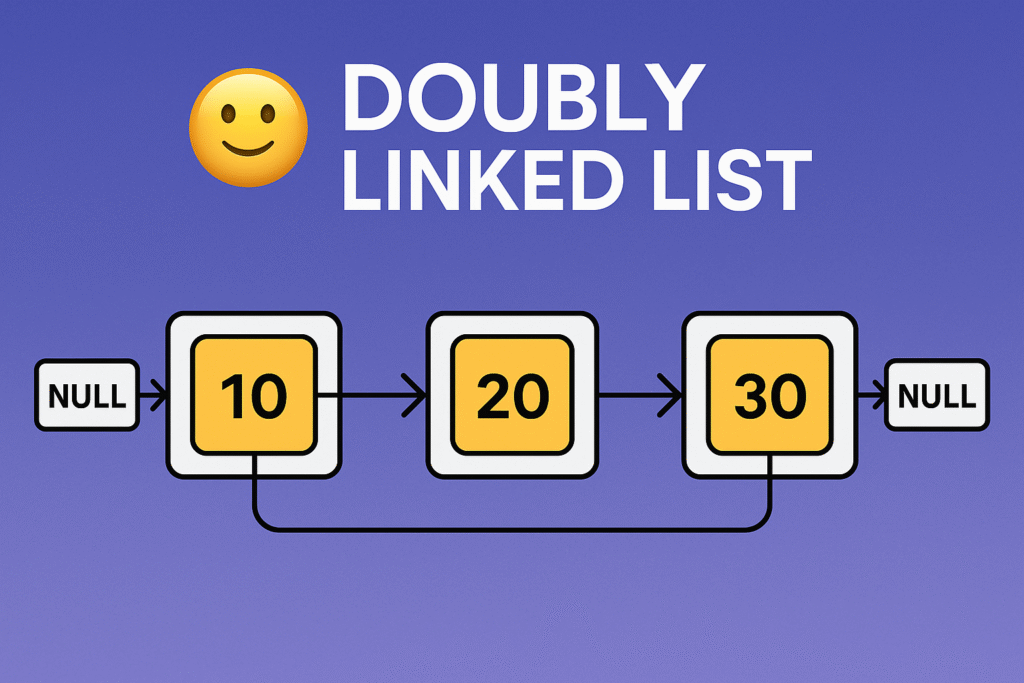
When you’re learning data structures, you’ll often hear about Linked Lists. A Doubly Linked List (DLL) is a powerful and flexible variation of the basic Singly Linked List that allows you to traverse in both directions — forward and backward.
In this beginner-friendly article, we’ll explore:
What is a Doubly Linked List?
How it works (with diagrams)
Real-world uses
Advantages over singly linked list
Basic operations (insertion, deletion, traversal)
Code example in C/C++
🚀 Whether you’re preparing for coding interviews or improving your DSA skills, understanding doubly linked lists is a must!
What is a Doubly Linked List?
A Doubly Linked List is a type of linear data structure made up of nodes, where each node contains:
Data (the actual value)
Pointer to the next node
Pointer to the previous node
⚙️ Node Structure of Doubly Linked List:
+-------+----------+----------+
| prev  |   data   |   next   |
+-------+----------+----------+
Each node is connected to its previous and next node, unlike a singly linked list, which only has a next pointer.
Visual Representation of Doubly Linked List
Let’s say we have 3 nodes with data: 10, 20, and 30.
Two-way traversal: You can navigate forward and backward.
Easier deletion: You can delete a node without needing the previous node pointer.
More flexible: Especially useful in complex data structures like Deques, Undo/Redo systems, Music Playlists, etc.
Disadvantages of Doubly Linked List
More memory: Each node requires extra space for the prev pointer.
More complex: Handling pointers can be error-prone for beginners.
Real-Life Applications of Doubly Linked List
Web browsers (backward and forward navigation)
Music playlist apps
Text editors (undo/redo operations)
Task managers (circular doubly linked lists for round-robin)
Conclusion DLL
Master Doubly Linked List in Data Structures (With Examples) 2025
The Doubly Linked List is an essential topic in Data Structures and Algorithms (DSA). It offers a better way to manage dynamic data, especially when two-way traversal is needed. Though slightly more complex than a singly linked list, the benefits are powerful.
Whether you’re preparing for a coding interview, building a system-level application, or just learning C programming, mastering DLLs will give you a strong foundation in memory management and pointer logic.
FAQs of Doubly Linked List
Q1: Is doubly linked list faster than singly linked list? Ans: DLL allows backward traversal and easier deletion, but it uses more memory. It’s more flexible, not necessarily faster.
Q2: Where is DLL used in real life? Ans: Browser history, playlist navigation, undo/redo features, and memory management systems.
Q3: What is the main drawback of doubly linked list? Ans: It uses extra memory due to the additional prev pointer and increases code complexity.
Q4: How is a doubly linked list different from a circular doubly linked list? Ans: In a doubly linked list, the last node’s next pointer is NULL, whereas in a circular doubly linked list, the last node’s next points back to the head, forming a circle.
Q5: Can a doubly linked list be empty? Ans: Yes, initially a doubly linked list can be empty with head pointing to NULL.
Q6: How do you insert a node at the beginning of a doubly linked list? Ans: Create a new node, point its next to the current head, set the head’s prev to the new node, and then update head to the new node.
Q7: What happens when you delete the last node in a doubly linked list? Ans: The second last node’s next pointer is set to NULL, and the last node is freed from memory.
Q8: Is it possible to implement a stack using a doubly linked list? Ans: Yes, a doubly linked list can be used to implement a stack with push and pop operations.
Q9: How does traversal in a doubly linked list work? Ans: You can traverse forward from head to NULL using next pointers or backward from the last node to head using prev pointers.
Q10: What are the memory requirements for a doubly linked list node? Ans: Each node stores data plus two pointers (prev and next), so it uses more memory compared to a singly linked list node, which stores only one pointer.
Q11: Can doubly linked lists have cycles? How to detect them? Ans: Yes, cycles can exist if nodes point back to earlier nodes. Cycle detection algorithms like Floyd’s Cycle-Finding Algorithm (tortoise and hare) can detect cycles.
Q12: Are doubly linked lists used in databases? Ans: Yes, doubly linked lists are used to implement certain data structures like LRU caches, which are common in databases and operating systems.
Q13: How do you reverse a doubly linked list? Ans: Swap the prev and next pointers for each node and update the head to the last node.
You can also Visit other tutorials of Embedded Prep