Tag: embedded systems tutorial

  • What are the Differences Between a Hard Real-Time System and a Soft Real-Time System? | Master RTOS Interview Questions (2026)

    Differences Between a Hard Real-Time System and a Soft Real-Time System : Learn the key differences between hard real-time and soft real-time systems with beginner-friendly examples. Explore real-time system types, applications, and FAQs for embedded systems, operating systems, and computer science students.

    When learning real-time systems in embedded systems or computer science, one of the most common questions is: What is the difference between a hard real-time system and a soft real-time system?

    Both types of systems deal with time-critical tasks, but they handle deadlines differently. Let’s break it down in simple terms.

    Differences Between a Hard Real-Time System and a Soft Real-Time System

    What is a Real-Time System?

    A real-time system is a computer system where the correctness of operations depends not only on producing the right result but also on delivering it at the right time. In other words, timing is as important as accuracy.

    Real-time systems are widely used in embedded systems, robotics, automotive, aerospace, medical devices, and telecommunications.

    Hard Real-Time System

    A hard real-time system is one where missing a deadline is unacceptable. Even a single delay can cause system failure or dangerous situations.

    • Key Characteristics:
      • Deadlines must always be met.
      • Deterministic response (predictable behavior).
      • Usually used in safety-critical applications.
    • Examples of Hard Real-Time Systems:
      • Airbag control system in cars 🚗
      • Pacemakers and medical life-support systems ❤️‍🩹
      • Flight control systems in airplanes ✈️
      • Industrial automation robots 🤖

    In all these cases, even a millisecond delay can lead to severe consequences.

    Soft Real-Time System

    A soft real-time system is more flexible. Missing a deadline occasionally does not cause system failure, but it may degrade performance or user experience.

    • Key Characteristics:
      • Deadlines are important but not strict.
      • Occasional delays are tolerable.
      • Focuses on performance efficiency rather than strict timing.
    • Examples of Soft Real-Time Systems:
      • Video streaming platforms 🎥 (buffering may occur, but playback continues)
      • Online gaming 🎮 (minor network delays are acceptable)
      • Multimedia systems 🎵 (slight delay in audio is tolerable)
      • E-commerce websites 🛒 (slight page load delay doesn’t break the system)

    Hard Real-Time vs Soft Real-Time: A Quick Comparison

    FeatureHard Real-Time SystemSoft Real-Time System
    Deadline HandlingMust always meet deadlinesMissing deadlines is tolerable
    Tolerance to DelayZero toleranceSome tolerance allowed
    Application DomainSafety-criticalPerformance-focused
    ExamplesAirbag, pacemaker, flight controlVideo streaming, gaming, multimedia

    Conclusion

    The main difference between hard and soft real-time systems lies in how strictly they treat deadlines.

    • Hard real-time systems cannot afford delays because they deal with life-critical or safety-critical operations.
    • Soft real-time systems allow flexibility, as a missed deadline only affects performance or user experience.

    Understanding this difference is crucial for students, developers, and engineers working in embedded systems, operating systems, and time-sensitive applications

    Frequently Asked Questions (FAQ)

    1. What is the main difference between a hard real-time system and a soft real-time system?

    The main difference is how they handle deadlines.

    • Hard real-time system → Missing a deadline is unacceptable and can cause system failure.
    • Soft real-time system → Missing a deadline is tolerable, but it may affect performance.

    2. Is an operating system like Windows or Linux a real-time system?

    • Standard Windows and Linux are not real-time systems because they do not guarantee strict deadline handling.
    • However, specialized versions like RTLinux or QNX can be used for real-time applications.

    3. Which is faster: a hard real-time system or a soft real-time system?

    It’s not about being “faster” but about predictability.

    • Hard real-time systems are deterministic (responses are guaranteed within a fixed time).
    • Soft real-time systems may respond quickly but without strict guarantees.

    4. Can a system be both hard and soft real-time?

    Yes, a single system can have mixed-criticality tasks. For example:

    • In a modern car 🚗, the airbag system is hard real-time, while the infotainment system is soft real-time.

    5. What are real-life examples of hard and soft real-time systems?

    • Hard Real-Time → Pacemaker, flight control, anti-lock braking system (ABS).
    • Soft Real-Time → Online gaming, video conferencing, multimedia streaming.

    6. Why are hard real-time systems used in critical applications?

    Because in safety-critical environments, even a 1-millisecond delay can cause accidents, loss of life, or major system failure .

    Differences Between a Hard Real-Time System and a Soft Real-Time System
    Differences Between a Hard Real-Time System and a Soft Real-Time System
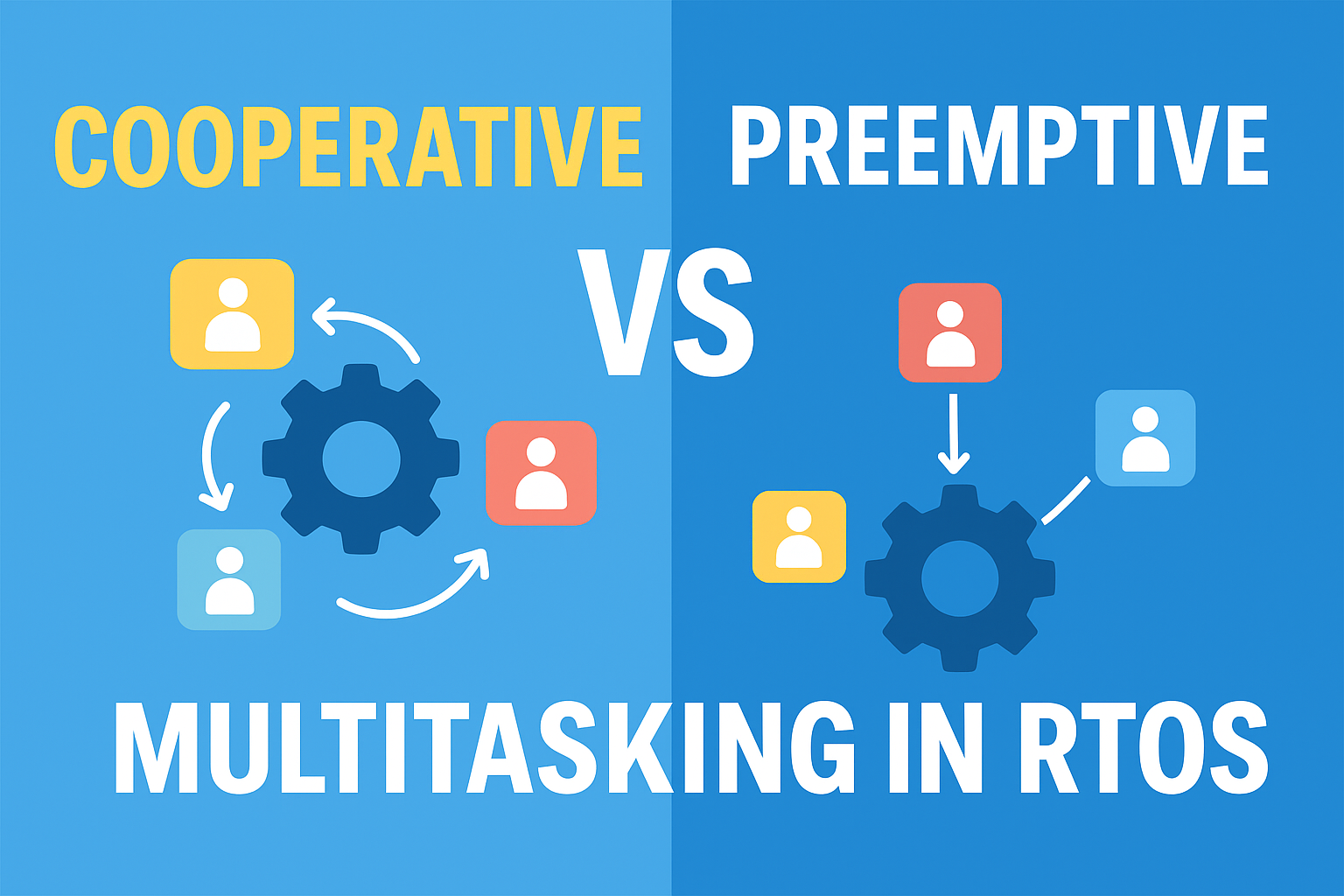
  • Trade-offs Between Cooperative and Preemptive Multitasking in RTOS | Master RTOS Interview Questions (2026)

    Learn the trade-offs between cooperative and preemptive multitasking in RTOS. Discover their advantages, disadvantages, use cases, and FAQs to choose the right model for your embedded system.

    In the world of embedded systems and real-time applications, performance and timing are everything. Unlike general-purpose operating systems such as Windows or Linux, where slight delays are acceptable, a Real-Time Operating System (RTOS) must ensure that tasks are executed on time and within strict deadlines.

    Introduction of Trade-offs Between Cooperative and Preemptive Multitasking

    Real-Time Operating Systems (RTOS) are widely used in embedded systems such as automotive ECUs, medical devices, and industrial controllers. One of the core features of an RTOS is multitasking, which allows multiple tasks to run seemingly at the same time.

    There are two common multitasking models in RTOS:

    • Cooperative Multitasking
    • Preemptive Multitasking

    Each model has its advantages, disadvantages, and specific use cases. To design efficient real-time systems, it is important to understand the trade-offs between cooperative multitasking and preemptive multitasking.

    What is Cooperative Multitasking?

    In a cooperative multitasking model, tasks voluntarily give up control of the CPU. This means the RTOS scheduler only switches tasks when a running task explicitly calls a yield function or completes execution.

    Key Characteristics of Trade-offs Between Cooperative and Preemptive Multitasking:

    • The CPU remains with a task until it decides to release control.
    • Context switching happens only at well-defined points.
    • The system depends on good behavior from tasks.

    Advantages of Cooperative Multitasking:

    • Simplicity: Easy to implement and understand.
    • Low Overhead: Fewer context switches mean more CPU time for tasks.
    • Predictability: Task switching occurs at known points, making debugging easier.

    Disadvantages of Cooperative Multitasking:

    • Risk of CPU Monopolization: A task that fails to yield can block the entire system.
    • Poor Real-Time Response: High-priority tasks may be delayed by long-running tasks.
    • Limited Scalability: Not suitable for complex applications with multiple time-critical tasks.

    Example Use Case: Small embedded systems such as calculators, digital watches, or basic IoT devices where tasks are lightweight and predictable.

    What is Preemptive Multitasking?

    In a preemptive multitasking model, the RTOS scheduler can interrupt tasks automatically based on priorities or timer ticks. This ensures that the CPU is allocated fairly and that high-priority tasks run without being blocked.

    Key Characteristics of Trade-offs Between Cooperative and Preemptive Multitasking:

    • The scheduler decides when to switch tasks.
    • High-priority tasks can preempt lower-priority ones immediately.
    • Requires proper handling of shared resources.

    Advantages of Preemptive Multitasking:

    • Fairness: No single task can monopolize the CPU.
    • High Responsiveness: Real-time deadlines can be met.
    • Better for Complex Systems: Can manage many tasks efficiently.

    Disadvantages of Preemptive Multitasking:

    • Higher Overhead: Frequent context switching consumes CPU time.
    • Increased Complexity: Requires synchronization mechanisms like mutexes and semaphores.
    • Harder to Debug: Bugs related to race conditions are more common.

    Example Use Case: Automotive systems, industrial automation, and medical devices where safety and real-time responsiveness are critical.

    Trade-offs Between Cooperative and Preemptive Multitasking Difference

    FactorCooperative MultitaskingPreemptive Multitasking
    CPU ControlTask decides when to yieldScheduler enforces switching
    OverheadLow (fewer context switches)Higher (frequent context switches)
    SimplicityEasy to implement and debugComplex, requires careful design
    FairnessDepends on task cooperationGuaranteed by scheduler
    ResponsivenessLimited, can cause delaysHigh, suitable for real-time systems
    Use CasesSimple devices, lightweight applicationsSafety-critical, time-sensitive systems

    Trade-offs Explained

    1. Performance vs Reliability:
      Cooperative multitasking has low overhead but risks reliability if a task fails to yield. Preemptive multitasking is more reliable but consumes more resources.
    2. Simplicity vs Complexity:
      Cooperative multitasking is beginner-friendly and easier to debug. Preemptive multitasking requires advanced concepts like mutexes, semaphores, and priority inversion handling.
    3. Responsiveness vs Determinism:
      Preemptive multitasking ensures timely responses, while cooperative multitasking offers deterministic but less responsive scheduling.

    When to Use Which?

    • Choose Cooperative Multitasking if:
      • The system is simple and predictable.
      • Tasks are lightweight and guaranteed to yield.
      • Power efficiency and low overhead are critical.
    • Choose Preemptive Multitasking if:
      • The system is complex with multiple critical tasks.
      • Real-time responsiveness is required.
      • Safety and fairness must be guaranteed.

    Conclusion of Trade-offs Between Cooperative and Preemptive Multitasking

    The choice between cooperative multitasking and preemptive multitasking in RTOS depends on the application’s needs.

    • Cooperative multitasking is simple, efficient, and suitable for small systems but risks delays if tasks do not yield.
    • Preemptive multitasking ensures fairness and responsiveness, making it ideal for safety-critical and real-time applications, but it comes with higher complexity and overhead.

    For most modern embedded systems, preemptive multitasking is preferred due to its reliability and ability to meet real-time constraints. However, cooperative multitasking still has its place in lightweight, power-constrained devices.

    FAQ: Trade-offs Between Cooperative and Preemptive Multitasking

    1. What is cooperative multitasking in RTOS?

    Cooperative multitasking is a model where tasks run until they voluntarily yield control to the scheduler. The RTOS depends on tasks being “well-behaved” and sharing CPU time responsibly.

    2. What is preemptive multitasking in RTOS?

    Preemptive multitasking allows the RTOS scheduler to forcibly interrupt tasks and allocate CPU time to higher-priority tasks. This ensures fairness and responsiveness but adds more complexity.

    3. Which model is easier to implement in an RTOS?

    Cooperative multitasking is easier to implement because it has lower overhead and requires minimal context switching. However, it relies heavily on proper task design.

    4. Why can cooperative multitasking cause delays?

    If a task does not yield control, it can block other tasks from executing, leading to delays, poor responsiveness, or even system freeze.

    5. Why is preemptive multitasking more reliable for real-time systems?

    Preemptive multitasking ensures that critical tasks always get CPU time when needed. This makes it more reliable for systems requiring strict real-time responses, such as automotive and medical devices.

    6. Which multitasking model has lower overhead?

    Cooperative multitasking has lower overhead because it avoids frequent context switches and reduces interrupt handling.

    7. Which multitasking model is more power-efficient?

    Cooperative multitasking can be more power-efficient in simple systems since fewer context switches reduce CPU load. However, preemptive multitasking can save power in real-time systems by ensuring tasks finish quickly and the CPU returns to idle mode.

    8. Can cooperative multitasking be used in critical systems?

    It can, but it is not recommended for safety-critical applications. Since one faulty or greedy task can block others, cooperative multitasking is risky for systems that require guaranteed timing.

    9. Is preemptive multitasking always better than cooperative multitasking?

    Not always. While preemptive multitasking ensures fairness and responsiveness, it also increases complexity, requires careful synchronization, and may waste CPU cycles due to frequent context switching.

    10. What is task starvation in cooperative multitasking?

    Task starvation occurs when a long-running task never yields control, preventing other tasks from executing. This problem is more common in cooperative systems.

    11. Do preemptive multitasking systems require synchronization mechanisms?

    Yes. Since tasks can be interrupted at any time, synchronization tools like semaphores, mutexes, and message queues are required to prevent data corruption and race conditions.

    12. Which multitasking model is best for beginners learning RTOS concepts?

    Beginners often start with cooperative multitasking because it is easier to understand and debug. Once comfortable, they move to preemptive multitasking for real-world, time-critical applications.

    Trade-offs Between Cooperative and Preemptive Multitasking
    Trade-offs Between Cooperative and Preemptive Multitasking in RTOS Master RTOS Interview Questions (2025)