Category: Real-Time Systems

  • Top Interview Questions on Interrupt Service Routine (ISR) | Master Embedded Interview Guide (2026)

    Interview Questions on Interrupt Service Routine : When preparing for embedded systems interviews, one of the most important topics is the Interrupt Service Routine (ISR). Recruiters often ask questions on ISR because it is a core concept in microcontrollers, operating systems, and real-time systems. In this guide, we’ll go through commonly asked ISR interview questions, explained in a simple way for beginners.

    What is an Interrupt Service Routine (ISR)?

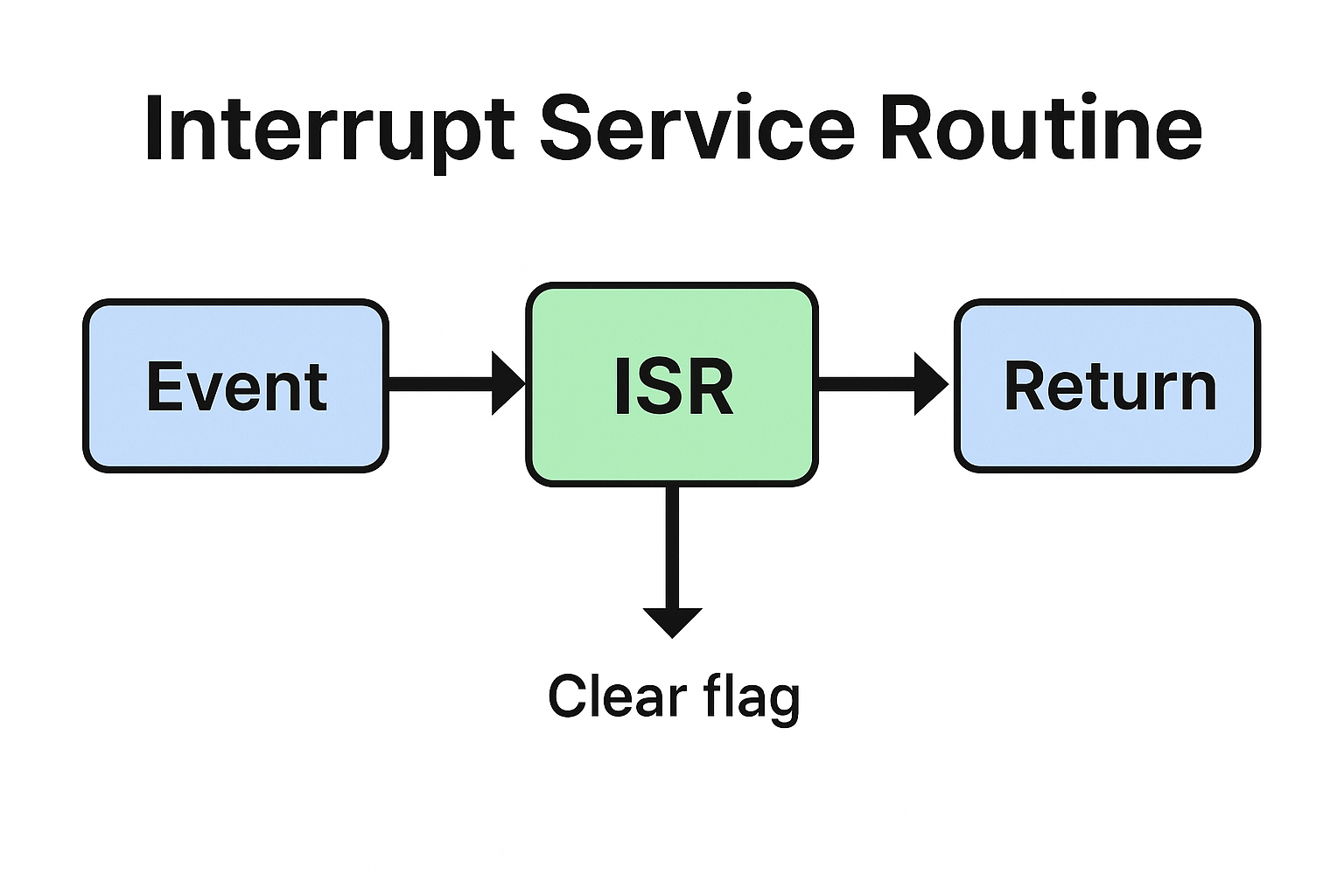
    An Interrupt Service Routine (ISR) is a special block of code that executes when a hardware or software interrupt occurs. Instead of continuously checking a condition (polling), the system pauses its normal execution and jumps to the ISR to handle the event immediately.

    Example: When you press a button on a microcontroller, an interrupt occurs, and the ISR handles the button press.
    Interview Questions on Interrupt Service Routine
    Top Interview Questions on Interrupt Service Routine (ISR) Master Embedded Interview Guide (2025)

    Common Interview Questions on Interrupt Service Routine (ISR)

    1. What is an ISR in embedded systems?

    Answer: An ISR is a function that handles interrupts. It is triggered automatically when an interrupt occurs, allowing the CPU to respond quickly to external or internal events.

    2. What are the characteristics of an ISR?

    Answer:

    • Fast execution : Should be short and efficient.
    • No return values : ISR does not return values.
    • No blocking calls : Avoid using functions like delay() inside ISR.
    • Context saving : CPU saves the current state before jumping to ISR.

    3. Can an ISR call another function?

    Answer: Yes, but it should only call lightweight functions. Heavy operations inside ISR may slow down the system and block other interrupts.

    4. What are nested interrupts?

    Answer: Nested interrupts occur when a higher-priority interrupt occurs while another ISR is still running. In such cases, the CPU pauses the current ISR and executes the higher-priority one.

    5. Why should we keep ISRs short?

    Answer: Long ISRs delay the processing of other interrupts. In real-time systems, this can cause missed events and system instability.

    6. What is the difference between ISR and a normal function?

    Answer:

    • ISR executes automatically when an interrupt occurs, while a normal function is called manually.
    • ISR does not return values, while functions can.
    • ISR runs in a special CPU context and must be as short as possible.

    7. Can we use global variables inside ISR?

    Answer: Yes, but they must be declared as volatile so that the compiler does not optimize them. This ensures real-time updates between the ISR and the main program.

    8. What is interrupt latency?

    Answer: Interrupt latency is the time delay between an interrupt request and the start of ISR execution. Low latency is important for real-time systems.

    9. How do you handle multiple interrupts?

    Answer:

    • Assign priority levels to interrupts.
    • Use interrupt vectors to map different ISRs.
    • Ensure critical ISRs are shorter and higher priority.

    10. What are some best practices for writing ISRs?

    Answer:

    • Keep ISRs short and simple.
    • Use global variables carefully (mark them as volatile).
    • Avoid using printf, malloc, or delay inside ISR.
    • Handle only critical tasks inside ISR and defer others to the main loop or task scheduler.

    List of Interview Questions on Interrupt Service Routine (ISR)

    Basic Questions of Interrupt Service Routine interview questions

    1. What is an Interrupt Service Routine (ISR)?
    2. Why do we need ISR in embedded systems?
    3. What are the main features of an ISR?
    4. What is the difference between polling and ISR?
    5. What happens when an interrupt occurs?

    Intermediate Questions of ISR in embedded systems

    1. What are the rules for writing an ISR?
    2. Why should an ISR be short and fast?
    3. Can we use global variables inside ISR?
    4. What is the role of the volatile keyword in ISR?
    5. What is interrupt latency?
    6. Can an ISR return a value? Why or why not?
    7. What is the difference between ISR and a normal function?
    8. Can ISRs be nested? What are nested interrupts?
    9. How does the CPU know which ISR to execute?
    10. What is an interrupt vector table?

    Advanced Questions of common ISR interview questions

    1. How are multiple interrupts handled in a system?
    2. What are interrupt priorities?
    3. What is the difference between maskable and non-maskable interrupts?
    4. What are reentrant and non-reentrant ISRs?
    5. Can we use dynamic memory allocation (malloc/free) inside ISR?
    6. Why is it not recommended to use printf() inside ISR?
    7. What are some common mistakes while writing ISRs?
    8. How do you handle critical tasks inside ISR?
    9. What happens if an ISR takes too long to execute?
    10. How do modern microcontrollers reduce interrupt latency?

    Practical/Implementation Questions of interrupt handling in embedded systems

    1. How do you declare an ISR in C/C++?
    2. How do you enable and disable interrupts in a microcontroller?
    3. What is the difference between hardware and software interrupts?
    4. Can an ISR call another ISR?
    5. How do you share data between ISR and the main program?
    6. What are best practices for writing ISRs?
    7. What tools or debuggers can be used to test ISR execution?
    8. Can an ISR cause a system crash? How?
    9. How does an operating system handle interrupts differently from bare-metal programming?
    10. What is the difference between vectored and non-vectored interrupts?

    1.What is an Interrupt Service Routine (ISR)?

    Ans: An ISR is a special function that executes automatically when an interrupt occurs, allowing the CPU to handle events quickly without polling.

    2.Why do we use ISR in embedded systems?

    Ans: ISR reduces CPU load, improves response time, and makes systems more efficient by handling events only when they occur.

    3. Can an ISR return a value?

    Ans: No, ISRs cannot return values because they are executed by hardware/OS, not called like regular functions.

    4. Why should ISR be short and fast?

    Ans: Long ISRs block other interrupts and can cause system delays or missed events.

    5. Can we use global variables in ISR?

    Ans: Yes, but they should be declared as volatile to ensure real-time updates between ISR and the main program.

    6. What is interrupt latency?

    Ans: Interrupt latency is the time delay between an interrupt request and the start of ISR execution.

    7. Can we use printf or delay inside ISR?

    Ans: No, functions like printf, malloc, or delay should be avoided inside ISR as they are slow and may cause system instability.

    8. What is the difference between ISR and normal function?

    Ans:
    a) ISR executes automatically when an interrupt occurs, while a normal function is called explicitly.
    b) ISR does not return values, while functions can.
    c) ISR runs in a special CPU context.

    9. What are nested interrupts?

    Ans: Nested interrupts occur when a higher-priority interrupt interrupts the execution of a lower-priority ISR.

    10. What are best practices for writing ISRs?

    Ans:
    a) Keep ISRs short and efficient.
    b) Use volatile for shared variables.
    c) Avoid blocking functions.
    d) Handle only critical tasks inside ISR, defer the rest to main loop or task scheduler.
    Interrupt Service Routine
    Interrupt Service Routine (ISR) Definition, Examples, Best Practices Embedded Interview Guide (2025)
  • What Are the Typical Synchronization Mechanisms Used in an RTOS? | RTOS Interview Question (2026)

    Typical synchronization mechanisms used in an RTOS (Real-Time Operating System) are techniques that manage the coordination and safe sharing of resources among multiple tasks running concurrently. These mechanisms—such as semaphores, mutexes, event flags, message queues, mailboxes, and barriers—help prevent race conditions, ensure mutual exclusion, and maintain deterministic behavior in time-critical applications. By enabling controlled access to shared memory, devices, and data structures, they keep real-time systems stable, predictable, and efficient. Whether it’s signaling between tasks, protecting resources, or coordinating task execution, these synchronization tools are essential for reliable RTOS performance.

    Typical Synchronization Mechanisms Used in an RTOS

    In a Real-Time Operating System (RTOS), multiple tasks often run concurrently and may need to share resources such as memory, hardware devices, or data structures. Without proper control, two tasks could try to access the same resource at the same time, leading to race conditions or data corruption.

    This is where synchronization mechanisms come into play. They ensure safe, predictable, and coordinated access to shared resources, maintaining system stability in real-time environments.

    Why Synchronization is Important in RTOS

    In real-time systems, timing and reliability are critical. Synchronization helps to:

    • Prevent race conditions and data corruption
    • Ensure mutual exclusion (only one task can access a resource at a time)
    • Maintain task coordination and predictable behavior
    • Improve system stability and deterministic performance

    Typical Synchronization Mechanisms Used in RTOS

    1. Semaphores

    A semaphore is a signaling mechanism that controls access to resources.

    • Binary Semaphore: Works like an on/off flag. Useful for task signaling and simple mutual exclusion.
    • Counting Semaphore: Allows a fixed number of tasks to access a resource simultaneously.

    Example: In an RTOS-based printer control system, a counting semaphore can allow up to 3 print jobs to be queued at the same time.

    2. Mutex (Mutual Exclusion)

    A mutex ensures that only one task can access a shared resource at any given moment.

    • Often supports priority inheritance, which helps prevent priority inversion problems in real-time systems.

    Example: Protecting a shared log file from being written by multiple tasks at the same time.

    3. Event Flags

    Event flags (or event groups) allow tasks to wait for specific conditions to occur.

    • Multiple bits in a flag group can represent different events.
    • Tasks can wait for any or all events to be set before proceeding.

    Example: A task waits for both “data received” and “data processed” flags before sending the next packet.

    4. Message Queues

    Message queues allow safe communication between tasks by sending and receiving messages in FIFO (First In, First Out) order.

    • Helps decouple tasks — the sender and receiver do not need to run at the same time.
    • Supports data passing with built-in synchronization.

    Example: A sensor task sends temperature readings to a processing task via a message queue.

    5. Mailboxes

    A mailbox is like a message queue but usually designed for fixed-size messages and single message storage.

    • Suitable when tasks need to exchange small messages quickly.

    Example: A control task sends a command to a motor driver task using a mailbox.

    6. Barriers

    A barrier is a synchronization point where multiple tasks must wait until all have reached the barrier before continuing.

    • Useful for coordinating stages in multi-task processing.

    Example: In a multi-core RTOS system, all tasks wait at a barrier until data loading is complete.

    Choosing the Right Mechanism

    The right synchronization mechanism depends on:

    • Type of resource (shared memory, hardware device, data buffer)
    • Number of tasks accessing the resource
    • Real-time constraints and timing requirements
    • Data size and communication frequency

    Quick Guide:

    • Use mutex for exclusive access to a resource.
    • Use semaphore for signaling between tasks or controlling resource count.
    • Use event flags for multi-condition synchronization.
    • Use message queues/mailboxes for safe inter-task communication.
    • Use barriers for group synchronization.

    Final Thoughts

    In an RTOS, synchronization mechanisms are essential for building stable, predictable, and safe embedded applications. Whether you are working with FreeRTOS, QNX, VxWorks, or any other RTOS, mastering semaphores, mutexes, event flags, and message queues will significantly improve your ability to design efficient real-time systems.

    FAQ – Typical Synchronization Mechanisms in an RTOS

    1. What is synchronization in an RTOS?

    Synchronization in an RTOS ensures that multiple tasks can safely share resources without conflicts or data corruption. It helps coordinate task execution and maintain predictable system behavior.

    2. Why is synchronization important in real-time systems?

    In real-time systems, timing is critical. Synchronization prevents race conditions, ensures mutual exclusion, and keeps system performance consistent and deterministic.

    3. What are the most common synchronization mechanisms in RTOS?

    The most common synchronization mechanisms include:

    • Semaphores (binary and counting)
    • Mutexes
    • Event flags
    • Message queues
    • Mailboxes
    • Barriers

    4. What is the difference between a semaphore and a mutex in RTOS?

    A semaphore is a signaling mechanism that can be used by multiple tasks, while a mutex provides exclusive access to a resource and usually supports priority inheritance to avoid priority inversion.

    5. When should I use event flags in RTOS?

    Event flags are best when a task must wait for one or more conditions to occur before continuing execution—such as waiting for multiple sensors to signal readiness.

    6. What is a message queue used for in RTOS?

    A message queue allows tasks to send and receive data safely, even if they run at different times. It supports FIFO ordering and prevents data loss during task communication.

    7. Do all RTOS platforms support the same synchronization mechanisms?

    No. While most RTOS platforms support semaphores, mutexes, and message queues, advanced features like barriers or event flags may vary depending on the RTOS (e.g., FreeRTOS, QNX, VxWorks).