Category: Interview Questions for Embedded Software Engineers

  • Top Interview Questions on Interrupt Service Routine (ISR) | Master Embedded Interview Guide (2026)

    Interview Questions on Interrupt Service Routine : When preparing for embedded systems interviews, one of the most important topics is the Interrupt Service Routine (ISR). Recruiters often ask questions on ISR because it is a core concept in microcontrollers, operating systems, and real-time systems. In this guide, we’ll go through commonly asked ISR interview questions, explained in a simple way for beginners.

    What is an Interrupt Service Routine (ISR)?

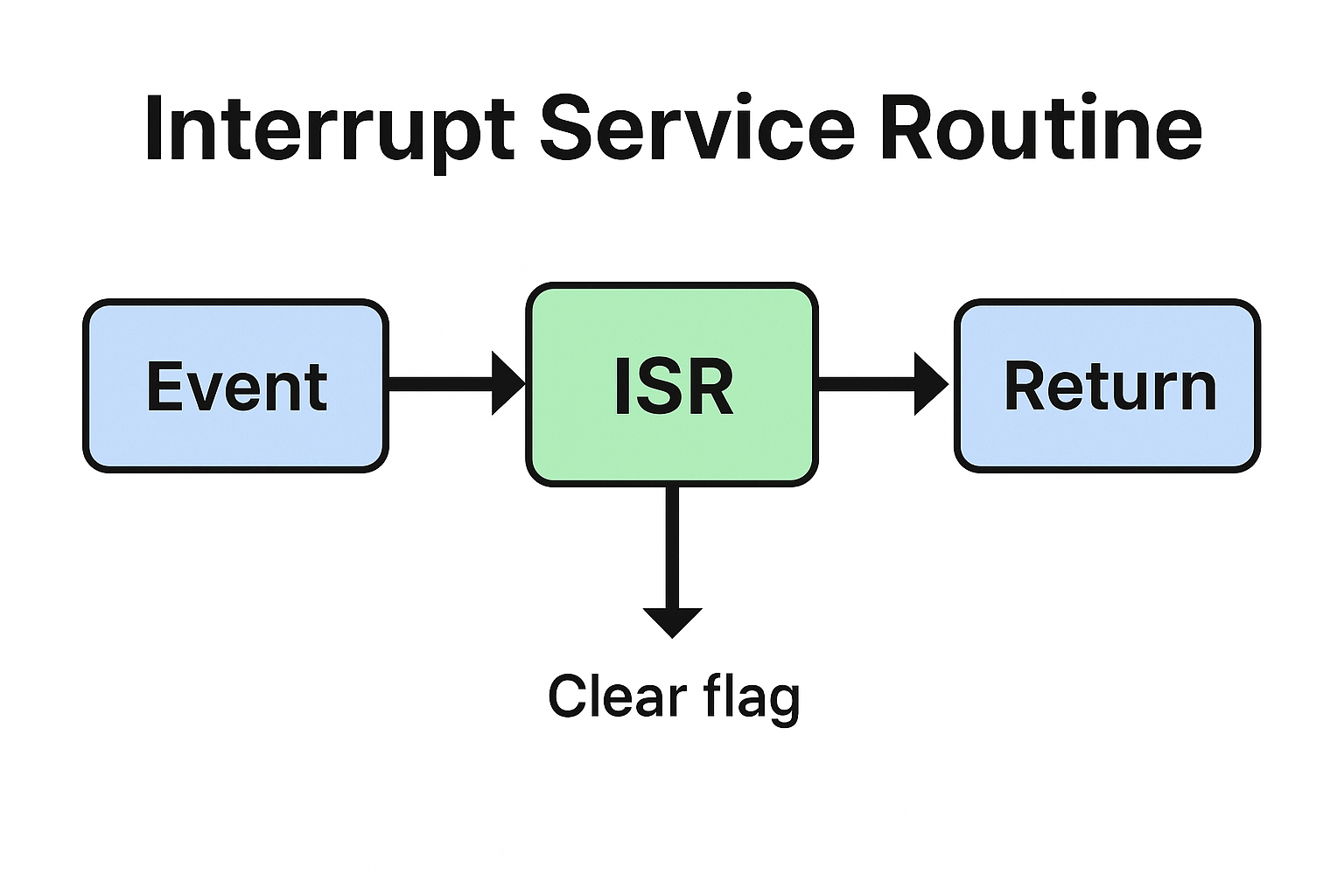
    An Interrupt Service Routine (ISR) is a special block of code that executes when a hardware or software interrupt occurs. Instead of continuously checking a condition (polling), the system pauses its normal execution and jumps to the ISR to handle the event immediately.

    Example: When you press a button on a microcontroller, an interrupt occurs, and the ISR handles the button press.
    Interview Questions on Interrupt Service Routine
    Top Interview Questions on Interrupt Service Routine (ISR) Master Embedded Interview Guide (2025)

    Common Interview Questions on Interrupt Service Routine (ISR)

    1. What is an ISR in embedded systems?

    Answer: An ISR is a function that handles interrupts. It is triggered automatically when an interrupt occurs, allowing the CPU to respond quickly to external or internal events.

    2. What are the characteristics of an ISR?

    Answer:

    • Fast execution : Should be short and efficient.
    • No return values : ISR does not return values.
    • No blocking calls : Avoid using functions like delay() inside ISR.
    • Context saving : CPU saves the current state before jumping to ISR.

    3. Can an ISR call another function?

    Answer: Yes, but it should only call lightweight functions. Heavy operations inside ISR may slow down the system and block other interrupts.

    4. What are nested interrupts?

    Answer: Nested interrupts occur when a higher-priority interrupt occurs while another ISR is still running. In such cases, the CPU pauses the current ISR and executes the higher-priority one.

    5. Why should we keep ISRs short?

    Answer: Long ISRs delay the processing of other interrupts. In real-time systems, this can cause missed events and system instability.

    6. What is the difference between ISR and a normal function?

    Answer:

    • ISR executes automatically when an interrupt occurs, while a normal function is called manually.
    • ISR does not return values, while functions can.
    • ISR runs in a special CPU context and must be as short as possible.

    7. Can we use global variables inside ISR?

    Answer: Yes, but they must be declared as volatile so that the compiler does not optimize them. This ensures real-time updates between the ISR and the main program.

    8. What is interrupt latency?

    Answer: Interrupt latency is the time delay between an interrupt request and the start of ISR execution. Low latency is important for real-time systems.

    9. How do you handle multiple interrupts?

    Answer:

    • Assign priority levels to interrupts.
    • Use interrupt vectors to map different ISRs.
    • Ensure critical ISRs are shorter and higher priority.

    10. What are some best practices for writing ISRs?

    Answer:

    • Keep ISRs short and simple.
    • Use global variables carefully (mark them as volatile).
    • Avoid using printf, malloc, or delay inside ISR.
    • Handle only critical tasks inside ISR and defer others to the main loop or task scheduler.

    List of Interview Questions on Interrupt Service Routine (ISR)

    Basic Questions of Interrupt Service Routine interview questions

    1. What is an Interrupt Service Routine (ISR)?
    2. Why do we need ISR in embedded systems?
    3. What are the main features of an ISR?
    4. What is the difference between polling and ISR?
    5. What happens when an interrupt occurs?

    Intermediate Questions of ISR in embedded systems

    1. What are the rules for writing an ISR?
    2. Why should an ISR be short and fast?
    3. Can we use global variables inside ISR?
    4. What is the role of the volatile keyword in ISR?
    5. What is interrupt latency?
    6. Can an ISR return a value? Why or why not?
    7. What is the difference between ISR and a normal function?
    8. Can ISRs be nested? What are nested interrupts?
    9. How does the CPU know which ISR to execute?
    10. What is an interrupt vector table?

    Advanced Questions of common ISR interview questions

    1. How are multiple interrupts handled in a system?
    2. What are interrupt priorities?
    3. What is the difference between maskable and non-maskable interrupts?
    4. What are reentrant and non-reentrant ISRs?
    5. Can we use dynamic memory allocation (malloc/free) inside ISR?
    6. Why is it not recommended to use printf() inside ISR?
    7. What are some common mistakes while writing ISRs?
    8. How do you handle critical tasks inside ISR?
    9. What happens if an ISR takes too long to execute?
    10. How do modern microcontrollers reduce interrupt latency?

    Practical/Implementation Questions of interrupt handling in embedded systems

    1. How do you declare an ISR in C/C++?
    2. How do you enable and disable interrupts in a microcontroller?
    3. What is the difference between hardware and software interrupts?
    4. Can an ISR call another ISR?
    5. How do you share data between ISR and the main program?
    6. What are best practices for writing ISRs?
    7. What tools or debuggers can be used to test ISR execution?
    8. Can an ISR cause a system crash? How?
    9. How does an operating system handle interrupts differently from bare-metal programming?
    10. What is the difference between vectored and non-vectored interrupts?

    1.What is an Interrupt Service Routine (ISR)?

    Ans: An ISR is a special function that executes automatically when an interrupt occurs, allowing the CPU to handle events quickly without polling.

    2.Why do we use ISR in embedded systems?

    Ans: ISR reduces CPU load, improves response time, and makes systems more efficient by handling events only when they occur.

    3. Can an ISR return a value?

    Ans: No, ISRs cannot return values because they are executed by hardware/OS, not called like regular functions.

    4. Why should ISR be short and fast?

    Ans: Long ISRs block other interrupts and can cause system delays or missed events.

    5. Can we use global variables in ISR?

    Ans: Yes, but they should be declared as volatile to ensure real-time updates between ISR and the main program.

    6. What is interrupt latency?

    Ans: Interrupt latency is the time delay between an interrupt request and the start of ISR execution.

    7. Can we use printf or delay inside ISR?

    Ans: No, functions like printf, malloc, or delay should be avoided inside ISR as they are slow and may cause system instability.

    8. What is the difference between ISR and normal function?

    Ans:
    a) ISR executes automatically when an interrupt occurs, while a normal function is called explicitly.
    b) ISR does not return values, while functions can.
    c) ISR runs in a special CPU context.

    9. What are nested interrupts?

    Ans: Nested interrupts occur when a higher-priority interrupt interrupts the execution of a lower-priority ISR.

    10. What are best practices for writing ISRs?

    Ans:
    a) Keep ISRs short and efficient.
    b) Use volatile for shared variables.
    c) Avoid blocking functions.
    d) Handle only critical tasks inside ISR, defer the rest to main loop or task scheduler.
    Interrupt Service Routine
    Interrupt Service Routine (ISR) Definition, Examples, Best Practices Embedded Interview Guide (2025)
  • Differences between RISC and CISC | Master Embedded Interview Guide (2026)

    Differences between RISC and CISC : Discover the differences between RISC and CISC processors, their advantages, disadvantages, and applications in computers and embedded systems. Learn which processor architecture suits your needs

    Differences between RISC and CISC

    In the world of computer architecture, RISC and CISC are two foundational processor designs that have shaped how modern computers work. Understanding these architectures is essential for students, engineers, and tech enthusiasts who want to deepen their knowledge of computer processors and embedded systems. In this article, we will explain what RISC and CISC are, their differences, advantages, disadvantages, and real-world applications.

    What is RISC (Reduced Instruction Set Computer)?

    RISC stands for Reduced Instruction Set Computer. It is a type of microprocessor architecture that uses a small set of simple instructions, allowing the processor to execute instructions faster. The main idea behind RISC is simplicity and efficiency. Each instruction is designed to perform a very basic operation, which typically completes in one clock cycle.

    Key Features of RISC

    • Simplified Instructions: Executes basic instructions only.
    • Uniform Instruction Length: All instructions usually have the same size.
    • Load/Store Architecture: Memory access is done only through specific instructions.
    • Faster Execution: Due to simplicity, pipelines can be implemented efficiently.
    • Low Power Consumption: Less complex hardware reduces energy usage.

    Advantages of RISC

    • High performance for simple instructions.
    • Easier to design and optimize pipelines.
    • Efficient for embedded systems and mobile devices.

    Disadvantages of RISC

    • Requires more instructions to perform complex tasks.
    • Larger program size due to the higher number of instructions.

    Examples of RISC Processors

    • ARM (Advanced RISC Machine)
    • MIPS (Microprocessor without Interlocked Pipeline Stages)
    • SPARC (Scalable Processor Architecture)

    What is CISC (Complex Instruction Set Computer)?

    CISC stands for Complex Instruction Set Computer. Unlike RISC, CISC processors use a large set of instructions, including complex operations that can perform multiple tasks in a single instruction. The main goal of CISC is to reduce the number of instructions per program, even if it increases the complexity of each instruction.

    Key Features of CISC

    • Complex Instructions: Each instruction can perform multiple low-level operations.
    • Variable Instruction Length: Instructions can have different sizes.
    • Memory-to-Memory Operations: Allows operations directly on memory without using registers.
    • Fewer Instructions per Program: Reduces the need for repetitive coding.

    Advantages of CISC

    • Reduced program size.
    • Easier for programmers to implement complex algorithms.
    • More powerful instructions can simplify software development.

    Disadvantages of CISC

    • Slower execution due to instruction complexity.
    • More power consumption and heat generation.
    • Complex design and harder to optimize pipelines.

    Examples of CISC Processors

    • Intel x86 Series
    • VAX (Virtual Address eXtension)
    • IBM System/360

    Differences between RISC and CISC

    FeatureRISCCISC
    Full FormReduced Instruction Set ComputerComplex Instruction Set Computer
    Instruction SetSimple and smallLarge and complex
    ExecutionSingle clock cycle per instructionMultiple clock cycles per instruction
    Memory AccessLoad/Store instructions onlyMemory-to-memory instructions allowed
    Program SizeLargerSmaller
    Hardware ComplexitySimpleComplex
    ExamplesARM, MIPS, SPARCIntel x86, VAX

    Applications of RISC and CISC

    • RISC Processors are commonly used in smartphones, tablets, embedded systems, and IoT devices because of their efficiency and low power consumption.
    • CISC Processors dominate personal computers, servers, and workstations, where performance and complex computations are required.

    Why Understanding RISC and CISC is Important

    Knowing the difference between RISC and CISC helps in:

    • Selecting the right processor architecture for specific applications.
    • Optimizing software for performance and energy efficiency.
    • Understanding the evolution of modern CPUs and embedded systems.

    Conclusion of topic Differences between RISC and CISC

    Both RISC and CISC architectures have their own advantages and use cases. While RISC focuses on simplicity and speed, making it ideal for mobile and embedded devices, CISC emphasizes powerful instructions and ease of programming, making it suitable for desktops and servers. Understanding these architectures is crucial for anyone working in computer engineering, embedded systems, or software development.

    Frequently Asked Questions (FAQ) | Differences between RISC and CISC

    1. What is the difference between RISC and CISC?
    RISC (Reduced Instruction Set Computer) uses a small set of simple instructions executed quickly, while CISC (Complex Instruction Set Computer) uses a large set of complex instructions, often requiring multiple clock cycles.

    2. Which is better, RISC or CISC?
    It depends on the application. RISC is ideal for embedded systems and mobile devices due to efficiency and low power consumption, whereas CISC is suited for desktops and servers requiring complex computations.

    3. What are some examples of RISC processors?
    Popular RISC processors include ARM, MIPS, and SPARC.

    4. What are some examples of CISC processors?
    Common CISC processors include Intel x86 series, VAX, and IBM System/360.

    5. Why do RISC processors use simpler instructions?
    RISC processors focus on simplicity to allow faster execution, efficient pipelining, and lower power consumption.

    6. Does CISC reduce program size?
    Yes, CISC’s complex instructions allow multiple operations in a single instruction, reducing the overall program size.

    7. What is the main application of RISC and CISC architectures?
    RISC is widely used in smartphones, tablets, and IoT devices, while CISC dominates personal computers, servers, and workstations.

    8. Can a processor be both RISC and CISC?
    Modern processors often incorporate hybrid designs, combining RISC efficiency with some complex CISC instructions for compatibility.

    Differences between RISC and CISC
    Differences between RISC and CISC Master Embedded Interview Guide (2025)
  • Master 25 OOPs Interview Questions for Embedded Software Engineers (2026)

    25 OOPs Interview Questions : Are you preparing for your next Embedded Software Engineer interview? A strong foundation in Object-Oriented Programming (OOPs) is critical, especially when working in C++ for embedded systems. In this article, we will explore 25 frequently asked OOPs interview questions, each explained in-depth with examples tailored for embedded systems. These questions are crafted to help you crack interviews at companies like Bosch, Continental, KPIT, Qualcomm, and more.

    25 OOPs Interview Questions

    Why OOPs in Embedded Software?

    Object-Oriented Programming helps embedded developers to:

    • Organize complex code
    • Promote reusability and modularity
    • Simplify maintenance and debugging
    • Support real-time performance with modern C++ features

    Top 25 OOPs Interview Questions for Embedded Software Engineers

    1. What is Object-Oriented Programming (OOP)?

    Object-Oriented Programming is a programming paradigm based on the concept of objects. Each object is an instance of a class, which encapsulates data and functions. OOP promotes reusability, modularity, and encapsulation — all essential for embedded systems where code efficiency and scalability matter.

    2. What are the main principles of OOP?

    There are four major principles:

    • Encapsulation: Hides internal details, exposes functionality
    • Abstraction: Shows only essential features
    • Inheritance: Reuses code across similar classes
    • Polymorphism: Allows function overloading and overriding

    3. How is OOP different in embedded systems compared to desktop systems?

    Embedded systems have limited memory and processing power, so OOP features must be used judiciously. For example, virtual functions and dynamic memory allocation can impact performance and are often avoided or replaced with static polymorphism (CRTP).

    4. What is a class and object?

    • Class: A blueprint defining data members and member functions
    • Object: A runtime instance of a class
    class LED {
      int pin;
    public:
      LED(int p): pin(p) {}
      void on() { digitalWrite(pin, HIGH); }
    };
    LED led1(13);
    

    5. What is encapsulation? How is it useful in embedded?

    Encapsulation hides implementation details, making code safer and modular. In embedded systems, it helps to limit direct hardware access and prevent bugs.

    6. Explain access specifiers: public, private, protected

    • public: Accessible from anywhere
    • private: Accessible only within the class
    • protected: Accessible in class and its derived classes

    7. What is constructor and destructor in C++?

    • Constructor: Automatically invoked when an object is created
    • Destructor: Automatically called when object goes out of scope
      Used in embedded for initializing hardware and releasing resources.

    8. What is constructor overloading?

    You can define multiple constructors with different parameters:

    class Timer {
    public:
      Timer() {}
      Timer(int delay) { /* Init with delay */ }
    };
    

    9. What is a copy constructor?

    It creates a copy of an object. Useful in embedded when passing objects by value.

    10. What is inheritance and how is it used?

    Inheritance allows creating new classes from existing ones, improving code reuse.

    class Sensor { /* Base */ };
    class TempSensor: public Sensor { /* Derived */ };
    

    11. What is function overloading vs overriding?

    • Overloading: Same function name, different parameters
    • Overriding: Redefining a base class method in a derived class using virtual

    12. What are virtual functions?

    Used for runtime polymorphism. In embedded systems, they should be used cautiously due to the added vtable overhead.

    13. What is pure virtual function and abstract class?

    A pure virtual function makes a class abstract. It’s used to enforce interfaces.

    class Interface {
    public:
      virtual void init() = 0;
    };
    

    14. What is static polymorphism?

    Also known as compile-time polymorphism, achieved using templates or function overloading. Preferred in embedded to avoid runtime overhead.

    15. What are friend functions and classes?

    They bypass encapsulation. Use only when needed in embedded code to access private data (e.g., during low-level hardware debugging).

    16. What is the ‘this’ pointer?

    Points to the current object. Used for object chaining or distinguishing between member and local variables.

    17. What are static data members and static functions?

    • Shared across all objects
    • Useful in embedded for tracking hardware state or shared resources

    18. What is the difference between composition and inheritance?

    • Inheritance: “is-a” relationship
    • Composition: “has-a” relationship

    Prefer composition in embedded to keep class hierarchy shallow and manageable.

    19. What is multiple inheritance and why is it risky?

    A class inherits from more than one base class. Risky in embedded due to ambiguity and complexity. Use interfaces or composition instead.

    20. What is object slicing?

    Occurs when an object of a derived class is assigned to a base class object, losing the derived part. Avoid this in embedded systems by using pointers or references.

    21. What is the role of constructors in embedded hardware abstraction?

    Constructors are used to initialize hardware resources, such as pins, registers, or peripherals, when objects are created.

    22. How do you implement state machines using OOPs in embedded systems?

    Using inheritance and polymorphism, each state can be a class, and transitions can be managed via function calls — clean and scalable.

    23. What is CRTP (Curiously Recurring Template Pattern)?

    Used in embedded systems for static polymorphism without runtime cost.

    template<typename Derived>
    class Base {
      void doSomething() {
        static_cast<Derived*>(this)->impl();
      }
    };
    

    24. How does OOP help in hardware abstraction?

    You can abstract hardware modules (UART, SPI, ADC) as classes with clean interfaces. This decouples application logic from hardware-specific code.

    25. What OOP features should be avoided or used carefully in embedded C++?

    Avoid:

    • Heap allocation (new, delete)
    • Virtual functions in performance-critical paths
    • RTTI and exceptions (not always supported in embedded toolchains)

    Final Thoughts

    Understanding OOPs concepts in C++ for embedded systems is vital to writing clean, maintainable, and scalable code. While embedded software places some constraints on typical OOP usage, modern C++ (especially C++17 and C++20) enables powerful yet efficient patterns suitable for real-time applications.

    If you are preparing for an embedded systems interview, these 25 OOPs interview questions will strengthen your understanding and help you ace your technical rounds.

    Master 25 OOPs Interview Questions for Embedded Software Engineers
    Master 25 OOPs Interview Questions for Embedded Software Engineers (2025)