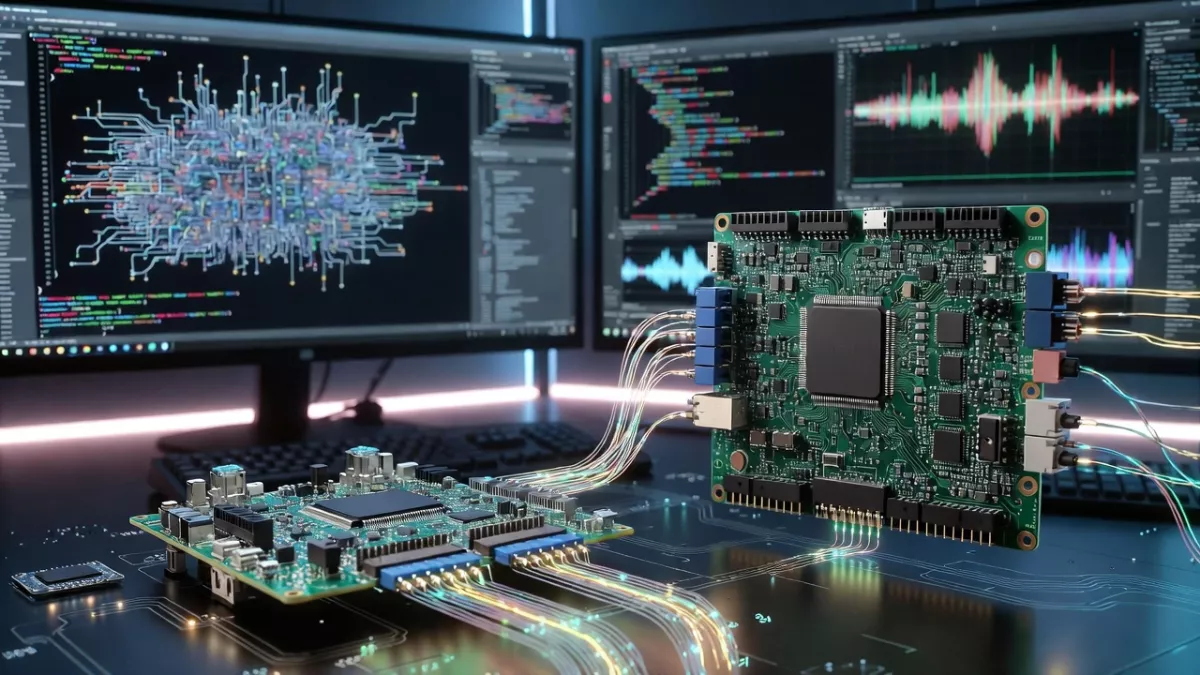
Master FreeRTOS interview questions from beginner to advanced with examples, task management, interrupts, and inter-task communication guide.
If you’re preparing for an embedded systems interview or just want to strengthen your understanding of FreeRTOS, this guide is for you. We’ll cover freertos interview questions from basic to advanced, along with examples, practical insights, and tips that will make you confident in any discussion.
1. FreeRTOS Introduction
FreeRTOS explained: FreeRTOS is a real-time operating system designed for microcontrollers and embedded systems. It allows multiple tasks to run concurrently, providing mechanisms for task scheduling, inter-task communication, and real-time responsiveness.
Why use FreeRTOS instead of bare-metal programming?
- Simplifies task management
- Provides synchronization primitives like queues and semaphores
- Ensures predictable timing for real-time applications
- Reduces complexity while remaining lightweight
Common Interview Question:
“What is FreeRTOS and why is it used in embedded systems?”
Answer: FreeRTOS is a real-time operating system that allows multitasking, inter-task communication, and real-time scheduling. It simplifies embedded software design, provides better resource management, and ensures timely response in real-time applications.
2. Features of FreeRTOS
Understanding FreeRTOS features is a must for interviews.
Key features of FreeRTOS:
- Multitasking: Allows creation of multiple independent tasks with their own stacks.
- Flexible Scheduling: Supports both preemptive and cooperative scheduling.
- Inter-task Communication: Queues, semaphores, mutexes, task notifications, event groups.
- Interrupt Handling: Safe interaction with ISRs using “FromISR” API variants.
- Low Memory Footprint: Optimized for microcontrollers with limited resources.
- Tickless Mode: For low-power applications.
Interview Tip: When asked about features, explain both functionality and why it matters in embedded systems.
3. FreeRTOS Task and Scheduler
How tasks work: Each task has its own stack and context (registers, program counter). The scheduler decides which task runs based on priority.
Context switching: When a higher-priority task becomes ready, the current task’s context is saved, and the new task’s context is restored. This ensures timely execution of critical tasks.
Common Interview Questions:
- “Explain FreeRTOS task scheduling and context switching.”
- “What happens when two tasks have the same priority?” — Time-slicing (round-robin) ensures fair CPU usage.
4. Inter-Task Communication
FreeRTOS provides multiple mechanisms to exchange data and synchronize tasks.
Mechanisms:
- Queues: FIFO buffers for sending data between tasks.
- Semaphores / Mutexes: Synchronization and resource protection. Mutexes support priority inheritance.
- Task Notifications: Lightweight signaling for single tasks.
- Stream / Message Buffers: Variable-length byte streams for complex data exchange.
Example: Sensor task sends data to a logger task via a queue. The logger retrieves data and processes it asynchronously.
Interview Tip: Be ready to explain when to use a queue, semaphore, or task notification based on performance and complexity.
5. FreeRTOS and Interrupts
Interrupt handling in FreeRTOS:
- Use “FromISR” API variants (
xQueueSendFromISR,xTaskNotifyFromISR) for safe interaction with tasks. - Keep ISRs short; defer heavy processing to tasks.
- Proper interrupt priority configuration is crucial.
freertos irq handler example:
- ISR reads a hardware register, signals a task using
xTaskNotifyFromISR, and callsportYIELD_FROM_ISRif a higher-priority task is ready.
Common Interview Questions:
- “How does FreeRTOS handle interrupts?”
- “What are the rules for using FreeRTOS APIs in ISRs?”
6. FreeRTOS Examples
6.1 Simple Task Example
void vLEDTask(void *pvParameters) {
    for (;;) {
        toggleLED();
        vTaskDelay(pdMS_TO_TICKS(500));
    }
}

int main(void) {
    hardwareInit();
    xTaskCreate(vLEDTask, "LED", 128, NULL, 1, NULL);
    vTaskStartScheduler();
    for (;;);
}
6.2 Inter-Task Communication Example
QueueHandle_t xSensorQueue;

void vSensorTask(void *pvParameters) {
    int value;
    for (;;) {
        value = readSensor();
        xQueueSend(xSensorQueue, &value, portMAX_DELAY);
        vTaskDelay(pdMS_TO_TICKS(100));
    }
}

void vLoggerTask(void *pvParameters) {
    int data;
    for (;;) {
        if (xQueueReceive(xSensorQueue, &data, portMAX_DELAY) == pdPASS) {
            logValue(data);
        }
    }
}

int main(void) {
    hardwareInit();
    xSensorQueue = xQueueCreate(10, sizeof(int));
    xTaskCreate(vSensorTask, "Sensor", 128, NULL, 2, NULL);
    xTaskCreate(vLoggerTask, "Logger", 128, NULL, 1, NULL);
    vTaskStartScheduler();
    for (;;);
}
7. Checking Task State
freertos check if task is running: Use eTaskGetState(TaskHandle_t taskHandle) to get the state (running, ready, blocked, suspended, deleted).
Interview Tip: Always explain the context — checking task state is useful for debugging or monitoring in embedded systems.
8. FreeRTOS Drivers Example
freertos driver example: A UART driver can use ISR + queue/task notification pattern. ISR reads data and notifies a processing task, which handles the logic, logs, or sends responses.
Interview Tip: You may be asked to design driver + FreeRTOS task architecture. Explain ISR-task separation, concurrency, and resource management.
9. FreeRTOS Requirements
freertos requirements:
- Microcontroller with sufficient RAM for kernel, task stacks, and queues.
- Proper timer hardware for tick generation.
- Stack sizes assigned per task.
- Interrupt priorities configured correctly.
- Optional: POSIX layer for abstraction (freertos+posix).
Interview Tip: Know memory, timing, and ISR constraints — interviewers may ask how you handle limited resources.
10. Advanced FreeRTOS Interview Questions for Experienced
- How to avoid priority inversion?
- Explain tickless idle and low-power modes.
- Difference between static and dynamic memory allocation in FreeRTOS.
- Designing robust driver-task systems for multiple peripherals.
- How FreeRTOS + POSIX abstraction works.
freertos interview questions for experienced often explore trade-offs, pitfalls, and real-world embedded design.
11. Common Pitfalls
- Using normal APIs in ISR
- Blocking high-priority tasks
- Insufficient task stack size
- Heap fragmentation
- Poor interrupt priority configuration
- Heavy ISR processing
12. FreeRTOS Guide Summary
- Understand tasks, scheduling, and context switching
- Master inter-task communication and synchronization primitives
- Know how to integrate ISR and tasks safely
- Be ready for both beginner and experienced questions
- Practice small code examples and design patterns
Beginner Level FreeRTOS Interview Questions
- What is FreeRTOS and why is it used?
- Explain the features of FreeRTOS.
- What are tasks in FreeRTOS?
- How does FreeRTOS scheduling work?
- What is the difference between preemptive and cooperative scheduling?
- What are the states of a FreeRTOS task?
- How do you create a task in FreeRTOS? (freertos task example)
- What is the role of
vTaskStartScheduler()? - What is the tick rate in FreeRTOS?
- What are queues in FreeRTOS?
- What are semaphores and mutexes in FreeRTOS?
- How is memory allocated for tasks? (static vs dynamic)
- What is a Task Handle in FreeRTOS?
- How to check if a task is running? (freertos check if task is running)
- Explain basic FreeRTOS inter-task communication (freertos inter task communication).
Intermediate Level FreeRTOS Interview Questions
- How does FreeRTOS handle interrupts? (freertos and interrupts)
- What is the difference between ISR and normal task functions in FreeRTOS?
- Explain
FromISRAPI in FreeRTOS. (freertos irq handler, freertos interrupt example) - What is priority inversion and how to avoid it?
- What is a tickless idle mode?
- How do queues and semaphores differ?
- What are event groups in FreeRTOS?
- How to implement a periodic task?
- How to suspend, resume, or delete a task?
- Explain FreeRTOS timers and their use cases.
- How to implement mutual exclusion with mutexes?
- How to debug tasks and monitor their state?
- Explain FreeRTOS heap management schemes (heap_1, heap_2, heap_4).
- Difference between blocking and non-blocking calls.
- How to safely communicate between an ISR and a task?
Advanced Level FreeRTOS Interview Questions
- How does FreeRTOS manage context switching?
- How to optimize FreeRTOS for low-power applications?
- How to handle multiple peripherals with a single FreeRTOS task?
- Explain FreeRTOS + POSIX abstraction. (freertos+posix)
- How do you implement a custom FreeRTOS driver? (freertos driver example)
- Explain the difference between static and dynamic memory allocation in FreeRTOS.
- How to implement real-time scheduling for critical tasks?
- What is the difference between a queue and a stream buffer/message buffer?
- How to monitor CPU utilization and stack usage in FreeRTOS?
- How to design a robust ISR-task communication system?
- How to handle priority inheritance with nested mutexes?
- What are the limitations of FreeRTOS in high-performance systems?
- How to migrate a bare-metal system to FreeRTOS?
- How to implement fault-tolerant tasks?
- Explain advanced FreeRTOS debugging techniques and runtime statistics.
Practical/Scenario-Based Questions
- How would you design a sensor-data logger using FreeRTOS tasks and queues?
- Implement an LED blink task with FreeRTOS.
- How would you handle UART data reception in an ISR and process it in a task?
- How to prioritize tasks in a multi-peripheral system?
- How to avoid deadlocks in FreeRTOS?
- How to implement inter-task notifications for event signaling?
- How would you monitor and recover a stuck task?
- How to integrate FreeRTOS with low-power sleep modes?
- How to schedule periodic and aperiodic tasks together?
- How to implement a watchdog using FreeRTOS tasks?
By following this freertos guide, you’ll confidently handle freertos interview questions and answers, practical examples, and demonstrate real-world embedded system knowledge.
Frequently Asked Questions (FAQ) on FreeRTOS
1. What is FreeRTOS and why is it used?
Answer: FreeRTOS is a lightweight real-time operating system for microcontrollers and embedded systems. It enables multitasking, predictable timing, and easy inter-task communication, making embedded software design simpler and more reliable.
2. What are the main features of FreeRTOS?
Answer: FreeRTOS features include preemptive and cooperative scheduling, task management, inter-task communication via queues and semaphores, low memory footprint, support for interrupts, and optional POSIX abstraction (freertos+posix).
3. How do you create a task in FreeRTOS?
Answer: Use xTaskCreate() to define a task with a name, stack size, parameters, priority, and a task handle. After creating tasks, start the scheduler with vTaskStartScheduler().
Example:
xTaskCreate(vLEDTask, "LED", 128, NULL, 1, NULL);
vTaskStartScheduler();
4. How does FreeRTOS handle inter-task communication?
Answer: FreeRTOS provides queues, semaphores, mutexes, task notifications, and event groups for inter-task communication. Queues are FIFO buffers, semaphores protect resources, and task notifications allow lightweight signaling.
5. What is a FreeRTOS queue and when should it be used?
Answer: A queue is a FIFO data structure used to send data safely between tasks. Use queues when tasks need to exchange data asynchronously, for example, sending sensor readings from a sensor task to a logger task.
6. How do interrupts work in FreeRTOS?
Answer: FreeRTOS uses “FromISR” APIs like xQueueSendFromISR and xTaskNotifyFromISR to safely interact with tasks from interrupt service routines (ISRs). Keep ISRs short and defer processing to tasks to maintain real-time performance.
7. How to check if a task is running in FreeRTOS?
Answer: Use eTaskGetState(TaskHandle_t taskHandle) to check a task’s state: running, ready, blocked, suspended, or deleted. This is useful for monitoring or debugging tasks in real-time applications.
8. What is priority inversion and how is it handled in FreeRTOS?
Answer: Priority inversion occurs when a high-priority task waits for a low-priority task holding a resource. FreeRTOS handles this with priority inheritance in mutexes, temporarily raising the low-priority task’s priority to avoid blocking critical tasks.
9. What are FreeRTOS timers and how are they used?
Answer: FreeRTOS provides software timers for executing tasks after a delay or periodically. Timers run in the timer service task and are ideal for periodic events like blinking LEDs or sampling sensors.
10. What is the difference between static and dynamic memory allocation in FreeRTOS?
Answer:
- Static allocation: Task stacks and resources are allocated at compile time; safer for embedded systems with limited memory.
- Dynamic allocation: Resources are allocated at runtime from the heap; flexible but may cause fragmentation.
11. Can FreeRTOS be used with POSIX APIs?
Answer: Yes, FreeRTOS can provide a POSIX-compatible layer (freertos+posix) that allows standard POSIX functions like threads, mutexes, and semaphores, making code migration from POSIX systems easier.
12. What are the best practices when using FreeRTOS in embedded systems?
Answer:
- Use task notifications for lightweight signaling.
- Keep ISRs short and defer processing to tasks.
- Assign adequate stack size for each task.
- Use mutexes with priority inheritance to prevent priority inversion.
- Monitor CPU and stack usage regularly.
- Avoid blocking high-priority tasks for long durations.
If you’re interested in learning more about real-world inter-task communication in embedded RTOS, check out this detailed guide on inter-task communication in QNX RTOS, which explains how tasks safely share data and synchronize.

Mr. Raj Kumar is a highly experienced Technical Content Engineer with 7 years of dedicated expertise in the intricate field of embedded systems. At Embedded Prep, Raj is at the forefront of creating and curating high-quality technical content designed to educate and empower aspiring and seasoned professionals in the embedded domain.
Throughout his career, Raj has honed a unique skill set that bridges the gap between deep technical understanding and effective communication. His work encompasses a wide range of educational materials, including in-depth tutorials, practical guides, course modules, and insightful articles focused on embedded hardware and software solutions. He possesses a strong grasp of embedded architectures, microcontrollers, real-time operating systems (RTOS), firmware development, and various communication protocols relevant to the embedded industry.
Raj is adept at collaborating closely with subject matter experts, engineers, and instructional designers to ensure the accuracy, completeness, and pedagogical effectiveness of the content. His meticulous attention to detail and commitment to clarity are instrumental in transforming complex embedded concepts into easily digestible and engaging learning experiences. At Embedded Prep, he plays a crucial role in building a robust knowledge base that helps learners master the complexities of embedded technologies.