A beginner’s complete guide to lift, drag, thrust, weight, Bernoulli’s principle, Newton’s laws, angle of attack, and everything else that keeps a 900,000-pound metal tube in the sky.
Picture this. You’re sitting in seat 24B, pressed back as the engines roar. The ground blurs outside the window, and then somehow hundreds of tonnes of metal just lifts off the Earth. You’ve seen it a thousand times. You’ve done it yourself. But if someone asked you to explain exactly how it works, most people go quiet.
That’s not a knock on anyone. Flight physics basics are one of those things that sound simple on the surface “wings push air down, plane goes up” but the real answer is layered, fascinating, and way more intuitive than the textbooks make it sound.
In this guide, we’re going deep. Not PhD-dissertation deep deep like the kind of conversation you’d have with an engineer friend who actually explains things without making you feel dumb. By the time you’re done reading, you’ll understand the four forces of flight, why Bernoulli’s principle matters, how Newton’s laws apply to aircraft, what angle of attack actually means, and why commercial jets stay up at 35,000 feet without falling out of the sky.
Fun fact: Flight physics isn’t magic. It’s physics figured out piece by piece over 120 years, starting with two bicycle mechanics from Ohio who refused to believe humans couldn’t fly.
Let’s start from the beginning.
1. Why Does Anything Fly? The Big Picture of Aerodynamics for Beginners
Before getting into forces and equations, let’s frame the problem correctly. For something to fly really fly, not just fall slower — it needs to overcome gravity. That’s the whole game.
Gravity pulls every object downward with a force equal to mass times gravitational acceleration (about 9.8 m/s²). For a Boeing 747 at max takeoff weight (around 412,000 kg), that’s roughly 4 million Newtons of downward force pinning it to the ground.
To get airborne, the aircraft needs to generate an equal or greater upward force. That upward force is called lift. And generating enough lift consistently, controllably, efficiently — is what the entire science of aerodynamics for beginners is really about. According to NASA’s Glenn Research Center Guide to Aerodynamics, aerodynamics affects everything from large airliners to kites — it is simply the study of forces and motion of objects moving through air.
Definition: Aerodynamics is the study of how air moves around objects and what forces that movement creates. It’s a branch of fluid dynamics — because air behaves like a fluid when objects move through it at speed.
Air Is Not Nothing
Here’s something people underestimate: air has mass. At sea level, a cubic meter of air weighs about 1.225 kg. That might not sound like much, but when wings are pushing through thousands of cubic meters of air per second, those interactions add up to millions of Newtons of force.
The key insight in understanding how do airplanes fly is that air resists being moved. When a wing moves through air, the air doesn’t politely step aside. It gets pushed, compressed, accelerated, and deflected — and it pushes back. All of those pushes and pulls, shaped correctly, sum up to lift.
What Makes a Wing Different from a Flat Board?
A flat board held at the right angle will generate some lift. A properly shaped wing called an airfoil does it far more efficiently. The shape matters enormously, and that’s where two of the most important concepts in flight physics enter: Bernoulli’s principle and Newton’s third law. We’ll look at both properly in a moment.
2. The Four Forces of Flight: Lift, Drag, Thrust, and Weight
Every aircraft — from a paper airplane to the Space Shuttle — experiences four fundamental forces during flight. These are the core of flight physics basics explained in a way that actually sticks. As NASA explains, the four forces of flight — lift, weight, thrust, and drag — make an object move up and down, and faster or slower, with the amount of each force compared to its opposing force determining how an object moves through the air.
| Force | Direction | Role |
|---|---|---|
| Lift | Upward, perpendicular to flight path | Counters weight. Generated mainly by wings. |
| Weight | Downward, toward Earth’s center | Always present. Result of gravity acting on aircraft mass. |
| Thrust | Forward, along flight path | Generated by engines or propellers. Overcomes drag. |
| Drag | Backward, opposing forward motion | Air resistance. Created by shape, friction, and lift itself. |
Lift vs. Weight: The Vertical Battle
When lift equals weight, the aircraft maintains altitude. When lift exceeds weight, it climbs. When weight exceeds lift, it descends. Pilots manage this balance constantly — not just by pointing the nose up or down, but by adjusting speed, flap settings, and engine power.
One thing people get wrong: an aircraft doesn’t need to be nose-up to climb. If the engines produce enough thrust and the wings generate surplus lift, a plane can climb while appearing relatively level. Conversely, an aircraft can descend with its nose slightly raised if flying slowly and losing lift.
Thrust vs. Drag: The Horizontal Battle
Thrust is what moves the aircraft forward. Without forward motion, wings can’t generate lift (in conventional fixed-wing aircraft). So thrust is indirectly responsible for keeping the plane up.
Drag is the enemy of efficiency. There are two main types. Induced drag is created as a byproduct of generating lift — it’s unavoidable. Parasite drag is everything else: friction, fuselage shape, landing gear, antennas, rivets. Aircraft designers spend enormous effort reducing parasite drag while managing induced drag through smart wing design. The SKYbrary Aviation Safety article on Lift offers an excellent technical breakdown of how these forces interact in real aircraft operations.
Key insight: When an aircraft is in straight, level, unaccelerated flight, all four forces are balanced: lift = weight, thrust = drag. Pilots call this state “trimmed flight.”
Equilibrium, Climbs, and Descents
In reality, aircraft are almost never in perfect balance — they’re constantly making small adjustments. Autopilot systems in modern commercial jets make these corrections hundreds of times per second. Understanding that flight is dynamic, not static, is one of the first mental shifts that changes how you think about aerodynamics.
3. How Wings Generate Lift: Bernoulli’s Principle and Newton’s Laws Together
This is probably the most misunderstood part of flight physics, and the internet has a bad habit of oversimplifying it. Let’s fix that.
Most school textbooks explain lift using the Bernoulli principle flight explanation alone. The story: the top of a wing is curved, so air traveling over it has farther to go than air along the flat bottom. To “keep up,” the upper air must travel faster. Faster-moving air has lower pressure (Bernoulli’s principle). Lower pressure on top, higher pressure below, pushes the wing upward. Lift!
This isn’t exactly wrong — Bernoulli’s principle is real and pressure differences do create lift. But it’s incomplete. The “equal transit time” assumption (that top and bottom air must arrive at the trailing edge simultaneously) is actually false. Air over the top of a wing arrives significantly earlier than air below — the separation is real, but it’s not explained by equal transit time.
The Bernoulli Principle: What It Actually Says
Daniel Bernoulli was an 18th-century Swiss mathematician who discovered a fundamental relationship between fluid velocity and pressure. As Britannica explains in its overview of Bernoulli’s theorem, the principle states that the total mechanical energy of a flowing fluid — comprising pressure energy, gravitational potential energy, and kinetic energy — remains constant. In practical terms: where a fluid speeds up, pressure decreases, and where it slows down, pressure increases.
Air flowing over the curved upper surface of a wing does speed up — not because it needs to “catch up,” but because the wing’s geometry directs it through a path where the airflow naturally accelerates. This acceleration reduces pressure on top. The higher-pressure air below pushes up. That pressure difference is a real, measurable component of the lift drag thrust weight equation.
But here’s what the Bernoulli-only story misses: it doesn’t fully account for how much lift is actually generated, especially at high angles of attack. That’s where Newton comes in.
Newton’s Third Law and the Deflection of Air
Newton’s third law states that for every action, there is an equal and opposite reaction. When a wing moves through air, it deflects air downward. That’s the action. The reaction is an equal upward force on the wing. That upward force is lift.
This is not a competing explanation to Bernoulli — it’s complementary. The FAA’s official Glider Flying Handbook (Chapter 3) puts it clearly: Newton’s third law describes the overall interaction between atmosphere and wing — as air deflects downward due to interaction with the wing, the wing experiences an upward lifting reaction — while Bernoulli’s principle looks at the effect of air changing speed as it moves past the wing. Together, these models provide a valid and complete explanation of lift.
Mental model: Bernoulli explains the pressure distribution around the wing. Newton explains why the air gets deflected and why that deflection means the wing must be pushed up. Both are right. Both are needed.
Modern aerodynamicists use computational fluid dynamics (CFD) software that models all these effects simultaneously to predict lift with extreme precision. For understanding how wings generate lift, just know: the wing’s shape and angle together cause air to move in ways that create more pressure below than above, and that pressure difference lifts the aircraft.
The Role of Wing Shape: Airfoil Design
Not all airfoils are equal. The shape of a wing’s cross-section — its camber, thickness, and chord length — dramatically affects how much lift it generates, at what speed, and how efficiently.
- Camber: the curvature from leading to trailing edge. More camber means more lift at low speeds — which is why flaps (which increase effective camber) help during takeoff and landing.
- Chord length: the straight-line distance from leading to trailing edge. Longer chord means more wing area interacting with air.
- Thickness: thicker airfoils tolerate higher angles of attack before stalling; thinner airfoils suit high-speed supersonic flight.
- Span: distance from wingtip to wingtip. Longer wings reduce induced drag — hence the long, slender wings on fuel-efficient jets like the Boeing 787.
Fighter jets use thin, often symmetric airfoils for high-speed maneuverability. Commercial jets use thick, cambered airfoils for efficiency at subsonic cruise speeds. Gliders use extremely high-aspect-ratio wings to maximize lift-to-drag ratios and stay airborne for hours.
4. Angle of Attack: The Most Important Variable You’ve Never Heard Of
If there’s one concept in flight physics basics explained properly that changes how you understand flying, it’s angle of attack. Not pitch angle, not nose position — angle of attack. They’re different things, and the difference really matters.
What Is Angle of Attack?
The angle of attack (AoA) is the angle between the chord line of a wing (the straight line from leading edge to trailing edge) and the relative wind — the direction air is actually coming from as seen by the aircraft.
When a pilot pulls back on the controls, they increase the angle of attack. The wing hits the incoming air at a steeper angle, deflects more air downward, and creates more lift. But only up to a point. The FAA’s Pilot’s Handbook of Aeronautical Knowledge — Chapter 5 covers this in detail, including how the FAA now promotes angle of attack indicators as a key safety tool to reduce loss-of-control accidents.
Critical distinction: Pitch angle (how high the nose is pointed) and angle of attack are NOT the same thing. An aircraft can have a low pitch angle but a high angle of attack if it’s descending rapidly. Or a high pitch angle but low angle of attack if climbing at speed.
The Lift Curve: More AoA Means More Lift… Until It Doesn’t
As angle of attack increases from zero, lift increases in a nearly linear fashion. More AoA means more air deflected downward, means more lift. This is the good part.
But at a certain critical angle — typically around 15 to 20 degrees for most subsonic aircraft — something bad happens. The airflow over the top of the wing can no longer follow the wing’s contour. It separates, becomes turbulent and chaotic, and stops generating lift. This is called a stall.
A stall has nothing to do with the engine quitting. It’s purely an aerodynamic event — the wing stops making lift because angle of attack is too high. A stall can happen at any airspeed, any attitude, any power setting. It’s purely a function of exceeding the critical angle of attack.
This is why stall training is one of the most fundamental parts of pilot education, and why commercial jets have angle of attack indicators and stick shakers — physical warnings that shake the control column to tell pilots they’re approaching the stall boundary.
Low-Speed Flight and High-Lift Devices
At low speeds, wings generate less lift. To compensate during takeoff and landing, pilots extend flaps, slats, and other high-lift devices. These increase the wing’s effective camber and area, allowing it to generate more lift at lower airspeeds — but they also increase drag, which is acceptable close to the ground at low speeds.
5. Newton’s Laws of Motion Applied to Aircraft: All Three of Them
We touched on Newton’s third law, but Newton’s laws of flight show up across every aspect of aviation. Let’s go through all three with concrete aircraft examples — because this is where aerodynamics stops being abstract and starts making real-world sense.
Newton’s First Law: Inertia and Straight-Line Flight
An object in motion stays in motion in a straight line at constant velocity unless acted on by an unbalanced force. For aircraft: in a perfect vacuum with no gravity and no air resistance, a plane would fly straight forever at the same speed without any thrust.
Reality is messier. Gravity constantly pulls the aircraft down. Drag constantly slows it. So pilots must continuously apply thrust and manage control surfaces to counteract these forces. The autopilot does this automatically on modern airliners, applying hundreds of tiny adjustments per second.
Newton’s Second Law: Force, Mass, and Acceleration
Force equals mass times acceleration (F = ma). This is the most quantitatively useful law for engineers.
In level flight, the net force in every direction is zero — no acceleration because the four forces are balanced. The moment any force becomes unbalanced, the aircraft accelerates in that direction. Pilots use this constantly during maneuvers.
This law also explains why heavier aircraft need longer runways. More mass requires more force (thrust) to reach takeoff speed. With fixed engine thrust, more mass means slower acceleration and a longer ground roll before the wings generate enough lift to become airborne.
Newton’s Third Law: Action-Reaction Throughout Aviation
Every action has an equal and opposite reaction. We covered how wings deflect air down to create upward lift. But this law appears everywhere in aviation:
- Propeller thrust: a propeller accelerates air backward. That airflow pushes the aircraft forward.
- Helicopter rotors: blades deflect air downward to generate lift. The torque reaction spins the helicopter body in the opposite direction — which is why helicopters need a tail rotor.
- Rocket propulsion: rockets expel hot gas backward at enormous velocity. The reaction accelerates the rocket forward — even in space where there’s no air to push against.
Myth buster: A jet engine doesn’t “push against air.” It accelerates mass backward. The reaction pushes the engine forward. In space, rockets work the same way — they carry their own oxidizer since there’s no atmospheric oxygen to burn.
6. How Engines Work: Generating Thrust in Different Ways
Lift gets the aircraft up. Thrust keeps it moving. Without forward motion in a conventional fixed-wing aircraft, there is no lift. Understanding how engines generate thrust completes the picture of how does an aircraft stay up from a full systems perspective.
Piston Engines and Propellers
The Wright Brothers’ Flyer used a piston engine driving a propeller. Piston engines burn fuel in cylinders to drive pistons, which rotate a crankshaft, which turns a propeller. The propeller is just a rotating wing — it generates thrust the same way a wing generates lift, by accelerating air backward.
Piston engines dominate general aviation. They’re simple, relatively lightweight, and efficient at low altitudes. But they lose efficiency rapidly at high altitude because thinner air provides less oxygen to burn fuel.
Gas Turbine Engines: Turboprops, Turbofans, and Turbojets
Commercial aviation runs on gas turbines. These work on the Brayton cycle: compress air, mix with fuel, ignite, expand rapidly through a turbine. The turbine drives the compressor (and in turboprops, the propeller). Exhaust provides additional thrust.
The turbofan dominates modern commercial jets. It has a large fan at the front that moves enormous amounts of air. Some goes through the combustion chamber (the core). Most bypasses it entirely (bypass flow). The ratio of bypass to core flow is the bypass ratio.
High bypass ratio engines (like the GE9X at over 10:1) are far more fuel-efficient at subsonic cruise speeds and significantly quieter. Low bypass ratio engines, used in military fighters, trade efficiency for raw thrust at supersonic speeds.
The Thrust Equation
Thrust is fundamentally about momentum change: Thrust = mass flow rate × (exit velocity − inlet velocity). To maximize thrust, you either increase how much air you move or how fast you accelerate it. High-bypass turbofans move a lot of air at moderate velocity — efficient and quiet. Turbojets move less air at very high velocity — powerful but fuel-hungry.
7. Drag: The Force Nobody Wants But Everybody Gets
Drag is the aerodynamic force that opposes forward motion through air. Understanding drag determines fuel burn, range, top speed, and aircraft design. Reducing drag while maintaining lift is the central engineering challenge in aviation.
Parasite Drag
Parasite drag is generated by the aircraft’s physical presence in the airstream, regardless of what the wings are doing. It has two main components.
Form drag comes from the aircraft’s shape. A blunt nose creates far more form drag than a streamlined one — which is why aircraft have pointed noses, streamlined fuselages, and retractable landing gear.
Skin friction drag comes from air molecules sliding along the aircraft’s surface. As described in the FAA Pilot’s Handbook of Aeronautical Knowledge summary, the boundary layer between the wing and the free-stream airflow is only about as wide as a playing card — but aircraft designers still remove protrusions and use flush-mount rivets to reduce friction, because every bit of skin friction drag costs fuel over millions of flight hours.
Parasite drag increases with the square of airspeed. Double the speed, quadruple the parasite drag. This is why supersonic flight consumes disproportionately more fuel.
Induced Drag
Induced drag is created as a direct consequence of generating lift. It’s unavoidable whenever a wing is making lift. When a wing generates lift, the pressure difference between top and bottom causes air to curl around the wingtips from below to above, creating swirling vortices. These wingtip vortices tilt the lift vector slightly backward — and that backward tilt is induced drag.
Induced drag increases as airspeed decreases. At low speeds during takeoff and landing, induced drag is dominant. At high cruise speeds, parasite drag takes over. SKYbrary’s article on Bernoulli’s principle provides a detailed technical look at how pressure distributions across the wing surface contribute to both lift and the induced drag penalty that comes with it.
Real-world application: The winglets on modern commercial jets aren’t just aesthetic. They reduce the strength of wingtip vortices, cutting induced drag by 3–5%. Over a fleet of hundreds of aircraft flying millions of hours, that’s an enormous fuel saving — and the math pencils out quickly for airlines.
The Total Drag Curve and Minimum Drag Speed
Because parasite drag increases with speed and induced drag decreases with speed, there’s a speed at which total drag is minimized. This is called L/D max — the speed of maximum lift-to-drag ratio. Flying at L/D max gives the aircraft its best glide ratio (critical in engine-out emergencies) and is often close to the most fuel-efficient cruise speed.
8. Stability and Control: How Aircraft Stay Straight
An aircraft doesn’t just need to fly. It needs to fly predictably and return to stable flight when disturbed by turbulence or pilot inputs. This is where stability and control come in — two related but distinct concepts in flight physics basics.
Axes of Rotation: Roll, Pitch, and Yaw
Aircraft rotate around three axes, each controlled by different surfaces:
- Pitch: nose up or nose down, controlled by the elevator. Pitching changes the angle of attack.
- Roll: banking left or right, controlled by ailerons near the wingtips. Rolling tilts the lift vector, causing the aircraft to turn.
- Yaw: nose left or right, controlled by the rudder on the vertical tail. Important during turns and crosswind landings.
In a coordinated turn, the pilot uses ailerons (roll) and rudder (yaw) together while adding back pressure on the elevator (pitch) to maintain altitude. Three-axis control happening simultaneously — which is why flight simulators are genuinely hard to fly realistically.
Longitudinal Stability: Why the Tail Exists
The horizontal stabilizer — the small wing on the tail — produces downward lift. This sounds counterintuitive. Why generate downward force?
Because the aircraft’s center of lift is typically behind its center of gravity, creating a nose-down pitching moment. The horizontal tail counters this by producing a downward force that creates a nose-up moment. It’s like a see-saw where the tail pushes down to keep everything level.
This design also creates positive longitudinal stability. If the nose pitches up due to a gust, the changing aerodynamic forces naturally tend to push it back down. The aircraft self-corrects — a property called static longitudinal stability.
Fly-by-Wire: When Computers Take Over
Some aircraft — the F-16 and many airliners like the Airbus A320 family — are designed to be aerodynamically unstable. Left to themselves, they would tumble out of control. Computers making thousands of corrections per second make them appear perfectly stable to the pilot.
An aerodynamically unstable aircraft is inherently more maneuverable. Military aircraft exploit this for extreme agility. Commercial fly-by-wire systems use envelope protection — the computers simply won’t allow the aircraft to exceed structural or aerodynamic limits regardless of what the pilot does.
9. High-Speed Flight: Transonic Flight, Compressibility, and the Sound Barrier
Everything above applies comfortably to subsonic flight. But at speeds approaching and exceeding Mach 1, new physical effects emerge that fundamentally change the aerodynamics. This is where flight physics basics explained gets genuinely mind-bending.
What Is the Speed of Sound and Why Does It Matter?
The speed of sound at sea level and 15°C is about 343 m/s (roughly 1,235 km/h). At altitude, where air is colder, it’s lower — around 295 m/s at 35,000 feet. Sound travels as pressure waves through air. When an aircraft approaches the speed of sound, it’s approaching the speed at which it can “warn” the air ahead of it that it’s coming.
At subsonic speeds, pressure waves propagate ahead of the aircraft, letting air start adjusting. As the aircraft approaches Mach 1, these waves bunch up. At exactly Mach 1, the aircraft keeps pace with its own pressure waves — they pile up at the nose, creating a shock wave.
Transonic Flight and the Drag Rise
Most commercial jets cruise at Mach 0.78 to 0.85. Even at these speeds, air over the curved wing surfaces accelerates to local supersonic speeds — creating pockets of supersonic flow that terminate in shock waves. This is the transonic regime.
These shock waves cause a dramatic increase in drag — wave drag. Early jets pushing into this regime experienced severe drag increases and control problems. This is what people called the “sound barrier” — not a physical wall, but a barrier of rapidly increasing drag that early aircraft couldn’t overcome.
The solution was swept wings. By sweeping the wings back, designers reduced the component of airspeed perpendicular to the leading edge, delaying the onset of local supersonic flow. Almost every commercial jet and military aircraft uses swept wings for this reason.
Supersonic Flight: Shock Waves and Sonic Booms
Once an aircraft exceeds Mach 1, it flies faster than its own pressure waves. It creates a cone-shaped shock wave — the Mach cone. This shock wave carries enormous energy and, when it reaches the ground, is heard as a sonic boom — a continuous phenomenon as long as the aircraft is supersonic, not a one-time event.
Fascinating fact: The Concorde cruised at Mach 2.04 — twice the speed of sound — at 60,000 feet. The airframe heated to over 120°C from aerodynamic friction. Its distinctive drooping nose extended for takeoff and landing visibility, then retracted for the needle-nosed shape needed to minimize supersonic drag.
10. Atmosphere and Altitude: How the Air Changes Everything
Aircraft don’t fly in a uniform medium. The atmosphere changes dramatically with altitude, affecting every aspect of flight performance. This is why what keeps a plane in the air at sea level involves different engineering considerations than what keeps it flying at 40,000 feet.
The Atmosphere in Layers
Commercial aviation takes place in the troposphere (ground to about 36,000 feet) and the lower stratosphere (above 36,000 feet). The boundary between them is the tropopause.
In the troposphere, temperature decreases with altitude at about 2°C per 1,000 feet. Weather happens here. Above the tropopause, temperature stabilizes. Commercial jets often cruise just above or at the tropopause to escape weather turbulence and get the efficiency benefits of cold, still air.
Density Altitude: The Number Pilots Really Care About
Air density decreases with altitude. Less dense air means fewer air molecules per cubic meter — which means wings generate less lift for a given speed, and engines produce less thrust because there’s less oxygen to burn. As the NASA Technical Report on Aerodynamics (NASA SP-367) explains, air density is a very important factor in lift, drag, and engine power output, and it depends on both temperature and local pressure — not just altitude alone.
Density altitude is the altitude your aircraft performs as if it were at, corrected for temperature and pressure. On a hot day at a high-elevation airport, the density altitude can be thousands of feet higher than actual elevation. Takeoffs from Denver (elevation ~5,400 feet) on a hot summer day require significantly longer runways and more speed than sea-level departures on a cool day.
Density altitude accidents are tragically common in general aviation. Pilots who don’t account for performance degradation in hot, high conditions attempt takeoffs their aircraft can’t complete.
Cruise Altitude: Why 35,000 Feet?
Commercial jets cruise at high altitudes for three reasons. First, thinner air means less parasite drag, allowing high speeds with less thrust. Second, engines are more efficient in cold, thin air. Third, weather is more predictable above the troposphere.
But altitude has limits. Above a certain point, the stall speed (minimum speed for controlled flight) approaches the maximum operating speed (above which structural damage could occur). The range between these narrows until there’s no margin left — the aerodynamic ceiling, typically around 40,000–45,000 feet for commercial jets.
11. Takeoff and Landing: Flight Physics in the Most Critical Phases
Takeoff and landing are when flight physics becomes most consequential. Most accidents occur in these phases, not during cruise. Understanding why helps explain everything from runway length calculations to approach procedures.
Takeoff Physics
During the takeoff roll, the aircraft accelerates down the runway. Wings start generating lift as soon as there’s airflow — but not enough to lift off until rotation speed (Vr) is reached. At Vr, the pilot pulls back, increasing angle of attack, generating enough lift to become airborne.
The critical speed is V1 — the decision speed. Before V1, if an engine fails, the pilot aborts the takeoff. After V1, even with an engine failure, the aircraft must continue — there’s no longer enough runway to stop. Calculating V1, Vr, and V2 (initial climb speed) for every takeoff, accounting for weight, runway length, elevation, temperature, and wind, is a precise science governed by FAA regulations and performance standards.
Landing Physics
Landing is, in one sense, a controlled stall near the ground. The pilot gradually reduces speed on approach, keeping the aircraft just above its stall speed, then flares (raises the nose) just before touchdown to reduce descent rate. The flare increases angle of attack, generating a brief moment of extra lift that slows the descent for a gentler touchdown.
Crosswind landings are a beautiful demonstration of multi-axis control. The pilot simultaneously uses rudder to align the nose with the runway centerline, ailerons to counteract sideways drift, and elevator to control descent rate — all while the wind is trying to push the aircraft sideways.
Autoland systems on modern commercial jets can land automatically in near-zero visibility. Cat III ILS approaches allow landings where the pilot literally cannot see the runway until the wheels are almost on it.
12. Stalls, Spins, and How Pilots Handle Them
Stalls deserve a deeper look — understanding them is one of the most important safety concepts in aviation, and one that’s frequently misunderstood by non-pilots.
Aerodynamic Stalls
A stall occurs when the critical angle of attack is exceeded. Airflow over the wing separates, turbulence replaces smooth laminar flow, and lift drops dramatically. The aircraft begins to descend.
In training, student pilots learn to recognize approaching stall symptoms: decreasing airspeed, mushy controls, buffeting (shaking caused by turbulent airflow hitting the tail), and the stall warning horn or stick shaker. Recovery is counterintuitive: reduce the angle of attack (lower the nose), add power, and as airspeed recovers, climb.
The counterintuitive part: when stalling and losing altitude, the instinct is to pull back harder. But that increases angle of attack further, deepening the stall. The correct recovery is to push forward — trust the physics, lower the nose, recover flying speed.
Accelerated Stalls and Overbanked Turns
The critical angle of attack doesn’t change — but the speed at which you reach it does. In a steep turn, the wing must generate more lift to maintain altitude. Without enough speed, the wing can stall at a much higher speed than in level flight — an accelerated stall.
In a 60-degree bank turn, the aircraft needs twice its normal lift. Stall speed increases by about 41%. In a 75-degree bank, the stall speed doubles — and most aircraft aren’t stressed to handle four times their weight in lift forces consistently. This is covered in detail in the FAA’s aviation aerodynamics documentation, which explains how load factor increases rapidly as bank angle increases, with stall speed rising in proportion to the square root of the load factor.
Spins: A Stall Gone Wrong
If one wing stalls before the other — which can happen if the aircraft is yawing at the moment of stall — the aircraft enters a spin. One wing generates much more lift than the other, creating a rolling and yawing motion pulling the aircraft into a rapidly rotating descent.
Spin recovery is a specific procedure: reduce power, apply full opposite rudder to stop the rotation, push forward to reduce angle of attack, then pull out of the resulting dive. In most commercial aviation, spin training isn’t required — aircraft are designed and certified with systems that prevent the conditions leading to spins.
13. The Future of Flight Physics: Electric Aviation, eVTOL, and What’s Next
The physics of flight don’t change — lift is still generated the same way it was in 1903. But the technologies used to create lift, generate thrust, and control aircraft are evolving faster than at almost any point in aviation history.
Electric Propulsion and Its Limitations
Electric motors are dramatically simpler than turbines, have fewer moving parts, and can be distributed around an aircraft in ways that enable entirely new designs. Small electric aircraft are already flying. The challenge is energy density: the best lithium-ion batteries store roughly 1/50th the energy per kilogram of jet fuel. This limits electric aircraft to short ranges and small sizes — for now.
Hybrid electric systems (a gas turbine generating electricity that powers electric motors) are a near-term solution that may enable efficiency gains for regional aircraft. But truly electric commercial aviation for long-haul routes awaits battery technology improvements that haven’t happened yet.
eVTOL: Electric Vertical Takeoff and Landing
The eVTOL category is one of the most dynamic in aviation right now. Companies like Joby Aviation, Archer, Lilium, and Wisk are developing aircraft that use multiple electric rotors — some tilting, some fixed — to take off vertically like a helicopter and cruise horizontally like a fixed-wing aircraft.
In hover mode, these aircraft support their weight entirely with rotor-generated thrust. In cruise mode, wing-generated lift takes over and the rotors tilt forward to provide thrust. The transition between these modes is one of the most complex aerodynamic challenges in modern eVTOL design.
Hypersonic Flight
At speeds above Mach 5, conventional aerodynamics breaks down. Air in front of the aircraft is heated to plasma temperatures by shock waves. Scramjet engines (supersonic combustion ramjets) can theoretically work at these speeds, but controlling and sustaining hypersonic flight remains one of the hardest engineering challenges in existence. Space planes, future long-haul transport concepts, and military vehicles are all areas where hypersonic research is accelerating rapidly.
14. Frequently Asked Questions About Flight Physics
What is the simplest explanation of how airplanes fly?
A plane generates lift by moving wings through air. The wing’s shape and angle cause air to push the wing upward with more force than the aircraft’s weight. Engines generate thrust to keep the aircraft moving forward, which keeps the wings generating lift. Four forces — lift, weight, thrust, and drag — interact to determine whether the aircraft climbs, descends, or maintains level flight.
Is Bernoulli’s principle enough to explain lift?
No. Bernoulli’s principle explains part of lift — the pressure difference between upper and lower wing surfaces. But Newton’s third law (the wing deflects air downward, creating an upward reaction force) is equally important. Real lift requires both effects simultaneously, and neither alone fully predicts the numbers that aerodynamicists actually calculate. For a deeper dive, SKYbrary’s Bernoulli’s Principle article provides a rigorous technical breakdown used by aviation safety professionals worldwide.
Can a plane fly upside down?
Yes, many aircraft can fly inverted. Aerobatic aircraft use symmetric airfoils that generate lift equally right-side-up or upside-down — the pilot simply adjusts angle of attack. Even non-aerobatic aircraft can briefly fly inverted if the pilot maintains the correct angle of attack, though engines and fuel systems may not function normally in that orientation.
Why does a plane need to maintain speed to fly?
Because wings need airflow over them to generate lift. Without relative airflow — which comes from the aircraft moving forward through air — there’s no pressure difference, no air deflection, and no lift. In a conventional fixed-wing aircraft, the minimum speed for controlled flight is the stall speed. Below that speed, the angle of attack becomes too high and the wing stops generating lift.
What actually happens during turbulence?
Turbulence is chaotic, irregular airflow caused by terrain, thunderstorms, jet streams, and clear-air turbulence. When an aircraft flies through it, the aircraft experiences rapid, irregular changes in aerodynamic forces on its wings and fuselage — which manifest as bumping and jolting. Modern aircraft are structurally stressed to handle loads far beyond what turbulence can realistically impose.
Safety note: Commercial aircraft are stress-tested to loads up to 3.75g positive and -1.5g negative — nearly four times the aircraft’s weight. Turbulence, while uncomfortable, rarely approaches these limits.
How does a pilot control which direction the plane goes?
Through three sets of control surfaces: ailerons (on the wings, control roll), elevator (on the tail, controls pitch), and rudder (on the vertical tail, controls yaw). In modern commercial jets, fly-by-wire computers translate pilot inputs into precise surface movements while applying envelope protection to prevent pilots from inadvertently exceeding structural or aerodynamic limits.
Conclusion: Flight Physics Basics Are More Intuitive Than You Think
Here’s the thing about flight physics basics explained properly: once you understand the core concepts, they stop being mysterious and start being logical. Of course wings create lift by manipulating pressure and deflecting air. Of course more speed means more lift up to the point where the airflow can’t follow the wing. Of course engines need to work harder to overcome drag that grows with the square of airspeed.
The Wright Brothers didn’t have computers, CFD software, or a century of aviation research. They had careful observation, systematic testing, and a genuine understanding of the forces at work. They built a wind tunnel in their bicycle shop and methodically worked through wing designs until they found what worked.
The physics they were working with is exactly what we’ve covered here. The four forces of flight. Bernoulli’s principle creating pressure differences. Newton’s laws governing every acceleration and reaction. Angle of attack as the primary variable controlling lift. Compressibility effects as speeds increase. Stability as the aircraft’s tendency to return to equilibrium.
Whether you’re an aviation enthusiast who wanted to understand what happens when you board a plane, a student starting your aviation journey, or someone genuinely curious about physics — you now have a solid foundation. The window seat will never look quite the same, and the next time you feel those engines spool up for departure, you’ll know exactly what’s about to happen and why.
Final thought: Flight is not magic. It’s physics applied with extraordinary precision, refined over 120 years, to achieve something that once seemed impossible. And every commercial flight you take is proof that humans got very, very good at it.
Related Topics to Explore Next
- How jet engines work a detailed breakdown
- Pilot training basics: what student pilots learn first
- Aircraft stability and control systems explained
- The history of aviation: from the Wright Brothers to modern jets
- How autopilot systems work on commercial aircraft
- Understanding weather and turbulence from a physics perspective
- Electric aviation and the future of sustainable flight
References and Further Reading
- NASA Glenn Research Center — Guide to Aerodynamics — Comprehensive beginner’s guide to aerodynamics from NASA’s official research division.
- NASA — What Is Aerodynamics? (Educational Resource) — NASA’s accessible explanation of the four forces of flight and how they interact.
- FAA — Pilot’s Handbook of Aeronautical Knowledge, Chapter 5: Aerodynamics of Flight — The official FAA handbook chapter covering all aspects of flight aerodynamics, used by student pilots and flight instructors.
- FAA — Glider Flying Handbook, Chapter 3: Aerodynamics of Flight (PDF) — FAA official resource explaining Newton’s laws and Bernoulli’s principle as complementary explanations of lift.
- SKYbrary Aviation Safety — Bernoulli’s Principle — Technical breakdown of Bernoulli’s principle as it applies to aerofoil lift, from the EUROCONTROL-managed aviation safety reference.
- SKYbrary Aviation Safety — Lift — Authoritative overview of how lift is generated on an aircraft, covering wing design, pressure differentials, and the relationship between lift and the other forces of flight.
- Encyclopaedia Britannica — Bernoulli’s Theorem — Academic reference covering the history and physics of Bernoulli’s principle from the 1738 original discovery to modern applications.
- NASA SP-367 — Introduction to the Aerodynamics of Flight (Technical Report, PDF) — NASA’s foundational technical publication on flight aerodynamics, covering fluid flow, lift, drag, stability, and high-speed effects.
- The Physics Classroom — Bernoulli’s Equation — Clear, educational explanation of Bernoulli’s equation and fluid dynamics for students and curious readers.
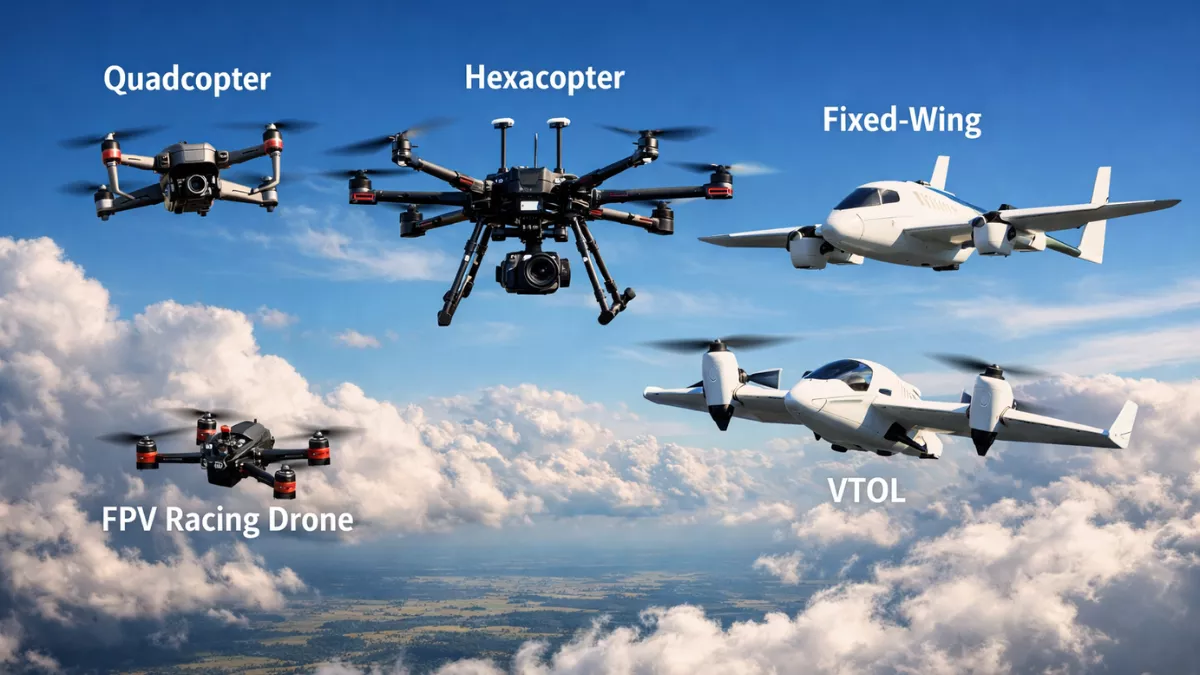
If you are completely new to drones altogether, start with this guide on Types of Drones Explained: Your Complete Beginner’s Guide for 2026 first, then come back here it will make everything below click faster.

Mr. Raj Kumar is a highly experienced Technical Content Engineer with 7 years of dedicated expertise in the intricate field of embedded systems. At Embedded Prep, Raj is at the forefront of creating and curating high-quality technical content designed to educate and empower aspiring and seasoned professionals in the embedded domain.
Throughout his career, Raj has honed a unique skill set that bridges the gap between deep technical understanding and effective communication. His work encompasses a wide range of educational materials, including in-depth tutorials, practical guides, course modules, and insightful articles focused on embedded hardware and software solutions. He possesses a strong grasp of embedded architectures, microcontrollers, real-time operating systems (RTOS), firmware development, and various communication protocols relevant to the embedded industry.
Raj is adept at collaborating closely with subject matter experts, engineers, and instructional designers to ensure the accuracy, completeness, and pedagogical effectiveness of the content. His meticulous attention to detail and commitment to clarity are instrumental in transforming complex embedded concepts into easily digestible and engaging learning experiences. At Embedded Prep, he plays a crucial role in building a robust knowledge base that helps learners master the complexities of embedded technologies.