Category: Battery Management

  • EV Battery Management System Firmware Design Challenges: 7 Critical Issues and a Complete Guide

    “It was a hot summer afternoon when Rahul, an embedded engineer, got a call from his manager. Their EV prototype, which had been performing well in lab tests, suddenly showed unexpected battery drain on a real road test. The culprit? Not the hardware, but the firmware running inside the Battery Management System (BMS). That was the moment Rahul realized—firmware design in EV Battery Management Systems is not just about coding; it’s about ensuring safety, efficiency, and reliability on wheels.”

    This simple story highlights a real-world truth: EV Battery Management System (BMS) firmware design is full of challenges that go far beyond just managing battery charging and discharging. In the electric vehicle industry, firmware is the hidden brain of the BMS that decides how safe, efficient, and long-lasting an EV battery can be.

    In this article, we’ll explore the major challenges in EV BMS firmware design, their impact, and why engineers need to carefully plan every line of code to meet automotive safety and performance standards.

    Designing firmware for an EV Battery Management System (BMS) requires compliance with ISO 26262 standards to ensure safety and reliability. According to the U.S. Department of Energy, battery efficiency is also a critical factor for EV adoption.

    What is EV Battery Management System Firmware?

    The Battery Management System (BMS) firmware is the embedded software that monitors and controls the battery pack in electric vehicles. It ensures:

    • Safe charging and discharging
    • Cell balancing
    • Thermal management
    • Fault detection and protection
    • Communication with the vehicle control unit

    Without robust firmware, even the best EV battery hardware can fail to deliver reliability, efficiency, and safety.

    Key Challenges in EV Battery Management System Firmware Design

    1. Real-Time Monitoring and Safety

    EV batteries can fail catastrophically if voltage, current, or temperature exceed safe limits. Firmware must continuously monitor battery parameters in real time and trigger safety actions instantly. The challenge? Writing highly optimized code that works under tight deadlines without missing critical events.

    2. Complex Cell Balancing Algorithms

    A battery pack may have hundreds of cells. Ensuring that all cells are balanced in terms of voltage is crucial for battery life. Firmware engineers face the challenge of designing efficient balancing algorithms (active or passive) that don’t slow down system performance.

    3. Thermal Management

    Temperature variations across cells can reduce battery efficiency. Firmware must handle smart cooling and heating control, but integrating these thermal management strategies with hardware sensors and actuators is complex.

    4. Power Efficiency vs. Processing Power

    Firmware must run continuously with low power consumption. But at the same time, it must process huge amounts of data from sensors. Balancing efficiency with performance is one of the toughest design challenges.

    5. Functional Safety (ISO 26262 Compliance)

    EVs are safety-critical systems. Firmware must comply with ISO 26262 functional safety standards. This requires error handling, redundancy, and fail-safe states, making firmware design more complex.

    6. Communication Protocols Integration

    Firmware must handle CAN, LIN, or Ethernet protocols to communicate with other ECUs in the vehicle. Ensuring reliable and real-time communication without data loss is a significant challenge.

    7. Scalability and Upgradability

    As EV battery technology evolves, firmware must support over-the-air (OTA) updates. Designing firmware that is modular, scalable, and secure against cyber threats is another big hurdle.

    Why These Challenges Matter

    If firmware fails, it can lead to:

    • Reduced battery life
    • Vehicle breakdowns
    • Safety hazards like thermal runaway
    • Lower consumer trust in EV technology

    That’s why BMS firmware is the backbone of EV performance, safety, and reliability.

    Impact on Key US Industries

    1. Automotive and Electric Vehicles (EVs)

    The US is leading the global shift toward electric and self-driving cars. Embedded systems manage everything from battery monitoring to driver assistance features. Tesla, GM, and Ford all rely heavily on embedded technology.
    This sector alone has created thousands of jobs and opened billions of dollars in new opportunities.

    2. Healthcare and Medical Devices

    The US healthcare market is huge, and embedded systems are at its core. Devices like pacemakers, insulin pumps, and wearable health monitors depend on reliable embedded software. With telemedicine and AI-driven diagnostics growing, the role of embedded systems is only getting bigger.

    3. Aerospace and Defense

    From Boeing aircraft to military drones, the US defense sector depends on embedded systems for navigation, communication, and safety. It’s a multi-billion-dollar industry where embedded engineers are in high demand.

    4. Consumer Electronics and IoT

    Smartphones, smart TVs, fitness trackers, and voice assistants (like Alexa) all run on embedded systems. The US market for IoT devices is expected to cross hundreds of billions in revenue in the next few years, and embedded tech is the backbone of it.

    5. Industrial Automation

    Factories in the US are adopting Industry 4.0, where embedded systems in robots and controllers improve efficiency, safety, and cost savings. This makes US manufacturing more competitive on the global stage.

    Economic Impact

    • Job Creation: Demand for embedded engineers, software developers, and hardware specialists continues to rise.
    • Innovation Powerhouse: Startups and big tech companies alike are building products around embedded systems, boosting the innovation ecosystem.
    • Market Growth: By integrating embedded systems, industries save costs, improve safety, and scale faster — making the US a global leader in tech adoption.

    Advantages for the US Market

    • Enhances competitiveness in automotive, healthcare, and aerospace.
    • Fuels the IoT revolution and smart city projects.
    • Opens new revenue streams through digital services.

    Challenges

    • Cybersecurity risks for connected devices.
    • High R&D costs for advanced embedded solutions.
    • Need for skilled workforce, which sometimes lags behind demand.

    FAQs on EV Battery Management System Firmware Challenges

    Q1. What are the biggest challenges in EV BMS firmware design?

    The biggest challenges include real-time monitoring, thermal management, cell balancing, ISO 26262 safety compliance, and reliable communication protocols.

    Q2. Why is functional safety important in BMS firmware?

    Functional safety ensures that even if the firmware fails, the EV battery stays in a safe state to avoid accidents or damage.

    Q3. How does firmware affect EV battery life?

    Efficient firmware extends battery life by balancing cells, optimizing charging cycles, and managing heat distribution. Poor firmware shortens lifespan.

    Q4. Can EV BMS firmware be updated?

    Yes. Modern EVs support Over-the-Air (OTA) updates, allowing manufacturers to fix bugs, improve safety, and add new features without physical recalls.

    Q5. Which standards must EV BMS firmware follow?

    The most important standard is ISO 26262 (functional safety). Some designs also follow AUTOSAR for modularity and communication consistency.

    Conclusion

    Designing firmware for an EV Battery Management System is not just about coding—it’s about solving real engineering challenges that directly impact safety and performance. From real-time monitoring to functional safety compliance, every challenge makes firmware development a critical part of the EV ecosystem.

    As the EV market continues to grow, engineers who can tackle these challenges will play a key role in shaping the future of sustainable transportation.
  • Nordic Semiconductor Unveils Advanced Power Management IC for Miniature Battery Devices

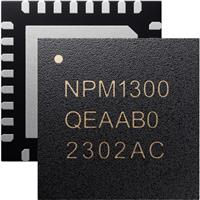
    Nordic Semiconductor nPM1304

    Nordic Semiconductor has launched the nPM1304, an ultra-low power power management IC (PMIC) designed specifically for compact, battery-operated devices. This advanced PMIC offers precise voltage regulation, efficient USB-C input support, and an innovative model-based fuel gauging system that accurately monitors battery state of charge while minimizing power consumption. Ideal for next-generation wearables and sensor applications, the nPM1304 delivers comprehensive battery management and system-level features, making it a perfect solution for miniaturized electronics demanding both power efficiency and reliability.

    Nordic Semiconductor Unveils Advanced Power Management IC for Miniature Battery Devices
    Nordic Semiconductor has unveiled its latest power management integrated circuit (PMIC), specifically engineered for compact electronic devices powered by small-capacity batteries. The new PMIC, named nPM1304, builds on the success of its predecessor, the nPM1300, and offers advanced power efficiency tailored for next-generation wearable technology and sensor applications.

    Next-Generation PMIC Designed for Miniaturized Battery-Powered Devices

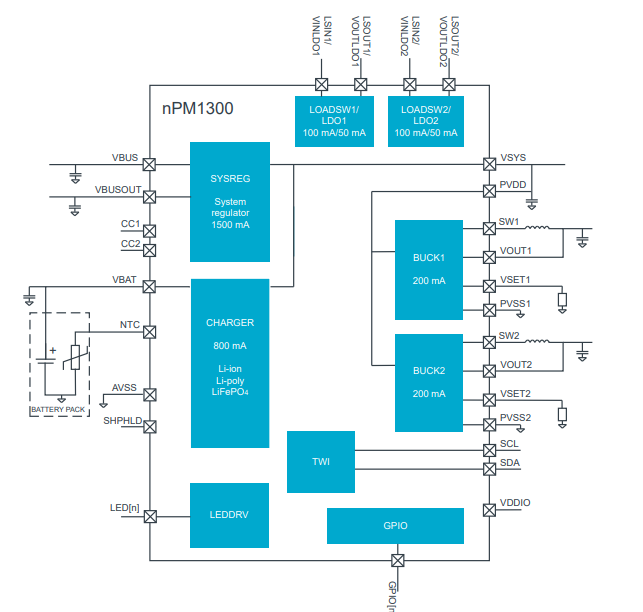
    The nPM1304 power management IC is designed to meet the growing demand for compact and energy-efficient solutions in the wearables and IoT market. It delivers four independently controlled power rails via two 200mA buck regulators and two 100mA load switches (which can also be configured as 50mA LDOs). Each power rail offers precise voltage regulation from 1.0 V up to 3.3 V, enabling versatile application support.

    Supporting USB-C input, the nPM1304 includes an integrated input regulator capable of handling 4.0 V to 5.5 V with a 1.5 A current limit and tolerates transient voltages up to 22 V, making it highly adaptable to varying power sources.

    [ VBUS ] ──► [ SYSREG ]
                      │
                      ▼
                   VSYS
                      │
     ┌────────────────┴─────────────┐
     │                              │
     │                              │
     │                          [ CHARGER ]
     │                              │
     │                   +----------+----------+
     │                   │                     │
     │                [ Battery ]         [ NTC ]
     │                                         │
     │                                    [ SHPHLD ]
     │                                         │
     │                                [ LEDDRV ]
     │
     │
     ▼
    [ BUCK1 ] ──► VOUT1
       │
     [ VSET1 ]
    
    [ BUCK2 ] ──► VOUT2
       │
     [ VSET2 ]
    
    [ LDO1 / LOADSW1 ] ──► LDO1_VOUT
    [ LDO2 / LOADSW2 ] ──► LDO2_VOUT
    
    [ GPIO ]
    [ TWI (I2C) ]
       │
    [SCL]  [SDA]
    

    Innovative Model-Based Fuel Gauging for Accurate Battery Monitoring

    One of the standout features of the nPM1304 PMIC is its model-based fuel gauging system. Unlike traditional coulomb counting methods that require continuous power consumption and recalibration, Nordic’s approach estimates the battery state of charge by analyzing voltage, current, and temperature data. This results in highly accurate battery monitoring with significantly reduced power consumption — drawing just 8 µA during active operation and zero current in sleep mode. This ultra-low power design is especially beneficial for devices with stringent energy budgets.

    Nordic Semiconductor Unveils Advanced Power Management IC for Miniature Battery Devices

    Comprehensive Battery Management with Programmable Charging

    The device supports a linear battery charger compatible with multiple chemistries, including Li-ion, Li-polymer, and LiFePO₄. Programmable charge currents range from 4 mA to 100 mA, and the termination voltage is adjustable between 3.5 V and 4.65 V, enabling flexible charging profiles tailored to specific battery types.

    Additional system-level features include watchdog and boot timers, power loss warning, configurable hard reset functions, recovery from failed boots, and a user-friendly I²C interface for system configuration. Developers also benefit from five general-purpose I/Os and three LED drivers integrated within the chip.

    Why Model-Based Fuel Gauging Outperforms Traditional Coulomb Counting

    Traditional coulomb counting estimates battery charge by measuring the current flowing in and out of the battery using sense resistors and integrating the results over time. Although effective, this method is prone to cumulative errors and requires periodic recalibration, which can be impractical for small devices with low and irregular current draws.

    Moreover, coulomb counting circuitry demands continuous power, often consuming a notable fraction of the device’s limited energy budget. Nordic’s model-based fuel gauge sidesteps these issues by employing a dynamic battery model that efficiently interprets sensor data, reducing energy use while maintaining state-of-charge accuracy.

    Nordic Semiconductor Unveils Advanced Power Management IC for Miniature Battery Devices

    Meeting Industry Demands for Compact and Efficient Power Management

    The nPM1304 addresses the growing need for compact, ultra-efficient power management ICs that support the increasing miniaturization of wearable and sensor devices. Nordic Semiconductor is now offering samples of this PMIC to developers looking to optimize power consumption in their battery-operated embedded systems.

    Advantages of nPM1300 PMIC

    ✅ Highly Integrated Solution

    • Combines charger, regulators, LED drivers, and GPIO in a single chip → reduces PCB space and BOM cost.

    ✅ Battery Charger Included

    • Supports Li-ion, Li-poly, and LiFePO4 batteries.
    • Integrated battery charging (up to 800 mA) eliminates need for separate charger ICs.

    ✅ Low Power Consumption

    • Suitable for battery-operated designs.
    • System regulator (SYSREG) and low quiescent current help extend battery life.

    ✅ Multiple Outputs

    • Two buck converters and two LDOs/Load switches allow powering different rails with separate voltages.
    • Flexible for different peripherals (MCU, sensors, radios).

    ✅ I²C Interface (TWI)

    • Programmable control of output voltages and other parameters → dynamic power management.
    • Enables MCU or SoC to adjust power rails in software.

    ✅ Integrated LED Drivers

    • Useful for status indicators or backlighting without extra driver ICs.

    ✅ Compact Solution

    • Smaller PCB footprint ideal for wearable, IoT, and portable devices.

    Disadvantages of nPM1300 PMIC

    ❌ Current Limitations

    • Buck converters limited to 200 mA → insufficient for high-power loads like large displays or motors.
    • LDO/Load switches limited to 100 mA / 50 mA.

    ❌ Complexity in Configuration

    • Requires software configuration via TWI → not purely hardware plug-and-play.
    • Might add development time for tuning voltages and power sequences.

    ❌ Limited Battery Chemistries

    • Although supporting common battery types, not suitable for NiMH, NiCd, or other less-common chemistries.

    ❌ Cost

    • Integrated PMICs can be more expensive than discrete solutions in ultra-low-cost designs.

    Real-Time Applications

    The nPM1300 is perfect for low-power embedded and portable applications requiring power efficiency and small form factor. Real-time examples:

    ✅ Wearable Devices

    • Smartwatches
    • Fitness bands
    • Medical patches

    ✅ IoT Devices

    • Wireless sensors
    • Smart home devices
    • Asset tracking tags

    ✅ Portable Medical Devices

    • Glucose monitors
    • Portable ECG devices

    ✅ Wireless Audio

    • Earbuds
    • Bluetooth headsets

    ✅ Compact Industrial Devices

    • Portable measurement tools
    • Handheld scanners

    ✅ Remote Controls / Smart Tags

    • Low-power BLE or proprietary RF remotes
    • RFID/NFC-enabled tags