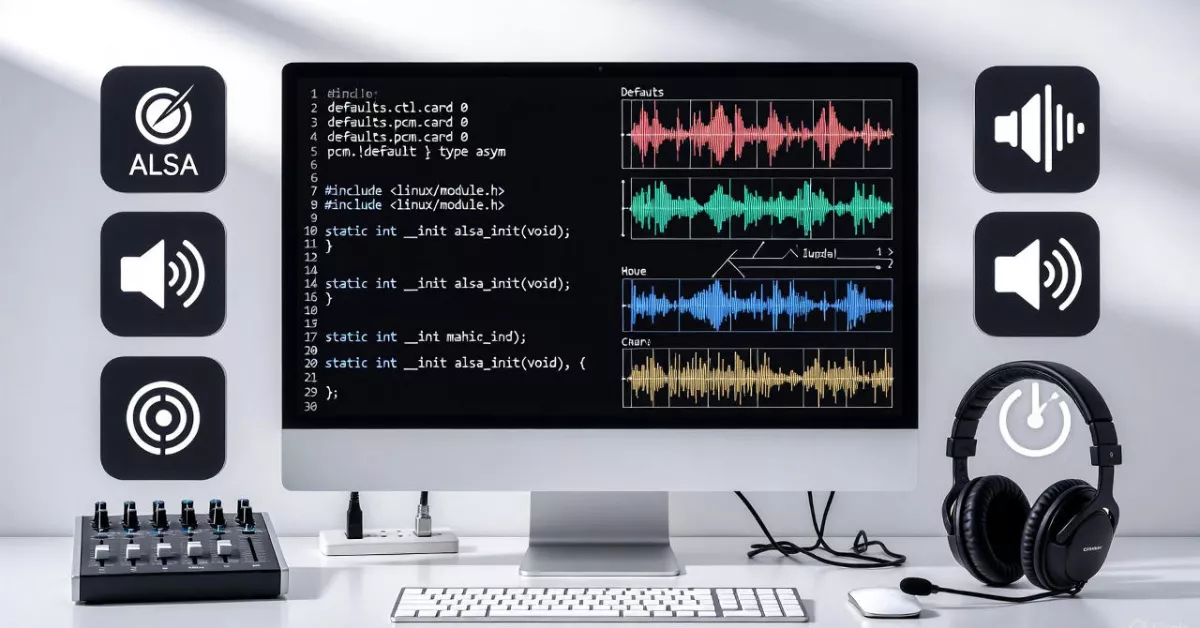
Master ALSA Audio Interview Questions with SET-2. Learn buffer size, period size, XRUNs, mixing, and real-world ALSA concepts to crack embedded audio interviews.
Are you preparing for an Embedded Audio Engineer interview and want to master ALSA audio concepts beyond the basics?
This SET-2 of ALSA Audio Interview Questions & Answers is designed for serious embedded professionals who want clear, practical, and interview-ready explanations.
In this part, we go deeper into real-world ALSA internals the kind of questions interviewers ask to test your hands-on experience, not just theory. Every concept is explained in a simple, logical, and practical way, with focus on how ALSA actually works inside Linux systems.
What you’ll learn in this video/article:
- Advanced ALSA PCM concepts and stream handling
- Period size, buffer size, latency & XRUN scenarios
- How ALSA manages multiple audio streams
- Software vs hardware mixing (dmix, dsnoop, softvol)
- ALSA plugins and real-life debugging tips
- Common ALSA interview traps and how to answer confidently
- This content is especially useful for:
- Embedded Linux Developers
- Audio Driver Engineers
- BSP & Platform Developers
- Automotive / Multimedia Audio Engineers
- Freshers & experienced professionals switching to audio domain
If you want to crack embedded audio interviews, understand ALSA from an interviewer’s perspective, and speak with confidence and clarity, this SET-2 is a must-watch/read.
Don’t forget to check SET-1 to build a strong foundation before diving into advanced topics.
1.What is ALSA Architecture?
ALSA (Advanced Linux Sound Architecture) is the core audio framework in the Linux kernel that provides low-level access to audio hardware such as sound cards, codecs, DSPs, and interfaces (I2S, PCM, HDMI, USB audio).
In short:
ALSA = kernel drivers + user-space library that together control audio hardware
High-Level ALSA Architecture Diagram
Application
   |
   |  (ALSA API - libasound)
   |
User Space
-----------------------------
Kernel Space
   |
   |  ALSA Core
   |     ├── PCM
   |     ├── Mixer (Control)
   |     ├── MIDI
   |     ├── Timer
   |
   |  Sound Card Driver
   |     ├── ASoC (Embedded)
   |     ├── PCI / USB
   |
   |  Codec + Platform + Machine Drivers
   |
Audio Hardware
User Space: ALSA Library (libasound)
What it does
- Provides APIs for applications
- Hides kernel complexity
- Handles audio routing, plugins, and configuration
Used by
aplay,arecord- Media players
- PulseAudio / PipeWire
- Embedded audio apps
Key responsibilities
- Open audio devices (
hw:0,0,plughw) - Configure:
- Sample rate
- Bit depth
- Channels
- Buffer & period size
- Plugin system:
dmix(software mixing)dsnoopplug
Interview line:
Applications never talk directly to hardware; they go through libasound.
Kernel Space: ALSA Core
The heart of ALSA inside the Linux kernel.
ALSA Core Responsibilities
- Manage sound cards
- Expose devices as
/dev/snd/* - Handle:
- Buffer management
- Interrupts
- DMA
- Synchronization
Important ALSA Subsystems
PCM (Pulse Code Modulation)
- Handles audio playback & capture
- Streams digital audio samples
- Manages:
- Ring buffers
- Period interrupts
- XRUN (underrun/overrun)
Most interview questions focus here.
Control (Mixer)
- Controls:
- Volume
- Mute
- Input source
- Gain
- Exposed via:
alsamixeramixer
Example:
Master Volume
Mic Gain
Playback Switch
MIDI
- Musical Instrument Digital Interface
- Used for keyboards, synths (less common in embedded)
Timer
- Provides accurate timing for audio events
- Used for synchronization
Sound Card Drivers
Each physical or virtual sound card has a driver.
Types of drivers
- PCI / USB audio
- ASoC (Audio SoC) – Embedded systems
Embedded Linux interviews mostly focus on ASoC.
ASoC (Audio System on Chip) Architecture
ASoC is designed for embedded platforms (Qualcomm, NXP, TI, STM).
ASoC splits the audio driver into 3 parts:
Machine Driver
       |
Codec Driver ---- Platform Driver
Codec Driver
- Controls external/internal audio codec (e.g. PCM6020, WM8960)
- Handles:
- I2C/SPI register programming
- DAC/ADC
- Analog paths
Platform Driver
- Controls SoC audio controller
- Handles:
- I2S / TDM / PCM
- DMA
- Clocking
Machine Driver
- Board-specific glue
- Connects:
- Codec ↔ Platform
- Defines:
- Audio routes
- DAI links
- Use cases
Interview killer line:
ASoC separates hardware control to improve reusability and scalability.
Audio Hardware Layer
This is the physical layer:
- Codec (DAC / ADC)
- Amplifier
- Speaker
- Mic
- Headphones
ALSA ensures data flows reliably from:
App → PCM Buffer → DMA → Codec → Speaker
Data Flow Example (Playback)
App (aplay)
   ↓
libasound
   ↓
ALSA PCM
   ↓
DMA Buffer
   ↓
I2S/TDM
   ↓
Codec DAC
   ↓
Speaker
Where PulseAudio / PipeWire Fits
App
 ↓
PulseAudio / PipeWire
 ↓
ALSA (lib + kernel)
 ↓
Hardware
ALSA is mandatory, PulseAudio is optional.
Common Follow Up Interview Questions
Q: Is ALSA user space or kernel?
Both (libasound in user space + ALSA core in kernel)
Q: Can ALSA mix multiple streams?
Kernel: No
User space: Yes (dmix)
Q: What is /dev/snd/pcmC0D0p?
PCM playback device for card 0, device 0
Q: Why ASoC?
Embedded systems have complex analog routing
One-Line Summary
ALSA is the Linux kernel’s low-level audio framework that manages sound hardware using kernel drivers and exposes standardized APIs to user-space applications via libasound.
2.What is a PCM device
A PCM device in ALSA represents a digital audio data stream interface used for playback or capture of audio samples between an application and the audio hardware.
In simple terms:
A PCM device is the path through which raw audio samples flow from software to hardware (speaker) or from hardware (mic) to software.
Why is it called PCM?
PCM (Pulse Code Modulation) is the standard digital representation of audio:
- Audio is represented as discrete samples
- Each sample has:
- Sample rate (e.g., 44.1 kHz)
- Bit depth (e.g., 16-bit)
- Channels (mono, stereo)
ALSA PCM devices handle only PCM data, not compressed formats like MP3 or AAC.
PCM Device Types
Playback PCM
- Sends audio to hardware
- Used for speakers, headphones
Example:
aplay music.wav
Device name:
/dev/snd/pcmC0D0p
(p = playback)
Capture PCM
- Receives audio from hardware
- Used for microphones
Example:
arecord voice.wav
Device name:
/dev/snd/pcmC0D0c
(c = capture)
PCM Device in ALSA Architecture
Application
   ↓
ALSA PCM API (libasound)
   ↓
Kernel ALSA PCM Layer
   ↓
DMA Buffer
   ↓
I2S / TDM / PCM Bus
   ↓
Audio Codec
Key Responsibilities of a PCM Device
A PCM device manages:
- Audio buffers (ring buffers)
- Sample format (S16_LE, S24_LE, etc.)
- Sample rate & channels
- Period size & buffer size
- DMA transfers
- Interrupt-driven data flow
Interview line:
A PCM device ensures continuous, real-time audio streaming using buffer and DMA management.
3.What is Buffer & Period
- Buffer: Total memory holding audio samples
- Period: Small chunk inside buffer
- Interrupt occurs after each period
Example:
Buffer = 4096 frames
Period = 1024 frames
→ Interrupt every 1024 frames
If data is late → XRUN occurs.
PCM States
A PCM device transitions through states:
OPEN → SETUP → PREPARED → RUNNING → XRUN → STOP
If an app fails to feed data on time → Underrun (Playback XRUN)
Hardware vs Plugin PCM Devices
| Type | Example | Purpose |
|---|---|---|
| Hardware PCM | hw:0,0 | Direct hardware access |
| Plugin PCM | plughw:0,0 | Auto format conversion |
| dmix | default | Software mixing |
Embedded systems often use hw PCM for low latency.
4.PCM Device vs Sound Card
| Sound Card | PCM Device |
|---|---|
| Physical or logical card | Audio data stream |
| Has controls & mixers | Only streaming |
| One card → multiple PCMs | Each PCM = one stream |
One-Line Definition
A PCM device in ALSA is a logical audio stream interface that transfers raw digital audio samples between applications and audio hardware using buffers and DMA.
Bonus: Embedded Interview Tips
In ASoC systems, each PCM device is created by:
- DAI links in the Machine Driver
- Connected via Codec + Platform drivers
5.What is hw:x,y vs plughw
Both hw:x,y and plughw:x,y are ALSA PCM device names, but they differ in how strictly they talk to hardware.
hw:x,y (Hardware PCM)
What it is
hw:x,y provides direct, raw access to the audio hardware.
x→ sound card numbery→ PCM device number
Example:
hw:0,0
Characteristics
- No software conversion
- No resampling
- No format/channel conversion
- Lowest latency
- Application must match exact hardware format
Interview line:
hw:x,yfails if the app format doesn’t exactly match what the hardware supports.
Example failure
Hardware supports:
48kHz, S16_LE, Stereo
App tries:
44.1kHz, S24_LE
→ Open fails
plughw:x,y (Plugin + Hardware PCM)
What it is
plughw:x,y wraps hw:x,y with ALSA’s plug plugin, which performs automatic format conversion.
What it does automatically
- Sample rate conversion
- Bit-depth conversion
- Channel conversion (mono ↔ stereo)
Characteristics
- Easier for applications
- More flexible
- Slightly higher latency
- Extra CPU usage
Interview line:
plughw:x,yguarantees audio playback by converting the stream to match hardware capabilities.
Side-by-Side Comparison
| Feature | hw:x,y | plughw:x,y |
|---|---|---|
| Hardware access | Direct | Via plug plugin |
| Format conversion | No | Yes |
| Resampling | No | Yes |
| Latency | Lowest | Slightly higher |
| CPU usage | Minimal | More |
| Failure chance | High (strict) | Low (flexible) |
| Embedded use | Preferred | Used if needed |
Real Command Example
Strict hardware access
aplay -D hw:0,0 test.wav
Auto-convert if needed
aplay -D plughw:0,0 test.wav
When to Use What? (Interview Scenario)
Use hw:x,y when:
- Writing embedded audio services
- Low-latency is critical
- Format is known and fixed
- Debugging driver / codec
Use plughw:x,y when:
- Writing generic applications
- Format may vary
- You want playback to “just work”
Common Interview Trap
Is plughw software mixing?
No.
plughw→ format conversion onlydmix→ software mixing (multiple apps)
One-Line Final Answer
hw:x,ygives direct, low-latency access to audio hardware and requires an exact format match, whileplughw:x,yuses ALSA plugins to automatically convert audio formats so playback always succeeds.
6.What is an ALSA Plugin?
An ALSA plugin is a user-space software layer in libasound that modifies, routes, or processes audio streams before they reach the actual hardware PCM device.
In simple words:
ALSA plugins sit between the application and hardware to make audio work even when formats, rates, or usage don’t match hardware limitations.
Where ALSA Plugins Sit in the Stack
Application
   ↓
ALSA Plugin (libasound)
   ↓
Hardware PCM (hw:x,y)
   ↓
Kernel → Codec → Speaker
Plugins are NOT in the kernel – they are user-space only.
Why ALSA Plugins Exist
Hardware PCM devices are strict and limited:
- Fixed sample rates
- Fixed bit depth
- Usually single-client access
- ALSA plugins solve this by:
- Converting formats
- Resampling audio
- Allowing multiple apps
- Routing audio streams
7.Common ALSA Plugins
plug Plugin (Most Important)
Used by: plughw:x,y
What it does:
- Sample rate conversion
- Bit-depth conversion
- Channel conversion
Interview line:
The
plugplugin ensures the audio format always matches hardware capabilities.
dmix Plugin (Software Mixing)
Used by: default
What it does:
- Allows multiple applications to play audio simultaneously
- Mixes streams in software
Important:
- Mixing is NOT done in kernel
- Happens in user space
dsnoop Plugin
What it does:
- Allows multiple apps to record from the same mic
softvol Plugin
What it does:
- Provides software volume control
- Useful when hardware mixer doesn’t exist
route Plugin
What it does:
- Custom channel routing
- Example: Stereo → Mono mapping
hw vs Plugin PCM (Quick Reminder)
| PCM Type | Plugin Used | Behavior |
|---|---|---|
hw:x,y | ❌ None | Strict, low latency |
plughw:x,y | ✔ plug | Auto conversion |
default | ✔ plug + dmix | Mixing + conversion |
ALSA Configuration & Plugins
Plugins are defined in:
/etc/asound.conf
~/.asoundrc
Example:
pcm.!default {
    type plug
    slave.pcm "hw:0,0"
}
This tells ALSA:
“Use plug plugin before sending audio to hardware.”
Embedded System Perspective
In embedded products:
- Audio services often use
hw:x,y - Plugins may be disabled for:
- Lower latency
- Predictable timing
- Lower CPU usage
But during development & debugging, plugins are very useful.
Common Interview Questions
1.Are ALSA plugins kernel drivers?
No, they are user-space components in libasound.
2.Can plugins affect latency?
Yes, plugins increase latency slightly.
3.Does ALSA mix audio in kernel?
No, mixing is done by dmix plugin in user space.
One-Line Interview Answer
An ALSA plugin is a user-space software component in libasound that processes, converts, or routes audio streams before they are sent to the hardware PCM device.
8.What is dmix in ALSA?
dmix is an ALSA user-space plugin that enables software mixing, allowing multiple applications to play audio simultaneously on hardware that supports only one playback stream.
In simple words:dmix mixes audio from multiple apps in software before sending it to the hardware.
Why dmix is Needed
Most audio hardware:
- Supports only one PCM playback stream
- Cannot mix multiple audio sources in hardware
Without dmix:
- First app plays audio
- Second app → “Device busy” error
With dmix:
- Both apps play audio together
Where dmix Sits in the Audio Stack
App1 ─┐
      ├─► dmix (software mixing)
App2 ─┘
          ↓
       hw:x,y
          ↓
       Kernel → Codec → Speaker
dmix runs in user space (libasound), not in the kernel.
How dmix Works (Interview Explanation)
- Each application writes audio to its own buffer
dmixresamples streams to a common format- Audio samples are summed (mixed)
- Mixed stream is written to the hardware PCM
Mixing happens per audio frame.
Key Characteristics of dmix
- Allows multiple playback streams
- Software-based (CPU usage)
- Slightly higher latency
- Not real-time safe for hard RT constraints
- Playback only (not capture)
dmix vs Hardware Mixing
| Feature | dmix | Hardware Mixing |
|---|---|---|
| Location | User space | Audio codec / DSP |
| Streams | Multiple | Multiple |
| CPU usage | Higher | Low |
| Latency | Higher | Lower |
| Embedded usage | Limited | Preferred |
dmix vs plughw (Common Interview Trap)
| Feature | dmix | plug |
|---|---|---|
| Purpose | Mixing | Format conversion |
| Multiple apps | ✔ Yes | ❌ No |
| Resampling | ✔ Yes | ✔ Yes |
| Used by default | ✔ Yes | ✔ Yes |
default PCM usually = plug + dmix
Device Names Using dmix
Common default device:
default
Explicit dmix usage:
dmix
Example:
aplay -D default song.wav
Embedded Interview Insight
In embedded systems:
dmixis often disabled- Audio services use
hw:x,y - Mixing is done by:
- DSP
- Audio framework
- Application layer
One-Line Perfect Interview Answer
dmixis an ALSA user-space plugin that performs software mixing, allowing multiple applications to play audio simultaneously on single-stream hardware.
Common Follow-Up Interview Questions
1.Does dmix work for capture?
No → dsnoop is used for capture
2.Is dmix part of kernel ALSA?
No, it is part of libasound
9.What is dsnoop in ALSA?
Short Interview Answer
dsnoop is an ALSA plugin that allows multiple applications to capture audio simultaneously from the same input device (mic).
Why dsnoop is needed
- By default, hardware capture devices support only one open handle
- If one app uses the mic, another app fails with “device busy”
- dsnoop solves this by duplicating (snooping) the capture stream
How dsnoop works
- One master capture stream reads from hardware
- dsnoop copies the data to multiple applications
- All apps receive the same audio data
Real-world example
- Zoom + Recorder app using the same microphone
- Without dsnoop → second app fails
- With dsnoop → both apps record audio
Key Points for Interview
- Used for capture (input) only
- Software-based plugin
- Adds slight latency
- Opposite concept of
dmix(which is for playback)
10.What is asym in ALSA?
Short Interview Answer
asym is an ALSA plugin that allows using different devices or plugins for playback and capture.
Why asym is needed
- Some hardware:
- Supports playback only
- Or capture only
- Or you want:
- Playback via
dmix - Capture via
dsnoop
- Playback via
How asym works
- Combines two independent PCM devices:
- One for playback
- One for capture
Example
Playback → dmix (speakers)
Capture  → dsnoop (microphone)
Key Points for Interview
- asym = asymmetric
- Playback and capture are configured separately
- Common in default ALSA device configuration
11.What is softvol in ALSA?
Short Interview Answer
softvol is an ALSA plugin that provides software-based volume control when hardware volume control is not available.
Why softvol is needed
- Many codecs or HDMI outputs:
- Have no hardware mixer
- ALSA mixer commands won’t work
- softvol adds a virtual volume control
How softvol works
- Audio samples are scaled in software
- Volume change happens before audio reaches hardware
Important Note
- softvol reduces dynamic range
- High volume may cause clipping
- Hardware volume is always preferred
Key Points for Interview
- Software volume control
- Works even when no hardware mixer exists
- Can introduce distortion if misused
12.What is ALSA Mixer?
Short Interview Answer
The ALSA mixer is the component that controls audio parameters like volume, mute, and input gain for sound devices.
What ALSA mixer controls
- Master volume
- PCM volume
- Mic gain
- Mute/unmute
- Input source selection
Types of ALSA Mixer Controls
| Type | Description |
|---|---|
| Playback | Speaker / headphone volume |
| Capture | Mic input gain |
| Switch | Mute / unmute |
| Enum | Select input source |
Mixer Access Tools
alsamixer(terminal UI)amixer(command line)- ALSA API (
snd_mixer_*)
Important Interview Clarification
ALSA mixer does NOT mix audio streams
It only controls gain and routing
Quick Interview Comparison Table
| Concept | Purpose | Direction |
|---|---|---|
| dsnoop | Share mic between apps | Capture |
| dmix | Mix multiple playback streams | Playback |
| asym | Different devices for play & capture | Both |
| softvol | Software volume control | Playback |
| ALSA mixer | Volume & gain control | Both |
One-Line Memory Tricks
- dsnoop → Duplicate mic input
- dmix → Mix speaker output
- asym → Different devices for in/out
- softvol → Fake volume in software
- Mixer → Controls volume, doesn’t mix
dsnoop – Tricky Q&A
Q: Why can’t multiple apps open a capture device directly?
A: Hardware capture devices usually support only one open handle, so ALSA blocks others.
Q: Does dsnoop modify audio data?
A: No, dsnoop duplicates the same captured samples to all clients.
Q: Is dsnoop hardware or software?
A: dsnoop is a software ALSA plugin.
Q: Does dsnoop add latency?
A: Yes, due to buffering and copying in software.
Q: Can dsnoop be used for playback?
A: No, dsnoop is capture-only; playback uses dmix.
asym – Tricky Q&A
Q: Why is asym used in default ALSA devices?
A: It allows separate configuration of playback and capture paths.
Q: Can asym combine dmix and dsnoop?
A: Yes, commonly dmix for playback and dsnoop for capture.
Q: Does asym do audio processing?
A: No, asym only routes streams, it doesn’t process audio.
Q: How does asym help half-duplex hardware?
A: It allows playback and capture to use different PCM devices.
Q: Can playback and capture run at different sample rates in asym?
A: Yes, if underlying plugins or hardware support it.
softvol – Tricky Q&A
Q: Why is softvol worse than hardware volume?
A: It scales samples in software, reducing dynamic range.
Q: Can softvol cause clipping?
A: Yes, increasing software gain can overflow samples.
Q: Why is softvol used with HDMI or USB audio?
A: Many such devices lack hardware mixer controls.
Q: Does softvol appear in alsamixer?
A: Yes, as a virtual mixer control.
Q: Does softvol increase CPU usage?
A: Slightly, because audio is processed in software.
ALSA Mixer – Tricky Q&A
Q: Does ALSA mixer mix multiple audio streams?
A: No, it only controls volume, mute, and routing.
Q: Difference between Master and PCM volume?
A: Master controls overall output, PCM controls stream level.
Q: Why does mixer volume sometimes not affect sound?
A: Because output may be using dmix or a fixed hardware path.
Q: Can mixer controls exist without hardware support?
A: Yes, via software controls like softvol.
Q: How are mixer controls exposed to user space?
A: Through ALSA control interface (snd_ctl / snd_mixer APIs).
Ultra-Tricky Interview Killers Q&A
Q: Why does amixer show controls but sound doesn’t change?
A: The active PCM path bypasses that mixer control.
Q: What happens if dsnoop buffer size is wrong?
A: You may get latency, dropouts, or XRUNs.
Q: Why does softvol increase CPU usage?
A: Because every sample is multiplied in software.
Q: What happens if asym playback fails but capture works?
A: Only playback path fails; capture continues independently.
Q: How do ALSA plugins interact with hardware?
A: Plugins sit above the hardware PCM driver and pass processed data down.
Final Interview Line
“ALSA plugins handle sharing, routing, and software control, while the hardware driver does the actual I/O.”
13.Hardware Mixer vs Software Mixer (ALSA / Embedded Audio)
One-Line Interview Definition
Hardware Mixer
A hardware mixer controls audio volume and routing using codec/DAC registers, without modifying samples in software.
Software Mixer
A software mixer mixes or scales audio in software before sending it to hardware.
Detailed Comparison
| Feature | Hardware Mixer | Software Mixer |
|---|---|---|
| Location | Inside audio codec / DSP | Inside CPU / ALSA plugins |
| Implementation | Register-based | Sample processing |
| CPU usage | ❌ No CPU usage | ✅ Uses CPU |
| Audio quality | ✅ Best (no clipping) | ⚠️ Can degrade |
| Dynamic range | Preserved | Reduced at high gain |
| Latency | Very low | Higher |
| Power consumption | Low | Higher |
| Works without codec support | ❌ No | ✅ Yes |
| Example | Codec volume register | dmix, softvol |
Hardware Mixer Examples
Examples in ALSA
- Codec volume control (PCM, Master)
- Mic gain registers
- Mute switches
- Controlled via:
alsamixeramixersnd_mixer_*
Software Mixer Examples
| Plugin | Purpose |
|---|---|
dmix | Mix multiple playback streams |
softvol | Software volume control |
dsnoop | Share capture streams |
Tricky Interview Q&A
Q: Does ALSA mixer always mean hardware mixer?
A: No, ALSA mixer can expose both hardware and software controls.
Q: Why is hardware mixer preferred?
A: It preserves audio quality and dynamic range.
Q: When is software mixer mandatory?
A: When hardware does not support mixing or volume control.
Q: Can software mixer cause clipping?
A: Yes, due to sample scaling in software.
Q: Why does HDMI audio often use software volume?
A: HDMI devices usually lack hardware volume registers.
Ultra-Short Memory Lines (Interview Gold)
- Hardware mixer → Codec register control
- Software mixer → CPU-based sample processing
- Hardware = quality
- Software = flexibility
Final Interview Statement (Say This)
“Hardware mixers are lossless and efficient, while software mixers trade CPU and quality for flexibility.”
14.What is dmix in ALSA?
dmix is an ALSA user-space plugin that enables software mixing, allowing multiple applications to play audio simultaneously on hardware that supports only one playback stream.
In simple words:dmix mixes audio from multiple apps in software before sending it to the hardware.
Why dmix is Needed
Most audio hardware:
- Supports only one PCM playback stream
- Cannot mix multiple audio sources in hardware
Without dmix:
- First app plays audio
- Second app → “Device busy” error
With dmix:
- Both apps play audio together
Where dmix Sits in the Audio Stack
App1 ─┐
      ├─► dmix (software mixing)
App2 ─┘
          ↓
       hw:x,y
          ↓
       Kernel → Codec → Speaker
dmix runs in user space (libasound), not in the kernel.
How dmix Works (Interview Explanation)
- Each application writes audio to its own buffer
dmixresamples streams to a common format- Audio samples are summed (mixed)
- Mixed stream is written to the hardware PCM
Mixing happens per audio frame.
Key Characteristics of dmix
✔ Allows multiple playback streams
✔ Software-based (CPU usage)
✔ Slightly higher latency
❌ Not real-time safe for hard RT constraints
❌ Playback only (not capture)
dmix vs Hardware Mixing
| Feature | dmix | Hardware Mixing |
|---|---|---|
| Location | User space | Audio codec / DSP |
| Streams | Multiple | Multiple |
| CPU usage | Higher | Low |
| Latency | Higher | Lower |
| Embedded usage | Limited | Preferred |
dmix vs plughw (Common Interview Trap)
| Feature | dmix | plug |
|---|---|---|
| Purpose | Mixing | Format conversion |
| Multiple apps | Yes | No |
| Resampling | Yes | Yes |
| Used by default | Yes | Yes |
default PCM usually = plug + dmix
Device Names Using dmix
Common default device:
default
Explicit dmix usage:
dmix
Example:
aplay -D default song.wav
Embedded Interview Insight
In embedded systems:
dmixis often disabled- Audio services use
hw:x,y - Mixing is done by:
- DSP
- Audio framework
- Application layer
One-Line Perfect Interview Answer
dmixis an ALSA user-space plugin that performs software mixing, allowing multiple applications to play audio simultaneously on single-stream hardware.
Common Follow-Up Interview Questions
1.Does dmix work for capture?
No → dsnoop is used for capture
2.Is dmix part of kernel ALSA?
No, it is part of libasound
15.What is snd_pcm_open()?
One-Line Interview Answer
snd_pcm_open()opens an ALSA PCM device for playback or capture and returns a PCM handle.
What it actually does
- Connects user space app to:
- Hardware PCM (
hw:0,0) - Or plugin PCM (
default,plughw)
- Hardware PCM (
- Allocates internal ALSA structures
- Does NOT start audio yet
Prototype (for understanding)
int snd_pcm_open(
    snd_pcm_t **pcm,
    const char *name,
    snd_pcm_stream_t stream,
    int mode
);
Key Interview Points
- Must be called before any PCM configuration
- Returns a
snd_pcm_t*handle - Can fail if device is busy or not found
16.What is snd_pcm_hw_params()?
One-Line Interview Answer
snd_pcm_hw_params()configures hardware-dependent parameters of a PCM device.
What it configures
- Sample rate
- Channels
- Sample format (S16_LE, S24_LE, etc.)
- Period size
- Buffer size
- Access type (interleaved / non-interleaved)
Typical Flow
snd_pcm_hw_params_alloca(&hw);
snd_pcm_hw_params_any(pcm, hw);
snd_pcm_hw_params_set_rate(pcm, hw, 48000, 0);
snd_pcm_hw_params_set_channels(pcm, hw, 2);
snd_pcm_hw_params_set_format(pcm, hw, SND_PCM_FORMAT_S16_LE);
snd_pcm_hw_params(pcm, hw);
Key Interview Points
- Affects DMA, hardware buffers
- Negotiated with driver
- Must be set before sw_params
17.Difference Between hw_params and sw_params
One-Line Interview Difference
hw_paramsconfigure hardware capabilities, whilesw_paramsconfigure runtime software behavior.
Interview Comparison Table (Very Important)
| Feature | hw_params | sw_params |
|---|---|---|
| Scope | Hardware | Software |
| Affects | Codec, DMA, buffers | App ↔ driver behavior |
| Set order | First | After hw_params |
| Sample rate | ✅ Yes | ❌ No |
| Format | ✅ Yes | ❌ No |
| Channels | ✅ Yes | ❌ No |
| Buffer size | ✅ Yes | ❌ No |
| Start threshold | ❌ No | ✅ Yes |
| Avail min | ❌ No | ✅ Yes |
| XRUN handling | ❌ No | ✅ Yes |
| Changes after start | ❌ No | ✅ Limited |
What are sw_params used for? (Interview Add-On)
Examples:
- When playback should start
- When app wakes up to write/read data
- How ALSA handles underrun / overrun
snd_pcm_sw_params_set_start_threshold(pcm, sw, threshold);
snd_pcm_sw_params_set_avail_min(pcm, sw, period_size);
Tricky Follow-Up Q&A
Q: Can you change hw_params while PCM is running?
A: No, the stream must be stopped.
Q: Why are hw_params negotiated?
A: Hardware may not support exact requested values.
Q: Can sw_params affect latency?
A: Yes, via start threshold and avail_min.
Q: Which params control XRUN behavior?
A: Mainly sw_params.
Final Interview Line (Say This)
“
snd_pcm_open()opens the device,hw_paramsdefine what the hardware can do, andsw_paramsdefine how the application interacts with it.”
18.What is Period Size?
One-line definition (Interview ready):
period size is the amount of audio data (frames) processed by ALSA in one interrupt or wake-up cycle.
Explanation (simple):
- Audio buffer is divided into multiple periods
- Each period = one chunk of audio
- After one period is played/recorded, ALSA notifies the application
Why it matters:
- Smaller period size → lower latency
- Larger period size → safer playback, less CPU load
Example:
Period size = 256 frames
Sample rate = 48 kHz
→ Wake-up every ~5.3 ms
19.What is Buffer Size?
One-line definition (Interview ready):
Buffer size is the total amount of audio data (in frames) stored between the application and the hardware.
Explanation:
- Buffer = multiple periods
- Holds audio to prevent glitches
- Acts as a shock absorber between app & hardware
Relationship:
Buffer size = Period size × Number of periods
Example:
Period size = 256 frames
Periods = 4
Buffer size = 1024 frames
Why it matters:
- Large buffer → stable audio, higher latency
- Small buffer → low latency, higher XRUN risk
20.What causes XRUN?
One-line definition (Interview ready):
XRUN happens when audio data is not delivered or consumed in time.
Types of XRUN:
| Type | Meaning |
|---|---|
| Underrun | Playback buffer becomes empty |
| Overrun | Capture buffer becomes full |
Common causes:
- CPU overload
- Very small buffer/period
- Scheduling delays
- Slow I/O or blocking calls
- High interrupt latency
Interview sentence:
“XRUN occurs when the producer and consumer are out of sync.”
21.How to Recover from XRUN?
One-line definition (Interview ready):
XRUN recovery resets the PCM device and restarts streaming.
Standard ALSA recovery steps:
snd_pcm_prepare(pcm_handle);
Typical recovery flow:
- Detect XRUN (
-EPIPEerror) - Call
snd_pcm_prepare() - Refill buffer
- Resume playback/capture
Prevention (important in interviews):
- Increase buffer size
- Use real-time scheduling
- Avoid blocking calls
- Optimize CPU usage
Interview tip:
“XRUN recovery is easy, but prevention is critical in real-time systems.”
Period Size vs Buffer Size (Quick Table)
| Aspect | Period Size | Buffer Size |
|---|---|---|
| Unit | Frames per interrupt | Total frames |
| Affects | Latency | Stability |
| Too Small | CPU stress | XRUN |
| Too Large | High latency | Delay |
Tricky Follow-Up Interview Questions (with Answers)
Q1. Can buffer size be smaller than period size?
No. Buffer must be ≥ period size.
Q2. Which impacts latency more?
Period size.
Q3. Does increasing buffer size fix XRUN?
Yes, but increases latency.
Q4. Is XRUN a hardware failure?
No, it’s a timing issue.
Q5. Does dmix increase XRUN chances?
Yes, due to extra software mixing overhead.
Final Interview Summary (Golden Lines)
“Period size controls latency, buffer size controls stability, and XRUN happens when timing breaks between them.”
21How ALSA Handles Blocking vs Non-Blocking Mode
Blocking Mode (Default)
One-line (Interview ready):
In blocking mode, ALSA API calls wait until the PCM device is ready to read or write audio data.
How it works:
snd_pcm_writei()blocks- App sleeps until:
- Enough buffer space is available (playback)
- Enough data is available (capture)
Example:
snd_pcm_open(&handle, "hw:0,0", SND_PCM_STREAM_PLAYBACK, 0);
Pros:
Simple to use
CPU-efficient
Good for basic apps
Cons:
Can cause delays if scheduling is poor
Risk of XRUN if app wakes up late
Interview line:
“Blocking mode is easier but less deterministic.”
Non-Blocking Mode
One-line (Interview ready):
In non-blocking mode, ALSA calls return immediately if the device is not ready.
How it works:
- Open PCM with
SND_PCM_NONBLOCK - Calls return
-EAGAINif not ready
Example:
snd_pcm_open(&handle, "hw:0,0",
             SND_PCM_STREAM_PLAYBACK,
             SND_PCM_NONBLOCK);
Handling non-blocking I/O:
- Poll using
poll()orselect() - Retry when device becomes ready
Pros:
- Low latency
- Better real-time control
- No thread blocking
Cons:
- More complex logic
- Requires event handling
Interview line:
“Non-blocking mode is preferred for real-time audio pipelines.”
Blocking vs Non-Blocking
| Feature | Blocking | Non-Blocking |
|---|---|---|
| Default | Yes | No |
| API behavior | Waits | Returns immediately |
| CPU usage | Lower | Higher |
| Latency control | Limited | Better |
| Complexity | Simple | Complex |
| Real-time apps | ❌ | ✅ |
Tricky Interview Question
Q: Can blocking mode still be low latency?
A: Yes, if period size is small and scheduling is real-time.
22.How to Reduce ALSA Latency
Use Smaller Period Size
Reduces wake-up interval
Period size ↓ → Latency ↓
Too small → XRUN risk
Reduce Buffer Size
Smaller buffer = less queued audio
Buffer size = Period × Periods
Best practice:
- 2–4 periods only
Use hw Instead of plughw
Avoid format conversion
hw:0,0  → lowest latency
plughw → adds conversion delay
Interview tip:
“plughw increases latency due to software processing.”
Use Non-Blocking + poll()
Avoid thread sleep delays
snd_pcm_nonblock(handle, 1);
Use Real-Time Scheduling
Prevents audio thread starvation
SCHED_FIFO / SCHED_RR
Interview line:
“Real-time scheduling is critical for low-latency audio.”
Avoid dmix (If Possible)
dmix adds buffering & mixing delay
Prefer:
hw device
Avoid:
dmix
Enable mmap Mode
Zero-copy audio access
snd_pcm_mmap_writei()
Interview line:
“MMAP mode reduces latency by avoiding memory copies.”
Tune sw_params
Important settings:
avail_minstart_threshold
Lower avail_min → faster wake-ups
Lower start_threshold → quicker start
Tricky Follow-Up Questions
Q1. Which has lower latency: blocking or non-blocking?
Non-blocking.
Q2. Is dmix real-time safe?
No.
Q3. Does ALSA guarantee real-time?
No, OS scheduling matters.
Q4. Is mmap always faster?
Usually yes, but hardware-dependent.
Q5. What’s the biggest cause of latency in ALSA?
Large buffers + software plugins.
Final Interview Golden Lines
“Low ALSA latency requires small buffers, real-time scheduling, direct hardware access, and non-blocking design.”
FAQ : ALSA Audio Interview Questions & Answers
1. What is ALSA and why is it important for embedded audio interviews?
ALSA (Advanced Linux Sound Architecture) is the core Linux audio framework that directly interacts with sound hardware. Interviewers focus on ALSA because it reflects your understanding of low-level audio handling, latency control, and driver interaction.
2. What is the difference between buffer size and period size in ALSA?
Buffer size defines the total audio memory, while period size defines how often interrupts occur. Interviewers ask this to check whether you understand latency, XRUNs, and real-time audio behavior.
3. What causes XRUN in ALSA and how do you handle it?
XRUN occurs when audio data is not delivered on time due to CPU load, wrong buffer configuration, or scheduling delays. Recovery is done using snd_pcm_prepare() or proper buffer tuning.
4. How does ALSA handle multiple audio streams?
ALSA uses plugins like dmix, dsnoop, and asym to manage multiple streams. Interviewers expect you to explain software mixing vs hardware mixing clearly.
5. What is dmix in ALSA and when is it used?
dmix is an ALSA software mixer that allows multiple applications to play audio simultaneously when hardware supports only one stream.
6. What is the difference between hw, plughw, and default ALSA devices?
hw→ Direct hardware access (no conversion)plughw→ Automatic format conversiondefault→ Uses ALSA plugins
This question tests practical ALSA usage knowledge.
7. What are ALSA plugins and why are they important?
ALSA plugins handle resampling, format conversion, mixing, and routing. They make ALSA flexible and are critical in real-world embedded systems.
8. How does ALSA achieve low latency in embedded systems?
By using small period sizes, real-time scheduling, proper IRQ handling, and minimal software layers, ALSA can achieve very low audio latency.
9. What happens if ALSA crashes in a running system?
If ALSA crashes, active audio streams stop, but the system usually remains stable. Recovery depends on application-level handling and sound server architecture (PulseAudio, PipeWire, etc.).
10. Why do interviewers ask ALSA questions even when PulseAudio or PipeWire is used?
Because PulseAudio and PipeWire sit on top of ALSA, and strong ALSA fundamentals show that you understand the real audio data path, not just high-level APIs.
Read More: Embedded Audio Interview Questions & Answers | Set 1
Read More : Embedded Audio Interview Questions & Answers | Set 2
Read More : Top Embedded Audio Questions You Must Master Before Any Interview
Read More : What is Audio and How Sound Works in Digital and Analog Systems
Read More : Digital Audio Interface Hardware
Read More : Advanced Linux Sound Architecture for Audio and MIDI on Linux
Read More : What is QNX Audio
Read more : Complete guide of ALSA
Read More : 50 Proven ALSA Interview Questions
Read More : ALSA Audio Interview Questions & Answers

Mr. Raj Kumar is a highly experienced Technical Content Engineer with 7 years of dedicated expertise in the intricate field of embedded systems. At Embedded Prep, Raj is at the forefront of creating and curating high-quality technical content designed to educate and empower aspiring and seasoned professionals in the embedded domain.
Throughout his career, Raj has honed a unique skill set that bridges the gap between deep technical understanding and effective communication. His work encompasses a wide range of educational materials, including in-depth tutorials, practical guides, course modules, and insightful articles focused on embedded hardware and software solutions. He possesses a strong grasp of embedded architectures, microcontrollers, real-time operating systems (RTOS), firmware development, and various communication protocols relevant to the embedded industry.
Raj is adept at collaborating closely with subject matter experts, engineers, and instructional designers to ensure the accuracy, completeness, and pedagogical effectiveness of the content. His meticulous attention to detail and commitment to clarity are instrumental in transforming complex embedded concepts into easily digestible and engaging learning experiences. At Embedded Prep, he plays a crucial role in building a robust knowledge base that helps learners master the complexities of embedded technologies.