
Learn Inheritance in C++ with simple examples, syntax, types, and access specifiers. A complete beginner to advanced guide for interviews and exams.
Inheritance in C++ is an Object-Oriented Programming (OOP) concept where one class (called the derived class) acquires the properties and behavior (variables and functions) of another class (called the base class).
In simple terms:
Inheritance allows you to reuse existing code and build new features on top of it.
Basic Syntax
class BaseClass {
// data members and member functions
};

class DerivedClass : access_specifier BaseClass {
// additional members of derived class
};
Example :
class BaseClass {
public:
    int a;

    void display() {
        cout << "This is base class" << endl;
    }
};

class DerivedClass : public BaseClass {
public:
    void show() {
        cout << "This is derived class" << endl;
    }
};
Example Program
#include <iostream>
using namespace std;

class Animal {
public:
    void eat() {
        cout << "Animal eats" << endl;
    }
};

class Dog : public Animal {
public:
    void bark() {
        cout << "Dog barks" << endl;
    }
};

int main() {
    Dog d;
    d.eat();   // inherited from Animal
    d.bark();  // own function
    return 0;
}
Output:
Animal eats
Dog barks
How Inheritance Works in C++
1.Base Class is Created
The base class contains common properties and functions.
class Animal {
public:
    void eat() {
        cout << "Animal eats" << endl;
    }
};
2.Derived Class Inherits Base Class
The derived class uses : to inherit from the base class.
class Dog : public Animal {
public:
    void bark() {
        cout << "Dog barks" << endl;
    }
};
3.Object of Derived Class is Created
When you create an object of the derived class, it can access:
- Its own methods
- Inherited methods from base class
int main() {
    Dog d;
    d.eat();   // inherited function
    d.bark();  // own function
}
Internal Working of Inheritance
Memory Sharing
- The derived class object contains base class data + its own data
- No duplication of code
Conceptually:
Dog object = Animal properties + Dog properties
Function Access
- Derived class can directly use public and protected members
- Cannot access private members of base class directly
Constructor Execution Order
When object is created:
- Base class constructor runs first
- Derived class constructor runs next
class A {
public:
    A() {
        cout << "Base Constructor" << endl;
    }
};

class B : public A {
public:
    B() {
        cout << "Derived Constructor" << endl;
    }
};
Output:
Base Constructor
Derived Constructor
Destructor Order (Reverse)
When object is destroyed:
- Derived class destructor runs
- Base class destructor runs
Function Overriding
Derived class can override base class function
class A {
public:
    void show() {
        cout << "Base";
    }
};

class B : public A {
public:
    void show() {
        cout << "Derived";
    }
};
Access Specifiers in C++ Inheritance
In inheritance, access specifiers define how the base class members are accessible in the derived class.
Types of Access Specifiers
public
- Accessible everywhere
- Can be used inside and outside the class
protected
- Accessible within the class and derived class
- Not accessible outside
private
- Accessible only within the same class
- Not accessible in derived class directly
Syntax with Access Specifier
class DerivedClass : access_specifier BaseClass {
    // code
};
Example:
class B : public A
How Access Specifiers Work in Inheritance
| Inheritance Type | Base public → | Base protected → | Base private → |
|---|---|---|---|
public | public | protected | ❌ not accessible |
protected | protected | protected | ❌ not accessible |
private | private | private | ❌ not accessible |
Example Code
#include <iostream>
using namespace std;

class A {
public:
    int x = 10;

protected:
    int y = 20;

private:
    int z = 30;
};

class B : public A {
public:
    void show() {
        cout << x << endl; // ✅ public → accessible
        cout << y << endl; // ✅ protected → accessible
        // cout << z; ❌ private → not accessible
    }
};

int main() {
    B obj;
    obj.show();
    cout << obj.x; // ✅ public accessible outside
    // cout << obj.y; ❌ not accessible outside
}
Key Points
public → accessible everywhereprotected → accessible in child class onlyprivate → not accessible in child class
Default inheritance:
class→ private inheritancestruct→ public inheritance
Real-Life Working Example
Think of:
- Parent Class: Vehicle
- Child Class: Car
Car automatically gets:
- speed
- engine
But also adds:
- air conditioning
- music system
Why Inheritance is Used in C++
Benefits
- Code reusability
- Reduces duplication
- Easy maintenance
- Supports polymorphism
- Improves readability
Important Points
- Inheritance uses
:operator - Base class constructor executes first
- Private members are not directly accessible
- Supports multiple types (single, multiple, multilevel, etc.)
- Used for “is-a” relationship (Dog is an Animal)
What is the use of : in C++ Inheritance?
In C++, the colon : is used to specify inheritance.
It tells the compiler that:
“This class is inheriting from another class.”
Basic Syntax
class DerivedClass : public BaseClass {
};
Here:
:→ means inherit frompublic→ access specifierBaseClass→ parent class
How : Works
When you write:
class B : public A {
};
It means:
- Class B gets properties and functions of class A
- B becomes child (derived class)
- A becomes parent (base class)
Example
#include <iostream>
using namespace std;

class A {
public:
    void show() {
        cout << "Base class" << endl;
    }
};

class B : public A {
};

int main() {
    B obj;
    obj.show();  // inherited using :
}
Without : → inheritance will NOT happen
Without : (No Inheritance)
class B {
};
Now:
- B has no relation with A
- Cannot access A’s functions
Real Meaning of :
Think of it like:
: = “is derived from”
: = “inherits from”
Important Uses of :
1. To inherit a class
class Child : public Parent2. Multiple inheritance
class C : public A, public B3. Access control during inheritance
class B : private ATypes of Inheritance in C++
1. Single Inheritance
One base class → One derived class
class A {};
class B : public A {};
2. Multiple Inheritance
One derived class inherits from multiple base classes
class A {};
class B {};
class C : public A, public B {};
3. Multilevel Inheritance
Chain of inheritance
class A {};
class B : public A {};
class C : public B {};
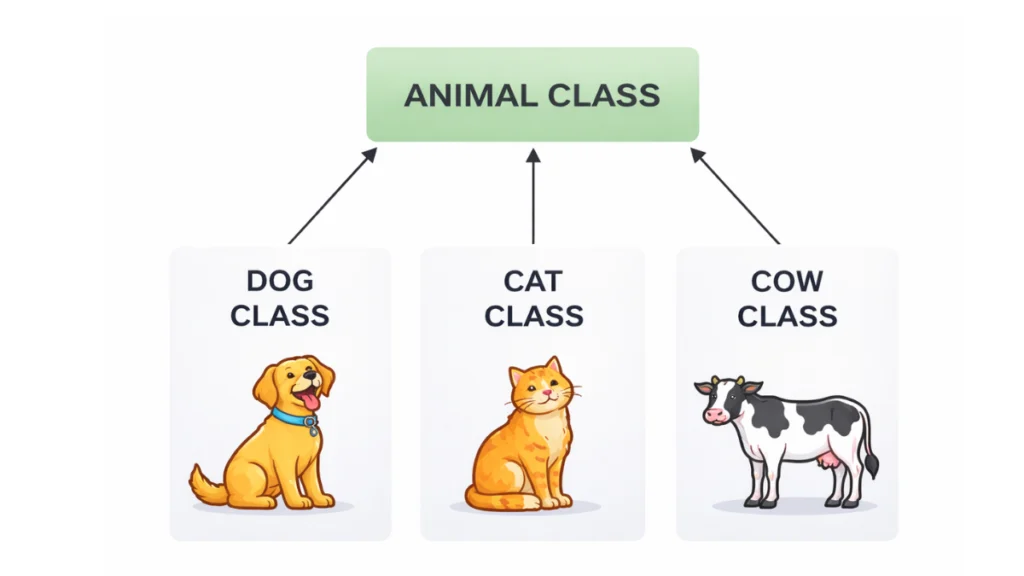
4. Hierarchical Inheritance
One base class → multiple derived classes
class A {};
class B : public A {};
class C : public A {};
5. Hybrid Inheritance
Combination of multiple types (complex structure)
Access Specifiers in Inheritance
| Inheritance Type | Public Members | Protected Members | Private Members |
|---|---|---|---|
| public | public | protected | not accessible |
| protected | protected | protected | not accessible |
| private | private | private | not accessible |
Example:
class A {
protected:
    int x;
};

class B : public A {
public:
    void set() {
        x = 10; // accessible
    }
};
Key Concepts
1. Code Reusability
Reuse existing class code → reduces redundancy
2. Method Overriding
Derived class can redefine base class function
class A {
public:
    void show() {
        cout << "A";
    }
};

class B : public A {
public:
    void show() {
        cout << "B";
    }
};
3. Constructor in Inheritance
Base class constructor runs first
class A {
public:
    A() {
        cout << "Base constructor" << endl;
    }
};

class B : public A {
public:
    B() {
        cout << "Derived constructor" << endl;
    }
};
4. Destructor Order
Destructor runs in reverse order
5. protected Keyword
Allows access in derived classes but not outside
6. super concept in C++
C++ uses base class name instead of super
class B : public A {
public:
    void show() {
        A::show(); // calling base class function
    }
};
Advantages of Inheritance
- ✔ Code reuse
- ✔ Easy maintenance
- ✔ Extensibility
- ✔ Improves readability
- ✔ Supports polymorphism
Disadvantages
- ❌ Tight coupling between classes
- ❌ Can increase complexity
- ❌ Improper use leads to errors
Real-Life Example
Think of:
- Vehicle (Base Class)
- Car, Bike (Derived Classes)
All share common features like speed, engine, but also have unique features.
Interview Questions
- What is inheritance in C++?
- Difference between inheritance and polymorphism?
- Types of inheritance?
- What is multiple inheritance?
- What is diamond problem?
- Difference between public, private, protected inheritance?
- Constructor order in inheritance?
- What is virtual inheritance?
Summary
Inheritance is a powerful feature in C++ that allows one class to inherit properties and behavior from another class, making code reusable, scalable, and easier to manage.
Frequently Asked Questions (FAQs) on Inheritance in C++
1️⃣ What is inheritance in C++?
Inheritance is an OOP concept where a derived class acquires properties and functions of a base class.
2️⃣ Why is inheritance used in C++?
It is used for:
- Code reusability
- Reducing duplication
- Easy maintenance
- Extending existing functionality
3️⃣ What is a base class and derived class?
- Base class → Parent class
- Derived class → Child class that inherits from base class
4️⃣ What does : mean in inheritance?
The : operator is used to define inheritance between classes.
5️⃣ What are the types of inheritance in C++?
- Single
- Multiple
- Multilevel
- Hierarchical
- Hybrid
6️⃣ What is single inheritance?
One derived class inherits from one base class.
7️⃣ What is multiple inheritance?
A derived class inherits from more than one base class.
8️⃣ What is multilevel inheritance?
A class is derived from another derived class (chain structure).
9️⃣ What is hierarchical inheritance?
Multiple classes inherit from the same base class.
🔟 What is hybrid inheritance?
Combination of multiple inheritance types.
1️⃣1️⃣ What are access specifiers in inheritance?
They control visibility of base class members:
publicprotectedprivate
1️⃣2️⃣ Can private members be inherited?
Yes, but they are not directly accessible in derived class.
1️⃣3️⃣ What is function overriding?
When a derived class provides its own implementation of a base class function.
1️⃣4️⃣ What is the order of constructor execution?
- Base class constructor executes first
- Then derived class constructor
1️⃣5️⃣ What is the diamond problem?
It occurs in multiple inheritance when a class inherits from two classes that have a common base class, causing ambiguity.
Solution: Virtual inheritance
For detailed understanding of Platform Devices and Drivers on Linux, refer to the Linux documentation on Platform Devices and Drivers .

Mr. Raj Kumar is a highly experienced Technical Content Engineer with 7 years of dedicated expertise in the intricate field of embedded systems. At Embedded Prep, Raj is at the forefront of creating and curating high-quality technical content designed to educate and empower aspiring and seasoned professionals in the embedded domain.
Throughout his career, Raj has honed a unique skill set that bridges the gap between deep technical understanding and effective communication. His work encompasses a wide range of educational materials, including in-depth tutorials, practical guides, course modules, and insightful articles focused on embedded hardware and software solutions. He possesses a strong grasp of embedded architectures, microcontrollers, real-time operating systems (RTOS), firmware development, and various communication protocols relevant to the embedded industry.
Raj is adept at collaborating closely with subject matter experts, engineers, and instructional designers to ensure the accuracy, completeness, and pedagogical effectiveness of the content. His meticulous attention to detail and commitment to clarity are instrumental in transforming complex embedded concepts into easily digestible and engaging learning experiences. At Embedded Prep, he plays a crucial role in building a robust knowledge base that helps learners master the complexities of embedded technologies.