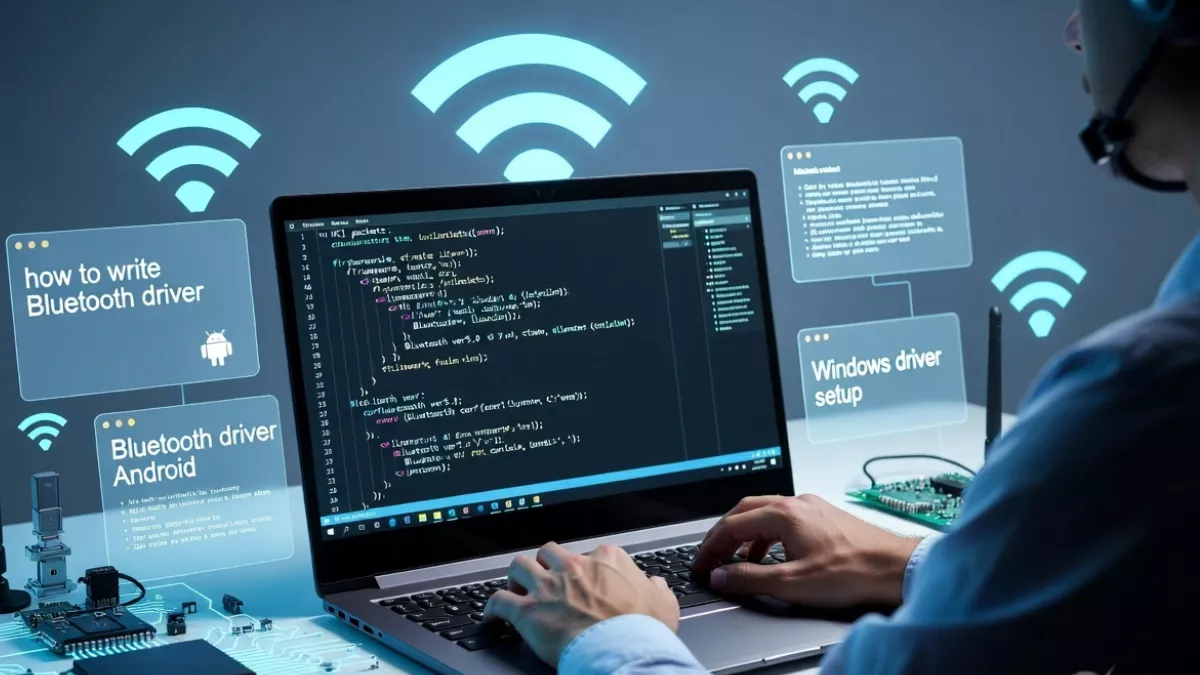
Bluetooth driver guide for beginners and developers. Learn how to write a Bluetooth driver, add Bluetooth drivers, check Bluetooth version, support Bluetooth ver5.0, and build drivers for Windows and Android step by step.
If you’ve ever wondered how to write Bluetooth driver code from scratch, you’re not alone. Bluetooth looks simple on the surface. You turn it on, connect your earbuds, and it just works. But under the hood, a lot is happening.
In this guide, how to write a Bluetooth driver in a way that actually makes sense. No corporate jargon. No buzzwords. Just clear explanations, practical steps, and the kind of advice I’d give a smart friend over coffee.
This is a long, technical guide designed to help you understand:
- How to write a Bluetooth driver
- How to make a Bluetooth driver for Windows or Linux
- How to add Bluetooth drivers
- How Bluetooth driver Android works
- What Bluetooth driver name means
- How to check Bluetooth version
- What Bluetooth ver5.0 changes
- And even basics like how to connect Bluetooth and how to use Bluetooth
Let’s get into it.
What Is a Bluetooth Driver?
A Bluetooth driver is the software layer that lets your operating system talk to Bluetooth hardware. Think of it as a translator between:
- The Bluetooth chip on your board
- The operating system kernel
- The applications using Bluetooth
Without the driver, the OS has no idea how to send or receive Bluetooth packets.
When someone ask how to write a Bluetooth driver, they usually mean one of these:
- Writing a kernel-level driver for a custom Bluetooth chip
- Porting an existing Bluetooth stack to embedded Linux
- Developing a Bluetooth driver Android layer for a custom device
- Creating a Windows-compatible driver for a new Bluetooth module
The exact steps depend on your platform, but the core concepts are the same.
How Bluetooth Architecture Works (Before Writing Code)
Before you start writing Bluetooth driver code, you need to understand the architecture.
Bluetooth is layered like this:
- Physical Layer – The radio (2.4 GHz)
- Link Layer
- HCI (Host Controller Interface)
- L2CAP
- RFCOMM / ATT / GATT
- Profiles (A2DP, HID, etc.)
Your driver usually interacts at the HCI layer.
If you’re building a custom board with a UART or USB Bluetooth chip, your job is to implement the HCI transport driver. That’s the core of writing Bluetooth driver code.
Step 1: Decide Your Target Platform
When people ask how to make a Bluetooth driver, the first real question is:
For which platform?
- Linux
- Windows (including tai driver bluetooth win 10 use cases)
- Android
- RTOS
- Custom embedded firmware
Let’s break it down.
Writing Bluetooth Driver for Linux
Linux already has a mature Bluetooth stack: BlueZ.
If you’re writing Bluetooth driver for Linux, you’re usually doing one of the following:
- Adding support for a new Bluetooth chip
- Writing an HCI transport driver
- Fixing low-level initialization issues
Common Transport Types
- UART
- USB
- SDIO
- PCIe
Basic Steps
- Identify your Bluetooth chipset
- Check if Linux already supports it
- If not, create a new HCI driver
- Register HCI device with kernel
- Implement open, close, send, receive handlers
Here’s what writing Bluetooth driver code roughly involves:
- Implementing
probe()andremove()for device detection - Registering with
hci_register_dev() - Handling interrupts or polling
- Parsing HCI packets
This is where “writing Bluetooth driver” becomes very hands-on and low-level.
Writing Bluetooth Driver for Windows
If you’re targeting Windows, especially for cases like tai driver bluetooth win 10, the process is different.
Windows uses:
- WDF (Windows Driver Framework)
- KMDF or UMDF
- Bluetooth driver stack integration
How to Add Bluetooth Drivers in Windows
If users are searching how to add Bluetooth drivers, it usually means:
- Install a vendor driver
- Update driver via Device Manager
- Add INF file for custom device
As a developer, you must:
- Write a kernel-mode driver using WDK
- Create INF file
- Sign the driver
- Install using Device Manager
Windows Bluetooth drivers must follow Microsoft’s Bluetooth stack model. You don’t rewrite the whole stack. You implement the lower hardware layer.
Bluetooth Driver Android: What’s Different?
When people search Bluetooth driver Android, they’re usually working with:
- AOSP
- Custom ROM
- Board bring-up
Android uses:
- Linux kernel Bluetooth driver
- BlueZ or Fluoride stack
- HAL (Hardware Abstraction Layer)
To write a Bluetooth driver for Android:
- Implement Linux kernel driver
- Add firmware loading support
- Configure init scripts
- Modify HAL layer if needed
- Test with ADB logs
Most Android Bluetooth issues are firmware loading problems, not actual driver logic errors.
How to Make a Bluetooth Driver From Scratch
Let’s simplify the real process.
If you’re building a custom embedded system and wondering how to make a Bluetooth driver, here’s your roadmap.
Step 1: Read the Chip Datasheet
You need:
- Register map
- HCI transport format
- Initialization sequence
- Firmware loading process
Without this, you’re guessing.
Step 2: Implement Transport Layer
For UART:
- Configure baud rate
- Setup interrupt
- Implement RX and TX buffers
For USB:
- Implement USB class driver
- Handle bulk endpoints
- Parse HCI packets
Step 3: Implement HCI Packet Handling
You must support:
- HCI Command packets
- HCI Event packets
- ACL data packets
This is the heart of how to write Bluetooth driver correctly.
Step 4: Register Device with OS
In Linux:
- Use
hci_register_dev()
In Windows:
- Use WDF device creation
In Android:
- Expose through kernel driver to HAL
Bluetooth Driver Name: Why It Matters
When people search Bluetooth driver name, they usually want to:
- Identify which driver is installed
- Match chipset with driver
- Fix compatibility issues
Examples:
- btusb
- hci_uart
- bcm43xx
- Intel Bluetooth driver
Driver name is important because:
- It defines firmware compatibility
- It determines stack integration
- It affects power management
Always choose a meaningful driver name that matches your hardware family.
How to Check Bluetooth Version
Before you optimize your driver, you should know the hardware capability.
If someone asks how to check Bluetooth version, here’s how:
On Windows
- Device Manager
- Check LMP version in properties
- Map LMP version to spec version
On Linux
Use:
hciconfig -a
On Android
Use:
adb shell dumpsys bluetooth_manager
Bluetooth Ver5.0: Why It Changes Driver Design
Bluetooth ver5.0 introduced:
- Longer range
- Higher data rate (2 Mbps)
- Improved advertising
- LE enhancements
If you’re writing Bluetooth driver for ver5.0 hardware, you must support:
- Extended advertising packets
- New HCI commands
- Updated firmware handling
Older drivers may not handle Bluetooth ver5.0 correctly if not updated.
Firmware Loading in Bluetooth Drivers
Many Bluetooth chips require firmware upload at boot.
This means your driver must:
- Request firmware file
- Load via UART or USB
- Validate checksum
- Reset controller
If firmware loading fails, Bluetooth will not work even if driver loads successfully.
This is one of the most common beginner mistakes in writing Bluetooth driver code.
Power Management in Bluetooth Driver
A proper Bluetooth driver must support:
- Suspend
- Resume
- Low power modes
- Wake signals
Without this, battery drains fast.
On laptops and phones, power management is not optional.
Debugging Bluetooth Driver
You will debug a lot. Here’s how:
Linux
- dmesg
- btmon
- hcidump
Windows
- Event Viewer
- WPP tracing
- DebugView
Android
- logcat
- kernel logs
- Bluetooth HCI snoop log
If you’re serious about how to write Bluetooth driver, you must get comfortable reading raw HCI logs.
How to Add Bluetooth Drivers Properly
If you’re distributing your driver:
Linux
- Add to kernel tree
- Create Kconfig entry
- Update Makefile
- Compile and load
Windows
- Create signed driver package
- Provide INF
- Test in clean environment
Android
- Add to BoardConfig
- Update init scripts
- Push firmware blobs
How to Connect Bluetooth After Driver Is Ready
Once your driver works, users still ask how to connect Bluetooth.
Basic steps:
- Enable Bluetooth
- Scan for devices
- Pair
- Connect profile
If pairing fails, check:
- HCI event errors
- Security level
- IO capability settings
How to Use Bluetooth Correctly in Applications
After driver layer is stable, application developers need to know how to use Bluetooth.
For example:
- Use GATT for BLE
- Use RFCOMM for serial
- Use A2DP for audio
- Use HID for keyboards
Driver provides the pipe. Applications use the pipe.
Common Mistakes Beginners Make
When learning how to write a Bluetooth driver, beginners often:
- Skip datasheet reading
- Ignore firmware loading
- Forget power management
- Hardcode baud rate
- Ignore HCI error codes
Take it slow. Validate each layer.
Testing Strategy for Bluetooth Driver
You should test:
- Cold boot
- Warm reboot
- Suspend resume
- File transfer
- Audio streaming
- BLE advertisement
- Stress test for 24 hours
Real stability comes from long-duration testing.
Performance Optimization Tips
For Bluetooth ver5.0 devices:
- Enable 2M PHY
- Optimize interrupt handling
- Reduce context switches
- Use DMA where possible
Good drivers are efficient and stable.
Final Thoughts on How to Write Bluetooth Driver
Writing a Bluetooth driver is not magic. It’s structured engineering work.
If you understand:
- HCI architecture
- Transport layer
- Firmware loading
- OS integration
- Power management
- Debugging tools
You can write a solid Bluetooth driver.
Whether you’re working on:
- Bluetooth driver Android
- tai driver bluetooth win 10
- Embedded Linux board
- Custom IoT device
The fundamentals stay the same. Take it step by step. Start with transport. Validate HCI. Confirm firmware. Test pairing. Optimize power.
That’s how you write a Bluetooth driver that actually works in the real world And once you build your first one, you’ll never look at the Bluetooth icon the same way again.
Frequently Asked Questions (FAQ) About Bluetooth Driver
1. How to write Bluetooth driver for beginners?
If you’re learning how to write Bluetooth driver as a beginner, start by understanding the Bluetooth architecture. Focus on:
- HCI layer
- Transport protocol (UART, USB, SDIO)
- Firmware loading
- OS integration
Begin with Linux because it has better documentation and open-source references. Study existing drivers before writing your own. Writing Bluetooth driver becomes easier once you understand packet flow and interrupt handling.
2. How to write a Bluetooth driver for Windows 10?
If you’re working on tai driver bluetooth win 10 type scenarios, you need to use:
- Windows Driver Kit (WDK)
- KMDF or UMDF framework
- Proper INF file configuration
- Driver signing
When people search how to write a Bluetooth driver for Windows, they usually need to integrate their hardware with Microsoft’s Bluetooth stack rather than build everything from scratch.
3. How to add Bluetooth drivers manually?
If Bluetooth is not working, users often search how to add Bluetooth drivers. You can:
On Windows:
- Open Device Manager
- Right-click device
- Update driver
- Install using INF file
On Linux:
- Load module using modprobe
- Compile driver into kernel
- Enable through Kconfig
For custom hardware, you must ensure firmware files are correctly placed in the firmware directory.
4. How to make a Bluetooth driver for custom hardware?
To make a Bluetooth driver, you need:
- Hardware datasheet
- Register map
- Transport interface details
- Firmware loading sequence
You implement the transport layer first, then register the device with the OS Bluetooth stack. This is the core process behind writing Bluetooth driver code.
5. What is Bluetooth driver Android and how does it work?
Bluetooth driver Android is usually a Linux kernel driver combined with Android’s HAL (Hardware Abstraction Layer).
It includes:
- Kernel-level HCI driver
- Firmware loader
- Android Bluetooth stack integration
If Bluetooth is not turning on in Android, most of the time the issue is firmware loading failure inside the driver.
6. What is Bluetooth driver name and why is it important?
Bluetooth driver name identifies which driver module is controlling your Bluetooth hardware.
Examples:
- btusb
- hci_uart
- Intel Bluetooth driver
Knowing the Bluetooth driver name helps when debugging, updating firmware, or checking compatibility issues.
7. How to check Bluetooth version in your system?
If you want to know whether your system supports Bluetooth ver5.0 or older versions:
On Windows:
- Open Device Manager
- Check LMP version in advanced settings
On Linux:
- Use hciconfig -a
Mapping LMP version tells you whether your hardware supports Bluetooth ver5.0, 4.2, or older standards.
8. What is special about Bluetooth ver5.0 in driver development?
Bluetooth ver5.0 introduced:
- Higher data rate (2 Mbps)
- Extended advertising
- Longer range
When writing Bluetooth driver for Bluetooth ver5.0 hardware, you must support updated HCI commands and extended packet handling.
9. How to connect Bluetooth after installing driver?
After installing the Bluetooth driver:
- Enable Bluetooth
- Scan devices
- Pair
- Connect
If connection fails, check HCI logs and ensure firmware loaded correctly. Many connection issues are actually driver initialization problems.
10. How to use Bluetooth correctly after driver setup?
To understand how to use Bluetooth properly:
- Use GATT for BLE devices
- Use A2DP for audio streaming
- Use HID for keyboards and mouse
- Use RFCOMM for serial communication
The Bluetooth driver handles hardware communication, but applications use Bluetooth profiles to transfer data.
11. Is writing Bluetooth driver difficult?
Writing Bluetooth driver is not impossible, but it requires:
- Understanding of kernel programming
- Hardware communication knowledge
- Debugging skills
- Patience
Start small. Test step by step. Validate packet flow. That’s the practical way to master writing Bluetooth driver.
Next Steps: Check out our guides onSPI driver development, platform device drivers, and writing device tree overlays on embeddedprep.com.

Mr. Raj Kumar is a highly experienced Technical Content Engineer with 7 years of dedicated expertise in the intricate field of embedded systems. At Embedded Prep, Raj is at the forefront of creating and curating high-quality technical content designed to educate and empower aspiring and seasoned professionals in the embedded domain.
Throughout his career, Raj has honed a unique skill set that bridges the gap between deep technical understanding and effective communication. His work encompasses a wide range of educational materials, including in-depth tutorials, practical guides, course modules, and insightful articles focused on embedded hardware and software solutions. He possesses a strong grasp of embedded architectures, microcontrollers, real-time operating systems (RTOS), firmware development, and various communication protocols relevant to the embedded industry.
Raj is adept at collaborating closely with subject matter experts, engineers, and instructional designers to ensure the accuracy, completeness, and pedagogical effectiveness of the content. His meticulous attention to detail and commitment to clarity are instrumental in transforming complex embedded concepts into easily digestible and engaging learning experiences. At Embedded Prep, he plays a crucial role in building a robust knowledge base that helps learners master the complexities of embedded technologies.