Learn Inheritance in C++ with simple examples, syntax, types, and access specifiers. A complete beginner to advanced guide for interviews and exams.
Inheritance in C++ is an Object-Oriented Programming (OOP) concept where one class (called the derived class) acquires the properties and behavior (variables and functions) of another class (called the base class).
In simple terms:
Inheritance allows you to reuse existing code and build new features on top of it.
Basic Syntax
class BaseClass {
// data members and member functions
};

class DerivedClass : access_specifier BaseClass {
// additional members of derived class
};
Example :
class BaseClass {
public:
    int a;

    void display() {
        cout << "This is base class" << endl;
    }
};

class DerivedClass : public BaseClass {
public:
    void show() {
        cout << "This is derived class" << endl;
    }
};
Example Program
#include <iostream>
using namespace std;

class Animal {
public:
    void eat() {
        cout << "Animal eats" << endl;
    }
};

class Dog : public Animal {
public:
    void bark() {
        cout << "Dog barks" << endl;
    }
};

int main() {
    Dog d;
    d.eat();   // inherited from Animal
    d.bark();  // own function
    return 0;
}
Output:
Animal eats
Dog barks
How Inheritance Works in C++
1.Base Class is Created
The base class contains common properties and functions.
class Animal {
public:
    void eat() {
        cout << "Animal eats" << endl;
    }
};
2.Derived Class Inherits Base Class
The derived class uses : to inherit from the base class.
class Dog : public Animal {
public:
    void bark() {
        cout << "Dog barks" << endl;
    }
};
3.Object of Derived Class is Created
When you create an object of the derived class, it can access:
- Its own methods
- Inherited methods from base class
int main() {
    Dog d;
    d.eat();   // inherited function
    d.bark();  // own function
}
Internal Working of Inheritance
Memory Sharing
- The derived class object contains base class data + its own data
- No duplication of code
Conceptually:
Dog object = Animal properties + Dog properties
Function Access
- Derived class can directly use public and protected members
- Cannot access private members of base class directly
Constructor Execution Order
When object is created:
- Base class constructor runs first
- Derived class constructor runs next
class A {
public:
    A() {
        cout << "Base Constructor" << endl;
    }
};

class B : public A {
public:
    B() {
        cout << "Derived Constructor" << endl;
    }
};
Output:
Base Constructor
Derived Constructor
Destructor Order (Reverse)
When object is destroyed:
- Derived class destructor runs
- Base class destructor runs
Function Overriding
Derived class can override base class function
class A {
public:
    void show() {
        cout << "Base";
    }
};

class B : public A {
public:
    void show() {
        cout << "Derived";
    }
};
Access Specifiers in C++ Inheritance
In inheritance, access specifiers define how the base class members are accessible in the derived class.
Types of Access Specifiers
public
- Accessible everywhere
- Can be used inside and outside the class
protected
- Accessible within the class and derived class
- Not accessible outside
private
- Accessible only within the same class
- Not accessible in derived class directly
Syntax with Access Specifier
class DerivedClass : access_specifier BaseClass {
    // code
};
Example:
class B : public A
How Access Specifiers Work in Inheritance
| Inheritance Type | Base public → | Base protected → | Base private → |
|---|---|---|---|
public | public | protected | ❌ not accessible |
protected | protected | protected | ❌ not accessible |
private | private | private | ❌ not accessible |
Example Code
#include <iostream>
using namespace std;

class A {
public:
    int x = 10;

protected:
    int y = 20;

private:
    int z = 30;
};

class B : public A {
public:
    void show() {
        cout << x << endl; // ✅ public → accessible
        cout << y << endl; // ✅ protected → accessible
        // cout << z; ❌ private → not accessible
    }
};

int main() {
    B obj;
    obj.show();
    cout << obj.x; // ✅ public accessible outside
    // cout << obj.y; ❌ not accessible outside
}
Key Points
public → accessible everywhereprotected → accessible in child class onlyprivate → not accessible in child class
Default inheritance:
class→ private inheritancestruct→ public inheritance
Real-Life Working Example
Think of:
- Parent Class: Vehicle
- Child Class: Car
Car automatically gets:
- speed
- engine
But also adds:
- air conditioning
- music system
Why Inheritance is Used in C++
Benefits
- Code reusability
- Reduces duplication
- Easy maintenance
- Supports polymorphism
- Improves readability
Important Points
- Inheritance uses
:operator - Base class constructor executes first
- Private members are not directly accessible
- Supports multiple types (single, multiple, multilevel, etc.)
- Used for “is-a” relationship (Dog is an Animal)
What is the use of : in C++ Inheritance?
In C++, the colon : is used to specify inheritance.
It tells the compiler that:
“This class is inheriting from another class.”
Basic Syntax
class DerivedClass : public BaseClass {
};
Here:
:→ means inherit frompublic→ access specifierBaseClass→ parent class
How : Works
When you write:
class B : public A {
};
It means:
- Class B gets properties and functions of class A
- B becomes child (derived class)
- A becomes parent (base class)
Example
#include <iostream>
using namespace std;

class A {
public:
    void show() {
        cout << "Base class" << endl;
    }
};

class B : public A {
};

int main() {
    B obj;
    obj.show();  // inherited using :
}
Without : → inheritance will NOT happen
Without : (No Inheritance)
class B {
};
Now:
- B has no relation with A
- Cannot access A’s functions
Real Meaning of :
Think of it like:
: = “is derived from”
: = “inherits from”
Important Uses of :
1. To inherit a class
class Child : public Parent2. Multiple inheritance
class C : public A, public B3. Access control during inheritance
class B : private ATypes of Inheritance in C++
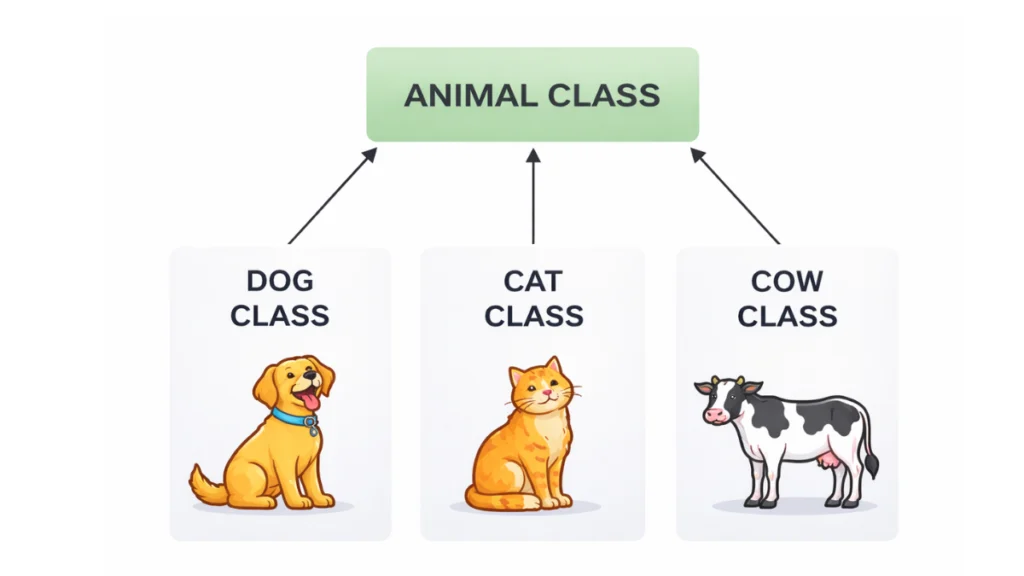
1. Single Inheritance
One base class → One derived class
class A {};
class B : public A {};
2. Multiple Inheritance
One derived class inherits from multiple base classes
class A {};
class B {};
class C : public A, public B {};
3. Multilevel Inheritance
Chain of inheritance
class A {};
class B : public A {};
class C : public B {};
4. Hierarchical Inheritance
One base class → multiple derived classes
class A {};
class B : public A {};
class C : public A {};
5. Hybrid Inheritance
Combination of multiple types (complex structure)
Access Specifiers in Inheritance
| Inheritance Type | Public Members | Protected Members | Private Members |
|---|---|---|---|
| public | public | protected | not accessible |
| protected | protected | protected | not accessible |
| private | private | private | not accessible |
Example:
class A {
protected:
    int x;
};

class B : public A {
public:
    void set() {
        x = 10; // accessible
    }
};
Key Concepts
1. Code Reusability
Reuse existing class code → reduces redundancy
2. Method Overriding
Derived class can redefine base class function
class A {
public:
    void show() {
        cout << "A";
    }
};

class B : public A {
public:
    void show() {
        cout << "B";
    }
};
3. Constructor in Inheritance
Base class constructor runs first
class A {
public:
    A() {
        cout << "Base constructor" << endl;
    }
};

class B : public A {
public:
    B() {
        cout << "Derived constructor" << endl;
    }
};
4. Destructor Order
Destructor runs in reverse order
5. protected Keyword
Allows access in derived classes but not outside
6. super concept in C++
C++ uses base class name instead of super
class B : public A {
public:
    void show() {
        A::show(); // calling base class function
    }
};
Advantages of Inheritance
- ✔ Code reuse
- ✔ Easy maintenance
- ✔ Extensibility
- ✔ Improves readability
- ✔ Supports polymorphism
Disadvantages
- ❌ Tight coupling between classes
- ❌ Can increase complexity
- ❌ Improper use leads to errors
Real-Life Example
Think of:
- Vehicle (Base Class)
- Car, Bike (Derived Classes)
All share common features like speed, engine, but also have unique features.
Interview Questions
- What is inheritance in C++?
- Difference between inheritance and polymorphism?
- Types of inheritance?
- What is multiple inheritance?
- What is diamond problem?
- Difference between public, private, protected inheritance?
- Constructor order in inheritance?
- What is virtual inheritance?
Summary
Inheritance is a powerful feature in C++ that allows one class to inherit properties and behavior from another class, making code reusable, scalable, and easier to manage.
Frequently Asked Questions (FAQs) on Inheritance in C++
1️⃣ What is inheritance in C++?
Inheritance is an OOP concept where a derived class acquires properties and functions of a base class.
2️⃣ Why is inheritance used in C++?
It is used for:
- Code reusability
- Reducing duplication
- Easy maintenance
- Extending existing functionality
3️⃣ What is a base class and derived class?
- Base class → Parent class
- Derived class → Child class that inherits from base class
4️⃣ What does : mean in inheritance?
The : operator is used to define inheritance between classes.
5️⃣ What are the types of inheritance in C++?
- Single
- Multiple
- Multilevel
- Hierarchical
- Hybrid
6️⃣ What is single inheritance?
One derived class inherits from one base class.
7️⃣ What is multiple inheritance?
A derived class inherits from more than one base class.
8️⃣ What is multilevel inheritance?
A class is derived from another derived class (chain structure).
9️⃣ What is hierarchical inheritance?
Multiple classes inherit from the same base class.
🔟 What is hybrid inheritance?
Combination of multiple inheritance types.
1️⃣1️⃣ What are access specifiers in inheritance?
They control visibility of base class members:
publicprotectedprivate
1️⃣2️⃣ Can private members be inherited?
Yes, but they are not directly accessible in derived class.
1️⃣3️⃣ What is function overriding?
When a derived class provides its own implementation of a base class function.
1️⃣4️⃣ What is the order of constructor execution?
- Base class constructor executes first
- Then derived class constructor
1️⃣5️⃣ What is the diamond problem?
It occurs in multiple inheritance when a class inherits from two classes that have a common base class, causing ambiguity.
Solution: Virtual inheritance
For detailed understanding of Platform Devices and Drivers on Linux, refer to the Linux documentation on Platform Devices and Drivers .
Leave a Reply