Embedded Linux : If you’ve ever wondered what’s behind the operating heart of smart devices, robots, drones, and industrial computers, you’ve likely bumped into the term Embedded Linux System. This isn’t just a buzzword engineers throw around. It’s a real, practical, open‑source platform powering millions of devices worldwide.
In this article, I’ll walk you through what an Embedded Linux System is, why it’s so popular, its key components like bootrom, bootloader, root filesystem, initiation package, and how you can build your own Embedded Linux from scratch.
By the end, you’ll not only understand how it all fits together, but also how to approach it in your own projects.
Let’s get into it.
What Is an Embedded Linux System?
The term Embedded Linux System simply means using the Linux operating system in a device that is not a desktop or laptop, but a specialized hardware with a dedicated function. Think of devices like:
- Smart thermostats
- Network routers
- Automotive infotainment systems
- Industrial controllers
- Wearables and IoT devices
In these systems, Linux isn’t just an afterthought; it’s the core that manages hardware, memory, processes, and user applications. Unlike traditional Linux on a PC, Embedded Linux is trimmed, configured, and optimized for the target hardware.
The beauty of Embedded Linux is that it’s open‑source, flexible, and adaptable. You can create systems that boot fast, use minimal resources, and still have powerful functionality.
Why Use Linux in Embedded Devices?
You might ask: Why not use a smaller OS or microcontroller firmware? Here’s why:
- Rich Feature Set: Linux has built‑in networking, filesystems, process scheduling, drivers, security, and more.
- Community Support: Embedded Linux has a huge global community, countless online resources, and continuous improvements.
- Hardware Support: From ARM to RISC‑V and x86, Linux supports most processor architectures.
- Open Source Without Cost: You don’t need expensive licenses.
- Scalable: For simple devices and complex ones alike.
It’s a win‑win when you need an OS that’s robust, maintained by community, and flexible enough to tailor.
Anatomy of an Embedded Linux System
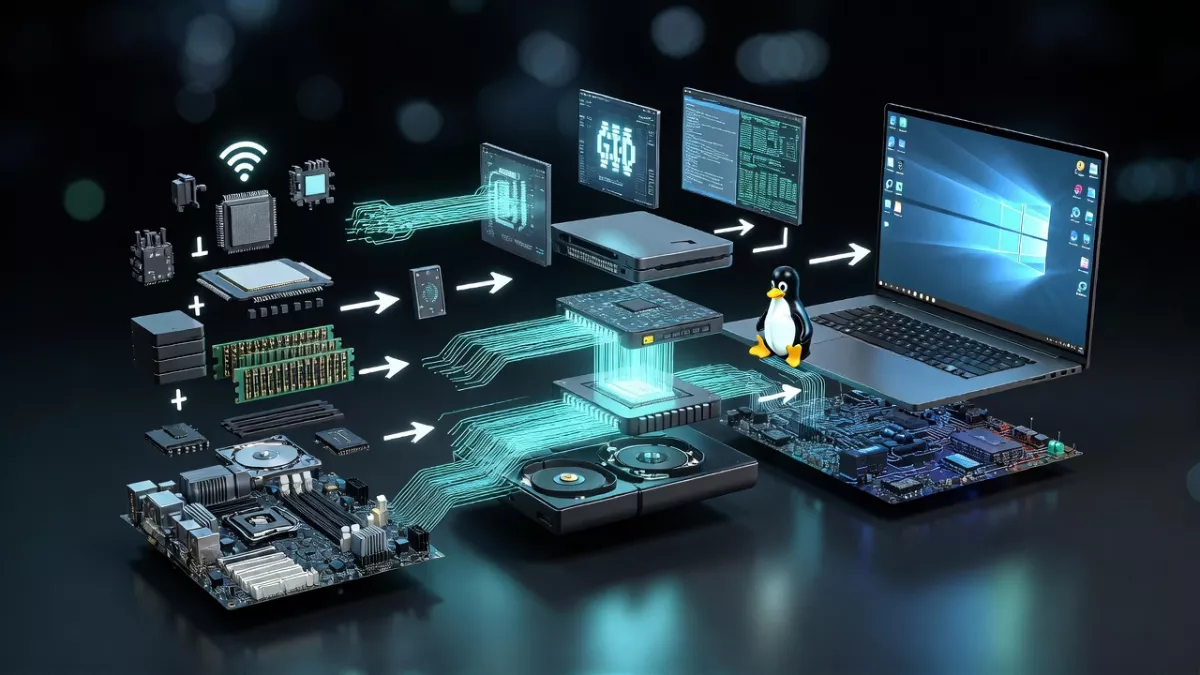
To understand how an Embedded Linux System works, let’s break it down into major components. These form the backbone of how the device boots and eventually runs applications.
1. Bootrom (ROM / Mask ROM)
Imagine turning on your device and it instantly knowing what to do first. That’s the bootrom in action.
- It’s a small piece of code stored in read‑only memory.
- It activates when power is applied.
- Its job is to set up basic hardware, such as clocks and memory.
- Then it loads the main loader (bootloader) into RAM.
Bootrom is like the wake‑up call for the device’s hardware. It’s usually provided by the chip manufacturer and is specific to the silicon.
2. Bootloader
Once the bootrom has done its job, it hands control over to the bootloader.
Think of the bootloader as the traffic controller. It loads the Linux kernel (the core part of the OS) into memory, sets up necessary kernel parameters, and then starts the kernel.
The bootloader may be responsible for:
- Initializing hardware interfaces
- Detecting peripherals
- Selecting which kernel to boot
- Setting up memory management unit (MMU)
- Offering debug or recovery menus
Common bootloaders in Embedded Linux include U‑Boot and Barebox.
Bootloader steps typically are:
- Execute from flash storage
- Initialize memory and CPU
- Load the Linux kernel
- Pass control to the kernel
Without the bootloader, your kernel would never start.
3. Linux Kernel
Now we get into the heart of the system — the Linux kernel.
The kernel is responsible for:
- Process management
- Memory management
- Device drivers
- Filesystems
- Scheduling
- Interrupt handling
In Embedded Linux, the kernel is usually customized:
- Only selected drivers are compiled in
- Optional features can be trimmed
- Size and footprint are optimized
But the core remains the same Linux codebase that runs on desktops — with tweaks for embedded hardware.
4. Application Binaries & Rootfs (Root Filesystem)
Once Linux starts, it needs something to run. That’s where application binaries and the root filesystem (rootfs) come into play.
What is Rootfs?
The root filesystem contains all the executables, configurations, libraries, scripts, and directories that define your embedded Linux environment.
Typically, it includes:
- Binaries (like shell tools, daemons)
- Libraries (shared or static)
- Configuration files
- Init scripts
- Device nodes
You might build your rootfs with tools like Buildroot, Yocto, or custom scripts.
Application Binaries
These are the executables running on the system — your programs.
In embedded devices, applications could be:
- Sensor data loggers
- Network services
- UI applications
- Device drivers
- Communication daemons
You choose what goes into rootfs based on your use case.
5. Init Package
When Linux finishes booting and kernel startup is complete, the system runs the Init package.
Traditionally in Linux, the init process (PID 1) is the first user‑level program. In Embedded Linux, init:
- Starts system services
- Mounts filesystems
- Launches background processes
- Prepares the device to run applications
Common init systems in embedded Linux include:
- BusyBox init
- systemd (for larger systems)
- custom init scripts
Init is like a stage manager — making sure everything starts in the right order.
How These Components Work Together
Now let’s connect the dots:
- Power On: device gets electricity
- Bootrom runs: wakes up hardware
- Bootloader loads: brings Linux kernel into RAM
- Kernel starts: initializes OS level hardware and drivers
- Init runs: starts services and apps
- Applications execute: device begins normal function
This flow is how every Embedded Linux system becomes a working product.
Understanding the Boot Process in Embedded Linux
To truly master Embedded Linux, you have to understand the boot sequence.
Step 1: Bootrom
The processor resets and starts execution from a predefined memory location. This location contains the bootrom code.
Bootrom checks:
- Basic memory and clock
- Security validations (sometimes)
- External storage location
Usually, bootrom finds the bootloader on flash and loads it to RAM.
Step 2: Bootloader
Bootloader takes over:
- Initializes SDRAM
- Parses boot configurations
- Loads the Linux kernel image
- Loads device tree (hardware description)
- Starts the kernel
At this point, you see debug prints on UART if you’ve configured early debug.
Step 3: Kernel Startup
Kernel decompresses itself and configures:
- Memory
- Scheduler
- Interrupts
- Drivers
- Filesystems
Then control is handed to init.
Step 4: Init
Init runs scripts or config files to start services:
- Mounts root filesystem
- Starts networking
- Launches main application
And that’s your embedded Linux device running!
Building an Embedded Linux System
The magic really begins when you build an Embedded Linux System from scratch. Let’s break down the build steps in a way that makes sense.
You need three things:
- Toolchain
- Linux Kernel
- Root Filesystem
1. Setup a Cross‑Compilation Toolchain
Embedded systems usually run on different CPUs (like ARM). You can’t compile directly on your development PC. You need a cross‑compiler.
A common toolchain is:
arm‑linux‑gnueabi‑gcc
This compiler builds binaries that run on ARM devices.
You typically install the toolchain or build it using tools like:
- Crosstool‑NG
- Prebuilt GCC toolchains
The toolchain allows you to build:
- The kernel
- Applications
- Target libraries
2. Configure and Build the Linux Kernel
Start by downloading the Linux kernel source.
Example:
make ARCH=arm CROSS_COMPILE=arm-linux-gnueabi- defconfig
make ARCH=arm
This configures and builds the kernel for your target hardware.
Tip: Always use the kernel config provided by your board vendor or SoC vendor — it will save time.
3. Build a Root Filesystem
There are three popular ways to build rootfs:
- BusyBox
- Buildroot
- Yocto Project
BusyBox
BusyBox gives you a tiny shell and core utilities.
make menuconfig
make
make install
It gives you basic commands like ls, cp, mount, etc.
Buildroot
Buildroot is an automated system to create rootfs, kernel, bootloader, and toolchain.
You select the packages you want, and Buildroot generates everything.
Yocto
Yocto is more complex but very powerful. If you need commercial‑level customization, Yocto is the choice.
Tips to Make Your Embedded Linux System Better
Here’s what I’d share as practical advice:
Use a Proper Toolchain
If your binaries aren’t built with the right cross compiler, they won’t run.
Strip Unused Features
Embedded systems often have limited memory. Trim excess:
- Unused drivers
- Unneeded services
- Large libraries
Enable Debug Early
Configure UART logging at boot. It helps debug early boot issues.
Use Version Control
Always keep kernel patches, configs, and rootfs scripts in Git.
Start Small
Begin with BusyBox before jumping into Yocto.
Embedded Linux System Interview Questions & Answers
Round 1 – Basic / Fundamentals
1. What is Embedded Linux?
Answer:
Embedded Linux is a Linux operating system customized for embedded devices with limited resources and dedicated functionality. Unlike desktop Linux, it is optimized in terms of size, boot time, and hardware support. It runs on devices like routers, IoT devices, automotive controllers, and wearables.
2. Why is Linux used in embedded systems?
Answer:
- Open-source and free
- Scalable and flexible
- Supports various hardware architectures (ARM, RISC-V, x86)
- Rich device driver and networking support
- Strong community and documentation
3. What is the difference between embedded Linux and desktop Linux?
Answer:
| Feature | Desktop Linux | Embedded Linux |
|---|---|---|
| Purpose | General computing | Specific device control |
| Boot Time | Longer | Fast boot, optimized |
| Memory Usage | Large | Small, optimized |
| Kernel Size | Standard | Trimmed/customized |
| User Interface | GUI | Often minimal/none |
4. What are the key components of an Embedded Linux System?
Answer:
- Bootrom
- Bootloader
- Linux Kernel
- Root filesystem (rootfs) & application binaries
- Init package (init system)
5. What is bootrom in embedded Linux?
Answer:
Bootrom is a small read-only memory code executed at power-on. It initializes basic hardware like clocks, memory, and peripherals and loads the bootloader into RAM. It is usually provided by the chip manufacturer.
6. What is a bootloader? Name some bootloaders used in Embedded Linux.
Answer:
Bootloader is the program that loads the Linux kernel into memory after bootrom execution. It initializes hardware and sets up memory and kernel parameters.
Examples: U-Boot, Barebox
7. What is the root filesystem (rootfs)?
Answer:
Rootfs contains all user-space files, libraries, and applications. It allows Linux to run processes and applications. Rootfs can be built using Buildroot, BusyBox, or Yocto.
8. What is init in Embedded Linux?
Answer:
Init is the first user-space process (PID 1) executed by the kernel. It initializes system services, mounts rootfs, and launches applications. Examples: BusyBox init, systemd, or custom init scripts.
9. What is the difference between statically and dynamically linked applications in Embedded Linux?
Answer:
- Statically linked: All required libraries are included in the binary. Larger size but independent.
- Dynamically linked: Uses shared libraries at runtime. Smaller binaries but requires libraries to be present.
10. Name some common file systems used in Embedded Linux.
Answer:
- ext4
- cramfs (Compressed ROM file system)
- JFFS2 (Journaling Flash File System)
- UBIFS (Unsorted Block Image File System)
- squashfs (compressed read-only filesystem)
11. What is a cross-compilation toolchain?
Answer:
It’s a set of tools (compiler, linker, libraries) that runs on one architecture (e.g., x86 PC) and generates binaries for a different target architecture (e.g., ARM) used in embedded devices.
12. What is Buildroot? What is Yocto?
Answer:
- Buildroot: Simplified tool to generate rootfs, kernel, and bootloader for embedded devices.
- Yocto: Advanced build system for creating customizable Linux distributions with recipes and layers.
13. Explain the Embedded Linux boot sequence.
Answer:
- Bootrom: Powers on and initializes hardware.
- Bootloader: Loads kernel & device tree, sets up memory.
- Kernel: Initializes hardware, drivers, and mounts rootfs.
- Init: Starts system services and applications.
14. What is a device tree (DT)?
Answer:
Device tree is a data structure that describes hardware components to the Linux kernel so it can initialize devices without hardcoding the drivers in the kernel. It’s essential for ARM and embedded boards.
15. What is BusyBox?
Answer:
BusyBox provides lightweight Unix utilities (shell, ls, cp, mount, etc.) for embedded systems. It’s often used to build minimal rootfs.
Round 2 – Advanced / Implementation / Hands-on
1. How do you build an Embedded Linux system from scratch?
Answer:
- Set up cross-compilation toolchain.
- Download and configure the Linux kernel for the target board.
- Build rootfs using Buildroot, BusyBox, or Yocto.
- Flash bootloader, kernel, and rootfs to target storage.
- Boot device and test system.
2. What is the role of the device tree blob (DTB) in booting Linux?
Answer:
The DTB tells the kernel about the hardware layout: memory, peripherals, GPIOs, interrupts, and buses. The bootloader passes the DTB to the kernel at startup.
3. How can you debug boot issues in Embedded Linux?
Answer:
- Enable UART/serial debug prints in bootloader and kernel.
- Use early printk in kernel for early messages.
- Use JTAG or GDB for low-level debugging.
- Check log files in rootfs if system boots partially.
4. How do you add a custom application to Embedded Linux?
Answer:
- Compile the application with cross-compiler.
- Place it in rootfs (usually /usr/bin).
- Update init scripts to run the application at startup.
5. How to reduce boot time in Embedded Linux?
Answer:
- Trim unnecessary drivers from kernel.
- Reduce services started by init.
- Use compressed initramfs.
- Optimize bootloader delay settings.
6. How is memory managed in Embedded Linux?
Answer:
- Kernel manages physical memory and virtual memory.
- Uses page tables, slab allocator, and buddy allocator.
- Embedded Linux may disable swap to save storage.
7. How do you debug user-space issues?
Answer:
- Use GDB for debugging applications.
- Enable strace for system call tracing.
- Use logging in applications.
- Monitor with top, htop, free, or procfs utilities.
8. How do you flash Embedded Linux onto a target board?
Answer:
- Prepare bootloader, kernel, and rootfs images.
- Use tools like
dd,fastboot, or vendor-specific flasher. - Boot from SD card or internal flash depending on the board.
9. What is initramfs and how is it different from rootfs?
Answer:
- initramfs: Temporary in-memory filesystem used during early boot before rootfs is mounted.
- rootfs: Final persistent filesystem where applications run.
10. How do you handle device drivers in Embedded Linux?
Answer:
- Compile drivers into the kernel (built-in) or as modules.
- Load modules using
insmodormodprobe. - Use
/procor/sysfor debugging device driver behavior.
11. What are some optimization strategies for Embedded Linux?
Answer:
- Use static linking for critical applications.
- Strip unused libraries.
- Use lightweight shells like BusyBox.
- Optimize kernel configuration.
- Enable only necessary modules and services.
12. What is the difference between init, systemd, and BusyBox init?
Answer:
| Init System | Features | Use Case |
|---|---|---|
| SysVinit | Script-based, sequential | Simple systems |
| systemd | Parallel service startup, logging | Complex embedded systems |
| BusyBox init | Minimal, script-based | Tiny, resource-limited devices |
13. How do you configure kernel for a specific embedded board?
Answer:
- Get board-specific defconfig:
make <board>_defconfig - Customize kernel using
make menuconfig - Enable/disable drivers, features, and filesystems
- Compile with cross-compiler:
make ARCH=arm CROSS_COMPILE=<toolchain>
14. Explain how you handle networking in Embedded Linux.
Answer:
- Use built-in kernel networking stack.
- Configure Ethernet/Wi-Fi through config files or scripts.
- Use DHCP or static IP.
- Debug using
ifconfig,ip,ping, andtcpdump.
15. How do you test an Embedded Linux System?
Answer:
- Boot the system and check kernel logs (
dmesg) - Verify services started by init
- Run application binaries and verify output
- Check hardware interfaces using GPIO/I2C/SPI
- Stress test memory, CPU, and peripherals
16. How do you update or upgrade Embedded Linux?
Answer:
- Flash new bootloader or kernel images
- Replace rootfs with updated binaries
- Use OTA (Over-The-Air) updates in IoT devices
17. How do you handle security in Embedded Linux?
Answer:
- Disable unused services
- Enable kernel security modules (SELinux, AppArmor)
- Use signed bootloaders and kernel
- Encrypt sensitive data in storage
18. What is a real-world example of Embedded Linux System?
Answer:
- Automotive: Infotainment systems
- Industrial: PLC controllers
- IoT: Smart home devices
- Networking: Routers, firewalls
With these 30+ questions and answers, you cover both rounds fully:
- Round 1: Basic understanding, components, boot process, rootfs, init, kernel concepts
- Round 2: Advanced implementation, cross-compilation, debugging, optimization, drivers, flashing, networking, security
Frequently Asked Questions (FAQ)
What distinguishes an Embedded Linux System from regular Linux?
Embedded Linux is tailored for specific hardware and functions, with optimized size, boot time, and fixed features.
Can I run graphical applications on Embedded Linux?
Yes, if your hardware supports it. With frameworks like Wayland or X11 and a toolchain configured, you can build UI apps.
Why is Linux popular in embedded systems?
Because it’s open‑source, flexible, supports lots of hardware, and is backed by a huge ecosystem.
Conclusion
An Embedded Linux System is more than a concept. It’s a real, flexible, reliable foundation for modern intelligent machines. It gives developers the freedom to build optimized systems, manage hardware efficiently, and deploy powerful applications even with limited resources.
Read More about Process : What is is Process
Read More about System Call in Linux : What is System call
Read More about IPC : What is IPC


Mr. Raj Kumar is a highly experienced Technical Content Engineer with 7 years of dedicated expertise in the intricate field of embedded systems. At Embedded Prep, Raj is at the forefront of creating and curating high-quality technical content designed to educate and empower aspiring and seasoned professionals in the embedded domain.
Throughout his career, Raj has honed a unique skill set that bridges the gap between deep technical understanding and effective communication. His work encompasses a wide range of educational materials, including in-depth tutorials, practical guides, course modules, and insightful articles focused on embedded hardware and software solutions. He possesses a strong grasp of embedded architectures, microcontrollers, real-time operating systems (RTOS), firmware development, and various communication protocols relevant to the embedded industry.
Raj is adept at collaborating closely with subject matter experts, engineers, and instructional designers to ensure the accuracy, completeness, and pedagogical effectiveness of the content. His meticulous attention to detail and commitment to clarity are instrumental in transforming complex embedded concepts into easily digestible and engaging learning experiences. At Embedded Prep, he plays a crucial role in building a robust knowledge base that helps learners master the complexities of embedded technologies.