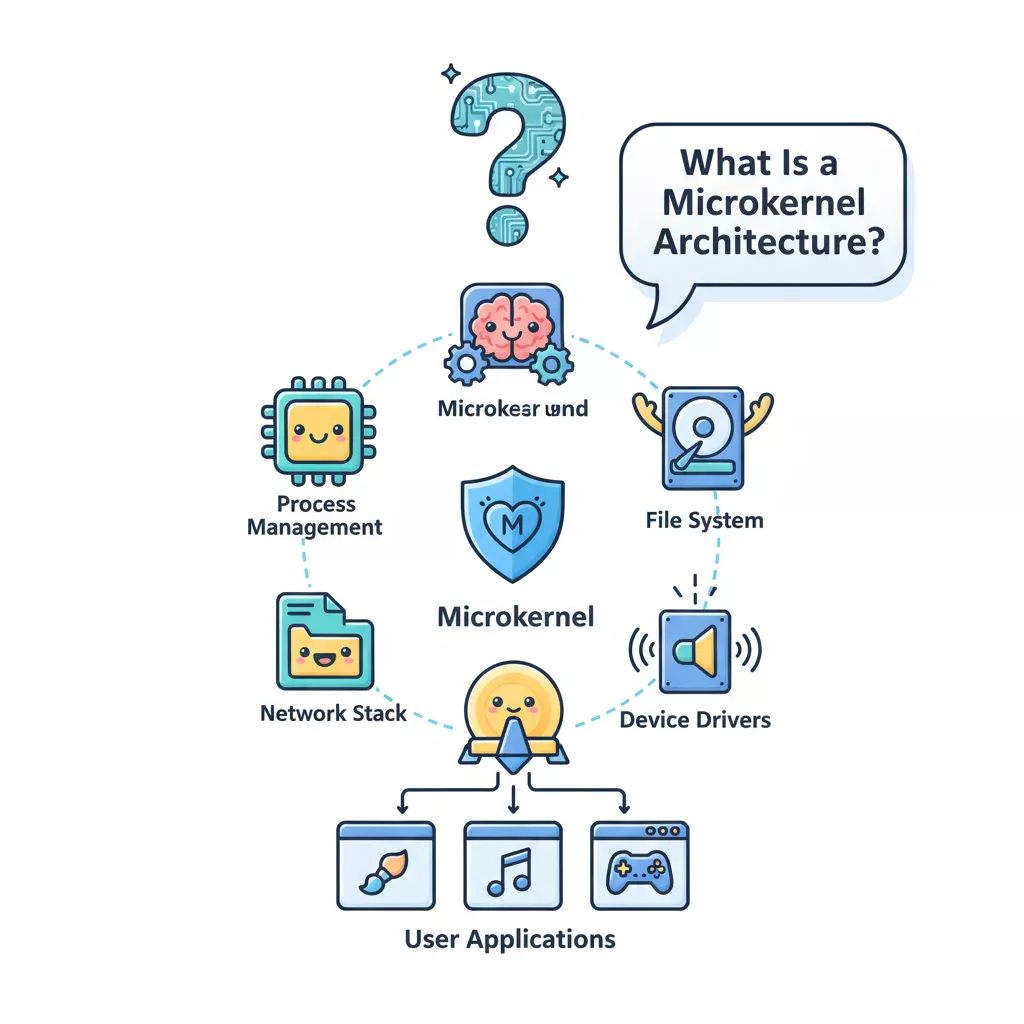
Learn what is a Microkernel Architecture, how it works, its advantages, real-world examples, and why it’s used in operating systems and embedded .
If you’ve ever wondered what makes your operating system tick, you’ve probably heard terms like kernel, microkernel, or monolithic kernel. Today, we’ll break down What Is a Microkernel Architecture in the simplest way possible. No heavy tech buzzwords—just real talk.
So, What Is a Microkernel Architecture?
Alright, let’s start with the basics.
What Is a Microkernel Architecture? It’s a way of designing an operating system where only the most essential parts of the OS run inside the kernel.
Think of the kernel as the “core brain” of your computer system. In a microkernel architecture, this brain does only what’s absolutely necessary—like handling CPU communication, memory, and interprocess communication (IPC). Everything else—like device drivers, file systems, and network protocols—runs outside the kernel, in user space.
So, when we ask What Is a Microkernel Architecture, it simply means a design that keeps the kernel small, clean, and secure.
Why Do We Need a Microkernel?
Here’s where it gets interesting.
Traditional operating systems used a monolithic kernel, where everything—drivers, file systems, and networking—ran together in one big chunk of code.
But in microkernel architecture, the idea is: “less is more.” The kernel only manages core tasks. That means if one part crashes (say, a driver), the whole system doesn’t go down.
In short, when people ask What Is a Microkernel Architecture, the answer is: It’s about building a more stable and modular OS
Breaking Down What Is a Microkernel Architecture (Step-by-Step)
Let’s simplify What Is a Microkernel Architecture into smaller pieces:
- Core Services Only – The microkernel handles only process scheduling, memory management, and interprocess communication.
- Everything Else in User Space – File systems, device drivers, and UI systems live outside the kernel.
- Modular Design – Each service works like a plug-in; easy to replace or update.
- High Security – If one module fails, it doesn’t crash the whole OS.
That’s the beauty of microkernel architecture—clean separation and safety.
Examples of Microkernel Architecture
If you’re still thinking What Is a Microkernel Architecture in real-world terms, here are a few famous examples:
- QNX – Used in cars, medical devices, and industrial systems.
- MINIX – A classic teaching OS that inspired Linux.
- L4 – A modern, efficient microkernel used in embedded systems.
- Mach – The foundation for Apple’s macOS and iOS kernel.
Each of these operating systems uses the concept of microkernel architecture to balance performance with reliability.
Microkernel vs Monolithic Kernel
When you think about What Is a Microkernel Architecture, it’s important to compare it with the monolithic kernel model.
| Feature | Microkernel | Monolithic Kernel |
|---|---|---|
| Design | Small, modular | Large, single block |
| Stability | High – faults isolated | Low – one crash can take all down |
| Performance | Slightly slower due to message passing | Faster due to direct communication |
| Security | Strong – limited kernel code | Weaker – everything in one space |
That’s why when we explore What Is a Microkernel Architecture, we often mention it’s used in systems where reliability and safety matter more than raw speed—like cars, aircraft, or medical devices.
Advantages of Microkernel Architecture
Let’s highlight the benefits of understanding What Is a Microkernel Architecture:
- Reliability: A faulty driver won’t crash the OS.
- Security: Less code in kernel space means fewer bugs and exploits.
- Flexibility: Easy to add or remove services.
- Maintainability: Developers can fix one module without breaking others.
- Scalability: Perfect for both small embedded systems and large servers.
So, when you hear someone ask What Is a Microkernel Architecture, think “safe, small, and smart.”
How Does a Microkernel Communicate?
In microkernel architecture, components talk using Inter-Process Communication (IPC).
Let’s say your file system needs data from memory—it sends a message to the memory manager through the kernel. The kernel just acts like a mailman delivering messages.
That’s what makes microkernel architecture lightweight yet powerful.
Where Is Microkernel Architecture Used?
Still curious about What Is a Microkernel Architecture in real life? You’ll find it in places where downtime is not an option.
For example:
- Automotive Systems (QNX-based infotainment)
- Aerospace Software
- Medical Equipment
- IoT Devices
- Smartphones (partly, like Apple’s iOS)
Because of its robustness, microkernel architecture is a favorite for mission-critical systems.
Disadvantages of Microkernel Architecture
While answering What Is a Microkernel Architecture, it’s fair to note it’s not all perfect.
The main downside? Performance overhead.
Since components talk via messages, it adds some delay compared to monolithic systems. But with modern CPUs and optimized IPC mechanisms, that gap is shrinking fast.
Building a Microkernel: Simple Idea, Big Impact
If you ever build an OS or embedded system, understanding What Is a Microkernel Architecture is crucial. Start small—make your kernel manage only processes and memory. Then add features like file systems and device drivers outside the kernel.
This modularity is what makes microkernel architecture so powerful and flexible.
Final Thoughts on What Is a Microkernel Architecture
So, to wrap it up, What Is a Microkernel Architecture isn’t just a technical concept—it’s a smarter philosophy of software design.
It’s about:
- Keeping the core system small,
- Moving everything else out,
- And ensuring stability even under failure.
If you’re stepping into embedded systems, real-time OS design, or just curious about how operating systems evolve, understanding What Is a Microkernel Architecture gives you a solid foundation.
Quick Recap
- What Is a Microkernel Architecture? – A minimal OS design where only core functions run in the kernel.
- Why Use It? – Better reliability, flexibility, and security.
- Examples? – QNX, MINIX, Mach, L4.
- Used In? – Cars, aircraft, IoT, and smartphones.
So next time someone asks, “Hey, what is a microkernel architecture?” — you’ll have the perfect answer ready.
FAQ: What Is a Microkernel Architecture
1. What Is a Microkernel Architecture in Simple Words?
When people ask What Is a Microkernel Architecture, think of it like this: it’s an operating system design where the kernel—the brain of the OS—handles only the most essential tasks.
It manages things like process scheduling, memory, and communication between programs. Everything else, such as drivers and file systems, runs separately.
This design keeps the system stable and easier to maintain.
2. Why Do We Use a Microkernel Architecture?
The main reason we use microkernel architecture is to make systems safer and more reliable.
If one part fails—like a buggy driver—it doesn’t crash the entire OS.
It’s also easier to update or replace components independently, which makes microkernel architecture great for embedded and real-time systems.
3. What Is the Difference Between a Microkernel and a Monolithic Kernel?
This is one of the most common questions after “What Is a Microkernel Architecture.”
Here’s the difference:
- In a monolithic kernel, everything runs in one big block of code inside the kernel.
- In a microkernel, only the core functions live inside the kernel; other parts run separately in user space.
As a result, microkernels are more modular and secure, while monolithic kernels can be faster but riskier.
4. What Are the Advantages of a Microkernel Architecture?
When we discuss What Is a Microkernel Architecture, we can’t skip the advantages:
- High Stability: One faulty module doesn’t crash the system.
- Better Security: Limited kernel code means fewer vulnerabilities.
- Easier Maintenance: Developers can fix or update individual services.
- Flexibility: Perfect for both small IoT devices and large servers.
- Portability: Easier to adapt across different hardware platforms.
That’s why industries like automotive and aerospace love microkernel architecture.
5. Are There Any Disadvantages of Microkernel Architecture?
Yes, a few. The main drawback of microkernel architecture is performance overhead.
Since components communicate using message passing instead of direct calls, it can be slower compared to a monolithic kernel.
However, modern systems are closing that gap with faster hardware and optimized interprocess communication (IPC).
6. What Are Some Real-Life Examples of Microkernel Architecture?
If you want to truly understand What Is a Microkernel Architecture, look at real systems using it:
- QNX – Used in cars and industrial control systems.
- MINIX – A teaching OS that inspired Linux.
- Mach – The core of macOS and iOS.
- L4 Microkernel Family – Used in embedded and mobile systems.
- Integrity OS – Common in aerospace and defense.
These examples show how microkernel architecture works in mission-critical systems where reliability matters most.
7. How Does a Microkernel Handle Communication Between Components?
In microkernel architecture, different parts of the OS talk to each other using Inter-Process Communication (IPC).
Think of it as the kernel acting like a postman—it passes messages back and forth between services.
This design keeps each module independent and the system more secure.
8. Is Linux Based on Microkernel Architecture?
No, Linux uses a monolithic kernel architecture.
However, it’s modular enough that it can dynamically load and unload drivers, which makes it feel a bit like a microkernel in some ways.
When people ask What Is a Microkernel Architecture, they often compare it with Linux for this reason.
9. What Is the Purpose of a Microkernel in Embedded Systems?
In embedded systems, microkernel architecture provides stability, safety, and modularity.
For instance, in automotive ECUs or medical equipment, reliability is critical.
If one driver fails, the rest of the system continues running—exactly why microkernel architecture is preferred.
10. Is Microkernel Architecture More Secure Than Monolithic Kernel?
Yes. Since microkernel architecture has a smaller codebase running in kernel mode, it exposes fewer attack points.
Even if a component like a driver gets hacked, it can’t easily compromise the kernel because it runs in user space.
That’s why when cybersecurity is a concern, microkernel architecture wins.
11. Can Microkernel Architecture Improve System Reliability?
Absolutely. One of the biggest answers to “What Is a Microkernel Architecture” lies in its reliability.
Because components are isolated, a crash in one doesn’t take the entire OS down.
This isolation also simplifies debugging and maintenance, making it a strong choice for safety-critical applications.
12. Is Microkernel Architecture Slower Than Monolithic Kernel?
Sometimes, yes.
Because microkernel architecture uses message passing (IPC) instead of direct calls, it introduces a bit of delay.
But in exchange, you get better fault isolation and security—which is often worth it.
13. How Does a Microkernel Architecture Improve Maintainability?
When you understand What Is a Microkernel Architecture, you realize it’s all about modularity.
Each component—like file systems or drivers—can be updated independently.
That means fewer system-wide bugs and easier long-term maintenance.
14. Who Invented the Microkernel Concept?
The idea of microkernel architecture originated in the 1980s.
Andrew Tanenbaum popularized it through MINIX, which was designed as a teaching tool.
Later, projects like Mach and QNX evolved the concept into modern real-time operating systems.
15. Why Is Microkernel Architecture Used in Modern Vehicles?
Cars use microkernel architecture (like QNX) because safety and uptime are critical.
If one part of the infotainment or sensor system crashes, others can keep working.
That’s why microkernel architecture is the go-to choice for automotive software platforms.
16. What Is an Example of Microkernel Communication?
A simple example: your file system needs to read data from memory.
In microkernel architecture, it sends a message to the memory manager via IPC.
The kernel just passes that message, acting as a messenger—not doing the actual work.
That’s what keeps it lean and efficient.
17. Can You Modify a Microkernel Without Rebuilding the Whole OS?
Yes! That’s one of the main reasons developers love microkernel architecture.
You can update or patch one module (like a driver or network service) without rebuilding or rebooting the entire operating system.
18. How Is QNX an Example of Microkernel Architecture?
QNX is the poster child of microkernel architecture.
It runs the kernel separately from user-space processes, ensuring that even if one service fails, the rest continue smoothly.
That’s why QNX is trusted in cars, industrial robots, and medical systems.
19. Does Windows Use Microkernel Architecture?
Partially.
Windows NT and its successors use a hybrid kernel, which combines aspects of both microkernel architecture and monolithic design.
So while not a “pure” microkernel, it borrows some of the same ideas.
20. Is Microkernel Architecture the Future of Operating Systems?
Many experts believe so.
With rising security and reliability needs—especially in IoT and autonomous systems—microkernel architecture offers a safer, modular way forward.
It might not replace Linux tomorrow, but it’s already shaping how the next generation of systems are built.


Mr. Raj Kumar is a highly experienced Technical Content Engineer with 7 years of dedicated expertise in the intricate field of embedded systems. At Embedded Prep, Raj is at the forefront of creating and curating high-quality technical content designed to educate and empower aspiring and seasoned professionals in the embedded domain.
Throughout his career, Raj has honed a unique skill set that bridges the gap between deep technical understanding and effective communication. His work encompasses a wide range of educational materials, including in-depth tutorials, practical guides, course modules, and insightful articles focused on embedded hardware and software solutions. He possesses a strong grasp of embedded architectures, microcontrollers, real-time operating systems (RTOS), firmware development, and various communication protocols relevant to the embedded industry.
Raj is adept at collaborating closely with subject matter experts, engineers, and instructional designers to ensure the accuracy, completeness, and pedagogical effectiveness of the content. His meticulous attention to detail and commitment to clarity are instrumental in transforming complex embedded concepts into easily digestible and engaging learning experiences. At Embedded Prep, he plays a crucial role in building a robust knowledge base that helps learners master the complexities of embedded technologies.