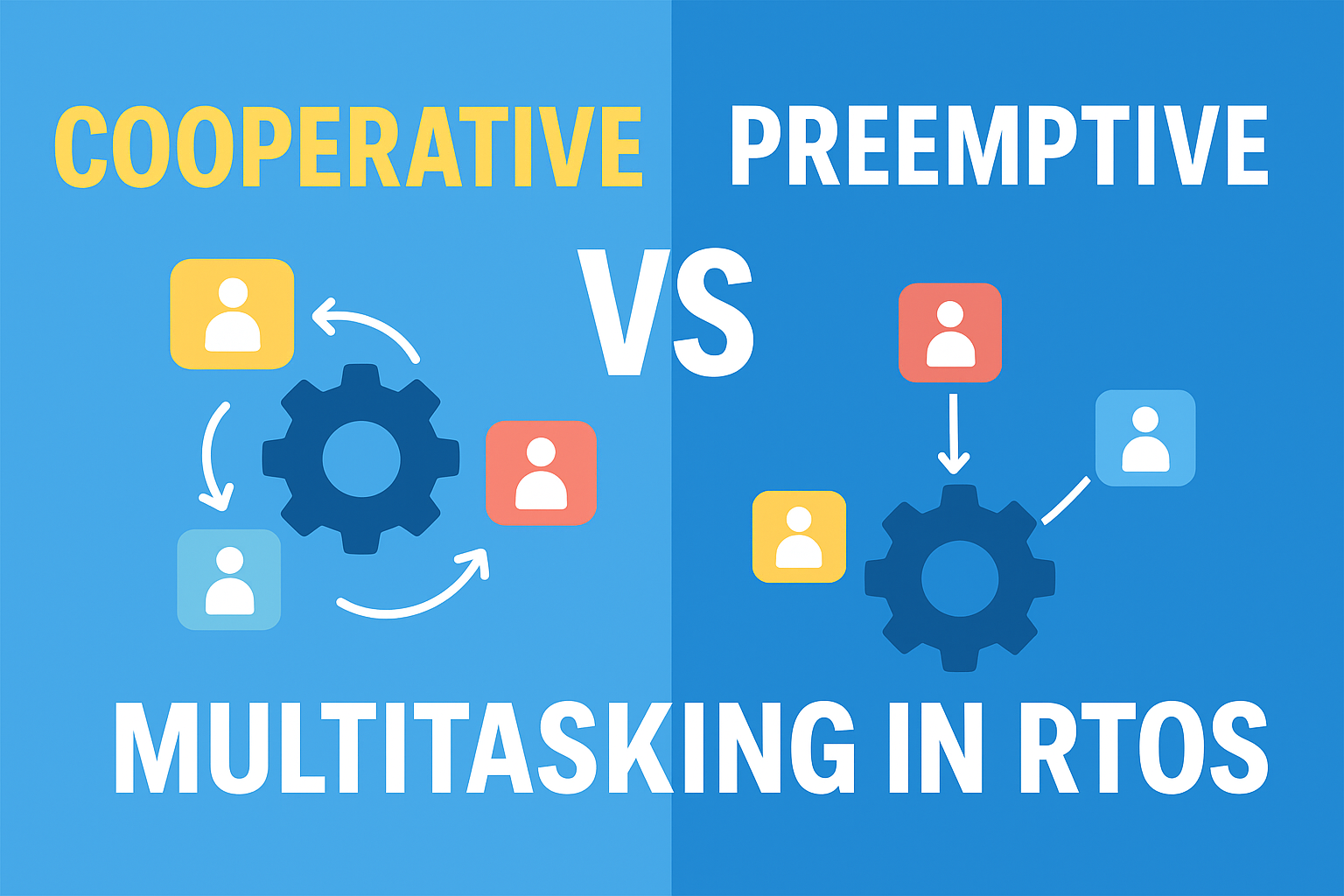
Learn the trade-offs between cooperative and preemptive multitasking in RTOS. Discover their advantages, disadvantages, use cases, and FAQs to choose the right model for your embedded system.
In the world of embedded systems and real-time applications, performance and timing are everything. Unlike general-purpose operating systems such as Windows or Linux, where slight delays are acceptable, a Real-Time Operating System (RTOS) must ensure that tasks are executed on time and within strict deadlines.
Introduction of Trade-offs Between Cooperative and Preemptive Multitasking
Real-Time Operating Systems (RTOS) are widely used in embedded systems such as automotive ECUs, medical devices, and industrial controllers. One of the core features of an RTOS is multitasking, which allows multiple tasks to run seemingly at the same time.
There are two common multitasking models in RTOS:
- Cooperative Multitasking
- Preemptive Multitasking
Each model has its advantages, disadvantages, and specific use cases. To design efficient real-time systems, it is important to understand the trade-offs between cooperative multitasking and preemptive multitasking.
What is Cooperative Multitasking?
In a cooperative multitasking model, tasks voluntarily give up control of the CPU. This means the RTOS scheduler only switches tasks when a running task explicitly calls a yield function or completes execution.
Key Characteristics of Trade-offs Between Cooperative and Preemptive Multitasking:
- The CPU remains with a task until it decides to release control.
- Context switching happens only at well-defined points.
- The system depends on good behavior from tasks.
Advantages of Cooperative Multitasking:
- Simplicity: Easy to implement and understand.
- Low Overhead: Fewer context switches mean more CPU time for tasks.
- Predictability: Task switching occurs at known points, making debugging easier.
Disadvantages of Cooperative Multitasking:
- Risk of CPU Monopolization: A task that fails to yield can block the entire system.
- Poor Real-Time Response: High-priority tasks may be delayed by long-running tasks.
- Limited Scalability: Not suitable for complex applications with multiple time-critical tasks.
Example Use Case: Small embedded systems such as calculators, digital watches, or basic IoT devices where tasks are lightweight and predictable.
What is Preemptive Multitasking?
In a preemptive multitasking model, the RTOS scheduler can interrupt tasks automatically based on priorities or timer ticks. This ensures that the CPU is allocated fairly and that high-priority tasks run without being blocked.
Key Characteristics of Trade-offs Between Cooperative and Preemptive Multitasking:
- The scheduler decides when to switch tasks.
- High-priority tasks can preempt lower-priority ones immediately.
- Requires proper handling of shared resources.
Advantages of Preemptive Multitasking:
- Fairness: No single task can monopolize the CPU.
- High Responsiveness: Real-time deadlines can be met.
- Better for Complex Systems: Can manage many tasks efficiently.
Disadvantages of Preemptive Multitasking:
- Higher Overhead: Frequent context switching consumes CPU time.
- Increased Complexity: Requires synchronization mechanisms like mutexes and semaphores.
- Harder to Debug: Bugs related to race conditions are more common.
Example Use Case: Automotive systems, industrial automation, and medical devices where safety and real-time responsiveness are critical.
Trade-offs Between Cooperative and Preemptive Multitasking Difference
| Factor | Cooperative Multitasking | Preemptive Multitasking |
|---|---|---|
| CPU Control | Task decides when to yield | Scheduler enforces switching |
| Overhead | Low (fewer context switches) | Higher (frequent context switches) |
| Simplicity | Easy to implement and debug | Complex, requires careful design |
| Fairness | Depends on task cooperation | Guaranteed by scheduler |
| Responsiveness | Limited, can cause delays | High, suitable for real-time systems |
| Use Cases | Simple devices, lightweight applications | Safety-critical, time-sensitive systems |
Trade-offs Explained
- Performance vs Reliability:
Cooperative multitasking has low overhead but risks reliability if a task fails to yield. Preemptive multitasking is more reliable but consumes more resources. - Simplicity vs Complexity:
Cooperative multitasking is beginner-friendly and easier to debug. Preemptive multitasking requires advanced concepts like mutexes, semaphores, and priority inversion handling. - Responsiveness vs Determinism:
Preemptive multitasking ensures timely responses, while cooperative multitasking offers deterministic but less responsive scheduling.
When to Use Which?
- Choose Cooperative Multitasking if:
- The system is simple and predictable.
- Tasks are lightweight and guaranteed to yield.
- Power efficiency and low overhead are critical.
- Choose Preemptive Multitasking if:
- The system is complex with multiple critical tasks.
- Real-time responsiveness is required.
- Safety and fairness must be guaranteed.
Conclusion of Trade-offs Between Cooperative and Preemptive Multitasking
The choice between cooperative multitasking and preemptive multitasking in RTOS depends on the application’s needs.
- Cooperative multitasking is simple, efficient, and suitable for small systems but risks delays if tasks do not yield.
- Preemptive multitasking ensures fairness and responsiveness, making it ideal for safety-critical and real-time applications, but it comes with higher complexity and overhead.
For most modern embedded systems, preemptive multitasking is preferred due to its reliability and ability to meet real-time constraints. However, cooperative multitasking still has its place in lightweight, power-constrained devices.
FAQ: Trade-offs Between Cooperative and Preemptive Multitasking
1. What is cooperative multitasking in RTOS?
Cooperative multitasking is a model where tasks run until they voluntarily yield control to the scheduler. The RTOS depends on tasks being “well-behaved” and sharing CPU time responsibly.
2. What is preemptive multitasking in RTOS?
Preemptive multitasking allows the RTOS scheduler to forcibly interrupt tasks and allocate CPU time to higher-priority tasks. This ensures fairness and responsiveness but adds more complexity.
3. Which model is easier to implement in an RTOS?
Cooperative multitasking is easier to implement because it has lower overhead and requires minimal context switching. However, it relies heavily on proper task design.
4. Why can cooperative multitasking cause delays?
If a task does not yield control, it can block other tasks from executing, leading to delays, poor responsiveness, or even system freeze.
5. Why is preemptive multitasking more reliable for real-time systems?
Preemptive multitasking ensures that critical tasks always get CPU time when needed. This makes it more reliable for systems requiring strict real-time responses, such as automotive and medical devices.
6. Which multitasking model has lower overhead?
Cooperative multitasking has lower overhead because it avoids frequent context switches and reduces interrupt handling.
7. Which multitasking model is more power-efficient?
Cooperative multitasking can be more power-efficient in simple systems since fewer context switches reduce CPU load. However, preemptive multitasking can save power in real-time systems by ensuring tasks finish quickly and the CPU returns to idle mode.
8. Can cooperative multitasking be used in critical systems?
It can, but it is not recommended for safety-critical applications. Since one faulty or greedy task can block others, cooperative multitasking is risky for systems that require guaranteed timing.
9. Is preemptive multitasking always better than cooperative multitasking?
Not always. While preemptive multitasking ensures fairness and responsiveness, it also increases complexity, requires careful synchronization, and may waste CPU cycles due to frequent context switching.
10. What is task starvation in cooperative multitasking?
Task starvation occurs when a long-running task never yields control, preventing other tasks from executing. This problem is more common in cooperative systems.
11. Do preemptive multitasking systems require synchronization mechanisms?
Yes. Since tasks can be interrupted at any time, synchronization tools like semaphores, mutexes, and message queues are required to prevent data corruption and race conditions.
12. Which multitasking model is best for beginners learning RTOS concepts?
Beginners often start with cooperative multitasking because it is easier to understand and debug. Once comfortable, they move to preemptive multitasking for real-world, time-critical applications.
You can also Visit other tutorials of Embedded Prep
- Multithreading in C++
- Multithreading Interview Questions
- Multithreading in Operating System
- Multithreading in Java
- POSIX Threads pthread Beginner’s Guide in C/C++
- Speed Up Code using Multithreading
- Limitations of Multithreading
- Common Issues in Multithreading
- Multithreading Program with One Thread for Addition and One for Multiplication
- Advantage of Multithreading
- Disadvantages of Multithreading
- Applications of Multithreading: How Multithreading Makes Modern Software Faster and Smarter”
- Master CAN Bus Interview Questions 2025
- What Does CAN Stand For in CAN Bus?
- CAN Bus Message Filtering Explained
- CAN Bus Communication Between Nodes With Different Bit Rates
- How Does CAN Bus Handle Message Collisions
- Message Priority Using Identifiers in CAN Protocol


Mr. Raj Kumar is a highly experienced Technical Content Engineer with 7 years of dedicated expertise in the intricate field of embedded systems. At Embedded Prep, Raj is at the forefront of creating and curating high-quality technical content designed to educate and empower aspiring and seasoned professionals in the embedded domain.
Throughout his career, Raj has honed a unique skill set that bridges the gap between deep technical understanding and effective communication. His work encompasses a wide range of educational materials, including in-depth tutorials, practical guides, course modules, and insightful articles focused on embedded hardware and software solutions. He possesses a strong grasp of embedded architectures, microcontrollers, real-time operating systems (RTOS), firmware development, and various communication protocols relevant to the embedded industry.
Raj is adept at collaborating closely with subject matter experts, engineers, and instructional designers to ensure the accuracy, completeness, and pedagogical effectiveness of the content. His meticulous attention to detail and commitment to clarity are instrumental in transforming complex embedded concepts into easily digestible and engaging learning experiences. At Embedded Prep, he plays a crucial role in building a robust knowledge base that helps learners master the complexities of embedded technologies.