Beginner-friendly guide to RTOS in embedded system. Learn what RTOS is, its features, types like FreeRTOS, QNX, VxWorks, and real-life .
When Arjun, a young engineer, bought his first microcontroller board, he was excited. He wrote a simple program to blink an LED, and it worked! But soon, he wanted more – he wanted the board to read sensor data, control a motor, and send information to his laptop at the same time.
That’s when he realized a problem: his simple code couldn’t keep up. Some tasks were delayed, others were missed entirely. Arjun thought, “Is there a smarter way to manage all these things at once?”
This is where he discovered the world of RTOS in embedded system.
What is RTOS in Embedded System?
An RTOS (Real-Time Operating System) is like a skilled traffic controller for embedded devices. Unlike a normal program that runs tasks one after another, an RTOS makes sure multiple tasks run together, without delay, and within strict timing.
Imagine a small factory:
- One worker checks the temperature sensor.
- Another worker controls the motor speed.
- A third worker sends data to the cloud.
If they all waited for each other, the factory would fail. An RTOS makes sure each worker gets their turn on time, keeping everything smooth.
A Real-Time Operating System (RTOS) is a special kind of operating system designed to handle time-critical tasks. Unlike general-purpose operating systems (Windows, Linux, Android), which focus on multitasking and user comfort, an RTOS ensures tasks are executed within strict deadlines.
In short: RTOS = predictability + reliability + speed.
Fun fact: The first RTOS was created in the 1960s at Cambridge University. Since then, RTOS has become the backbone of industries like aerospace, medical devices, defense, and robotics.
Types of Real-Time Operating Systems


RTOS in Embedded Systems can be classified into three types depending on timing strictness:
- Hard Real-Time OS
- Deadlines are absolute – failure is unacceptable.
- Example: Airbag systems, pacemakers, missile control.
- Soft Real-Time OS
- Deadlines are important, but small delays are acceptable.
- Example: Multimedia streaming, online gaming, audio systems.
- Firm Real-Time OS
- Missing deadlines may not cause total failure but reduces system quality.
- Example: Stock trading, video processing.
Why Do We Need RTOS in Embedded Systems?
Arjun soon understood that:
- Timing matters – Sensors and motors can’t wait too long.
- Multitasking is real – Many things must happen at once.
- Efficiency counts – The processor should not waste time.
In other words, RTOS in embedded system ensures reliability and real-time responses.
Purpose of RTOS in Embedded Systems
Arjun realized why RTOS is essential:
- Precise task scheduling – ensures critical tasks finish on time.
- Efficient resource management – CPU, memory, and I/O are used wisely.
- Predictable behavior – system response is reliable even under heavy load.
- Multitasking – handles multiple real-time events without blocking.
This makes RTOS in embedded systems ideal for applications where every millisecond
Common Features of RTOS in Embedded Systems
When Arjun started exploring, he noticed RTOS in Embedded Systems comes with:
- Task Scheduling – Decides which task runs first.
- Inter-task Communication – Lets tasks talk to each other safely.
- Real-Time Clock – Keeps track of precise timing.
- Resource Management – Handles CPU, memory, and I/O efficiently.
These features made his project faster and smarter.
Different Types of RTOS in Embedded Systems
Just like there are different cars for different roads, there are many RTOS choices for embedded systems:
- FreeRTOS – Lightweight, open-source, great for microcontrollers.
- RTEMS – Used in aerospace and research projects.
- QNX – Popular in automotive, medical, and mission-critical systems.
- VxWorks – Trusted in defense and aerospace.
- Zephyr – Open-source, supported by Linux Foundation.
- ThreadX (Azure RTOS) – Known for IoT and consumer electronics.
Each RTOS has its own strengths, but the idea remains the same: real-time, reliable task management.
Real-Life Example –> Arjun’s Smart Home Project
Arjun decided to build a smart home controller using RTOS. Here’s what happened:
- Task 1: Monitor temperature and humidity.
- Task 2: Control fan speed.
- Task 3: Send updates to his phone.
- Task 4: Trigger an alarm if smoke is detected.
With a simple loop, this was impossible. But with RTOS in embedded system, each task ran in perfect harmony. His project finally worked like magic.
The Bigger Picture of RTOS in Embedded Systems
RTOS is not just for hobby projects. It runs in:
- Cars (airbags, engine control, infotainment)
- Medical devices (pacemakers, monitors)
- Robotics (drones, factory robots)
- Space missions (NASA uses RTOS in satellites)
Wherever timing is critical, RTOS in embedded system plays the hero.
Examples and Uses of Embedded Real-Time Operating System
RTOS powers technologies we rely on daily:
- 🚗 Automotive → airbags, ABS braking, infotainment.
- ✈️ Aerospace → flight control, radar, command systems.
- 🏥 Medical → heart pacemakers, imaging devices.
- 📡 Defense → missile guidance, radar tracking.
- 📈 Finance → real-time stock trading systems.
- 🤖 Robotics → drones, industrial automation.
- 🎥 Multimedia → real-time audio and video streaming.
Popular RTOS examples: FreeRTOS, VxWorks, QNX, Zephyr, ThreadX.
Advantages of Embedded Real-Time Operating System
- Maximum utilization of CPU and devices.
- Extremely low context switching time (microseconds).
- Predictable, error-free task execution.
- Efficient memory allocation.
- Perfect for embedded systems with small program size.
Disadvantages of Embedded Real-Time Operating System
- Can handle only limited tasks at once.
- Complex algorithms for scheduling.
- Requires specific device drivers and interrupts.
- Uses heavy system resources (sometimes costly).
- Limited flexibility compared to GPOS.
Difference Between Normal Execution and RTOS Execution
1. Normal Execution (Super Loop Method)
In traditional embedded code (without RTOS), everything runs in a single endless loop:
// Normal Embedded System (No RTOS)
#include <stdio.h>
#include <unistd.h>  // for sleep()

void readSensor() {
    printf("Reading Sensor...\n");
    sleep(2);  // simulate delay
}

void controlMotor() {
    printf("Controlling Motor...\n");
    sleep(3);  // simulate delay
}

void sendData() {
    printf("Sending Data...\n");
    sleep(1);  // simulate delay
}

int main() {
    while(1) {
        readSensor();
        controlMotor();
        sendData();
    }
    return 0;
}
What happens here?
- Each task waits for the previous one to finish.
- If
controlMotor()takes 3 seconds, the sensor has to wait! - This causes delays and missed real-time events.
2. RTOS Execution (Using FreeRTOS Example)
With an RTOS, tasks run independently and are scheduled by the kernel.
// RTOS Based Example (FreeRTOS)
#include "FreeRTOS.h"
#include "task.h"
#include "stdio.h"

void readSensorTask(void *pvParameters) {
    while(1) {
        printf("Reading Sensor...\n");
        vTaskDelay(2000 / portTICK_PERIOD_MS); // run every 2 sec
    }
}

void controlMotorTask(void *pvParameters) {
    while(1) {
        printf("Controlling Motor...\n");
        vTaskDelay(3000 / portTICK_PERIOD_MS); // run every 3 sec
    }
}

void sendDataTask(void *pvParameters) {
    while(1) {
        printf("Sending Data...\n");
        vTaskDelay(1000 / portTICK_PERIOD_MS); // run every 1 sec
    }
}

int main(void) {
    xTaskCreate(readSensorTask, "Sensor", 1000, NULL, 1, NULL);
    xTaskCreate(controlMotorTask, "Motor", 1000, NULL, 1, NULL);
    xTaskCreate(sendDataTask, "Data", 1000, NULL, 1, NULL);

    vTaskStartScheduler(); // start the RTOS scheduler

    for(;;); // should never reach here
    return 0;
}
What happens here?
- Each task has its own independent schedule.
- The RTOS decides when and how often each task runs.
- No task blocks another → true multitasking.
Key Difference
| Aspect | Normal Loop (No RTOS) | With RTOS (FreeRTOS) |
|---|---|---|
| Task Execution | Sequential | Parallel (scheduled) |
| Delays | One task delays others | Independent timing |
| Efficiency | Low | High |
| Scalability | Hard to manage | Easy to add tasks |
Where Does RTOS Work Compared to Normal OS?
Arjun, our young embedded engineer, once wondered:
“Why do some systems like my laptop handle so many apps at once, while my microcontroller struggles with even three tasks?”
His mentor smiled and said, “Let’s think of computers as layered cakes 🍰. Each cake has different layers, and how they are designed decides whether it’s for a birthday party (normal OS) or a rocket launch (RTOS).”
1. Normal Operating System – The Party Cake
Imagine you’re at a birthday party. Everyone wants cake – kids, parents, friends. The host ensures everyone gets a piece, even if they must wait a little. No one starves, but some might wait longer.
That’s how a normal OS works.
+---------------------------+  Applications (Games, Browsers, Editors)
|   User Space              |
+---------------------------+  System Libraries (APIs)
|   Kernel Space            |
|   - Process management    |
|   - Memory management     |
|   - Device drivers        |
|   - File system           |
|   - Scheduler (fair share)|
+---------------------------+  Hardware (CPU, memory, devices)
- Scheduler acts like the party host – ensuring fairness.
- Applications share time equally.
- If your game loads 1 second late, it’s fine.
- Focus = throughput and user comfort.
Example: Windows, Linux, Android.
2. RTOS – The Emergency Cake
Now imagine a hospital emergency room. Doctors don’t serve patients in the order they arrived. Instead, the critical patient (heart attack) gets treated immediately, even if others have been waiting.
That’s how an RTOS kernel works.
+---------------------------+  Application Tasks (sensor, motor, data)
|   RTOS API Layer          |
+---------------------------+  RTOS Kernel
|   - Real-time Scheduler   |
|   - Task/Thread mgmt      |
|   - Inter-task comm.      |
|   - Timers (deadlines)    |
|   - Memory mgmt (basic)   |
|   - Interrupt handling    |
+---------------------------+  Hardware (MCU, sensors, I/O devices)
- RTOS scheduler is the emergency doctor – it decides instantly who is most critical.
- Deadlines are strict.
- If a motor must stop in 10 ms, it will.
- Focus = determinism and safety.
Example: FreeRTOS, QNX, VxWorks, Zephyr.
Main Differences (Cake vs Emergency Room)
| Feature/Layer | Normal OS (Windows/Linux) | RTOS (FreeRTOS, QNX, VxWorks) |
|---|---|---|
| Scheduler | Fairness (everyone gets time) | Priority-based (critical first) |
| Applications | Many apps (GUI, games, tools) | Real-time tasks (sensors, motors) |
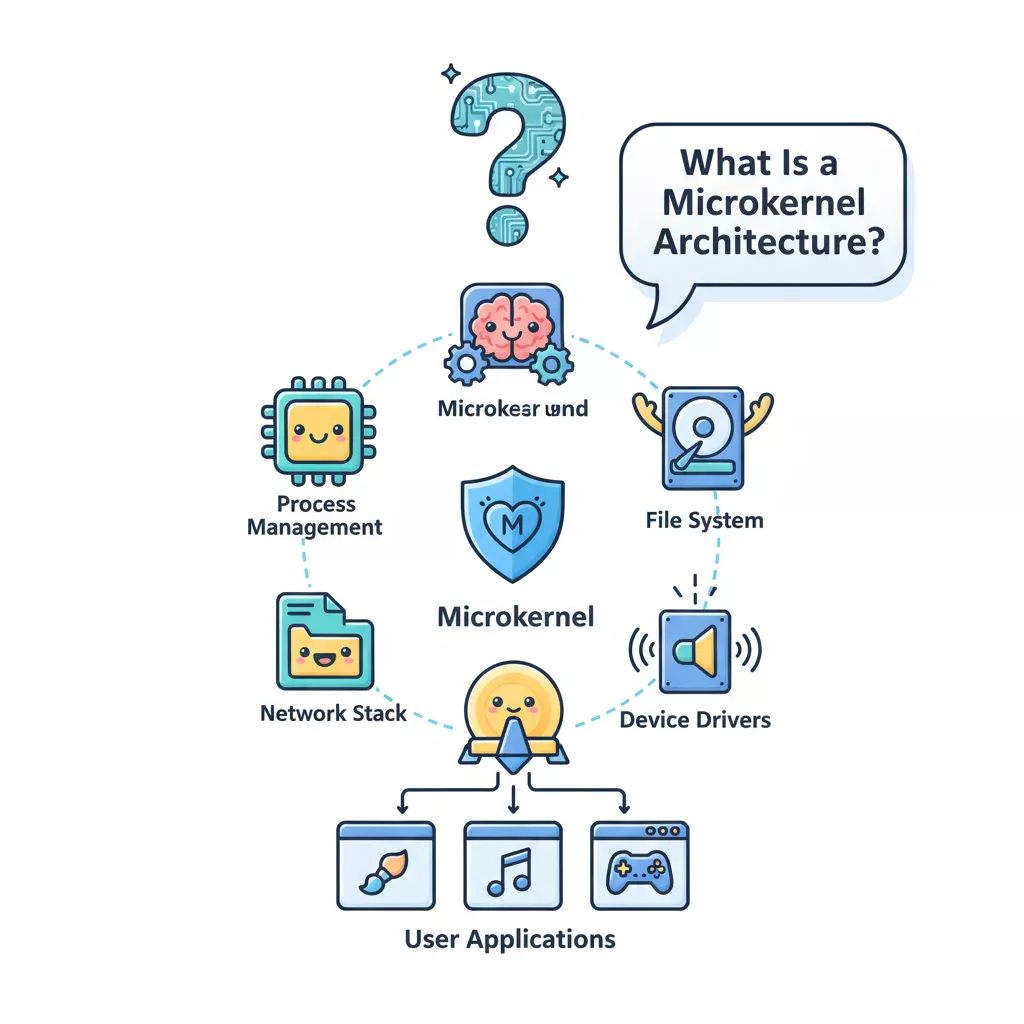
| Kernel | Heavy (file system, GUI, drivers) | Lightweight (tasks, ISRs, timers) |
| Timing | Flexible, soft deadlines | Strict, hard deadlines |
| Hardware Access | Abstracted via drivers | Very close to hardware |
| Use Cases | PCs, servers, phones | Cars, robots, medical devices |
Summary
- A normal OS is like a city mayor – keeping things fair and balanced for all citizens.
- An RTOS is like a traffic cop at a busy junction – making sure ambulances (high-priority tasks) always pass first.
Without this difference, your smartphone would be fine with a normal OS, but your airbag system in a car must run on RTOS – because a late response could cost lives.
Final Thoughts
Arjun’s journey shows us that RTOS is like the invisible brain behind embedded systems. Without it, complex devices would stumble. With it, they become reliable, safe, and smart.
If you’re just starting out, try FreeRTOS on an Arduino or ESP32. You’ll see how tasks work together, just like a well-coordinated team.
In the world of embedded systems, mastering RTOS is like learning to conduct an orchestra – every instrument (task) plays at the right time, creating a beautiful symphony of technology.
You can also Visit other tutorials of Embedded Prep
- Multithreading in C++
- Multithreading Interview Questions
- Multithreading in Operating System
- Multithreading in Java
- POSIX Threads pthread Beginner’s Guide in C/C++
- Speed Up Code using Multithreading
- Limitations of Multithreading
- Common Issues in Multithreading
- Multithreading Program with One Thread for Addition and One for Multiplication
- Advantage of Multithreading
- Disadvantages of Multithreading
- Applications of Multithreading: How Multithreading Makes Modern Software Faster and Smarter”
- Master CAN Bus Interview Questions 2025
- What Does CAN Stand For in CAN Bus?
- CAN Bus Message Filtering Explained
- CAN Bus Communication Between Nodes With Different Bit Rates
- How Does CAN Bus Handle Message Collisions
- Message Priority Using Identifiers in CAN Protocol


Mr. Raj Kumar is a highly experienced Technical Content Engineer with 7 years of dedicated expertise in the intricate field of embedded systems. At Embedded Prep, Raj is at the forefront of creating and curating high-quality technical content designed to educate and empower aspiring and seasoned professionals in the embedded domain.
Throughout his career, Raj has honed a unique skill set that bridges the gap between deep technical understanding and effective communication. His work encompasses a wide range of educational materials, including in-depth tutorials, practical guides, course modules, and insightful articles focused on embedded hardware and software solutions. He possesses a strong grasp of embedded architectures, microcontrollers, real-time operating systems (RTOS), firmware development, and various communication protocols relevant to the embedded industry.
Raj is adept at collaborating closely with subject matter experts, engineers, and instructional designers to ensure the accuracy, completeness, and pedagogical effectiveness of the content. His meticulous attention to detail and commitment to clarity are instrumental in transforming complex embedded concepts into easily digestible and engaging learning experiences. At Embedded Prep, he plays a crucial role in building a robust knowledge base that helps learners master the complexities of embedded technologies.