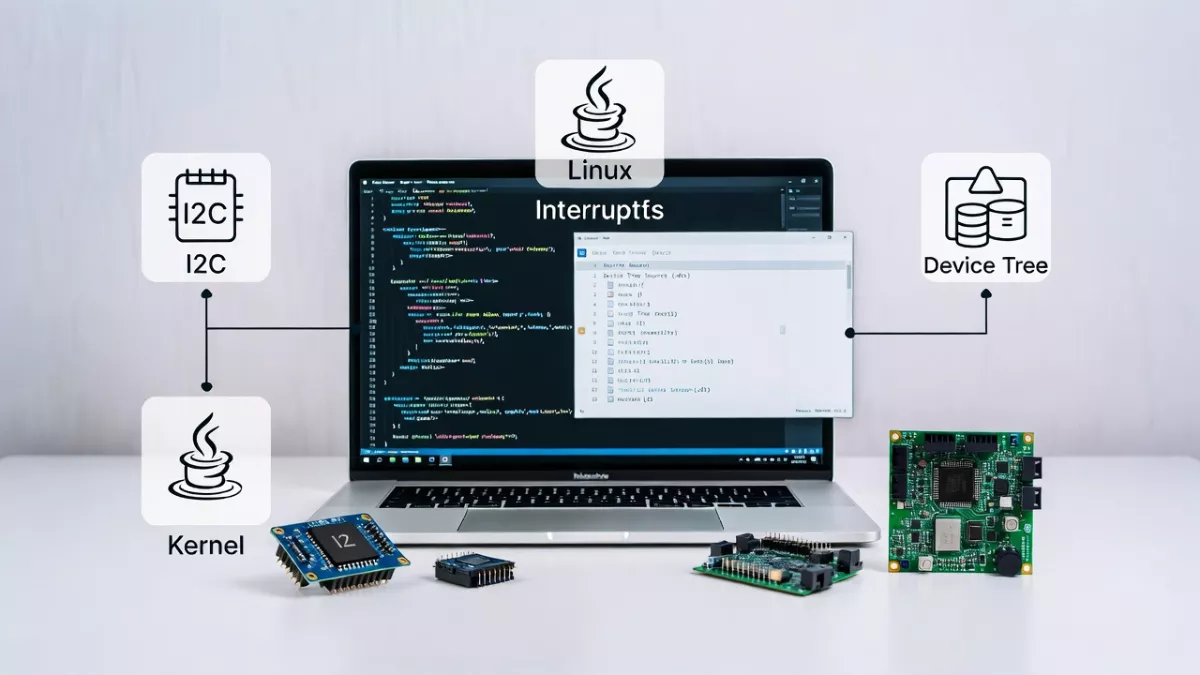
Learn about Module parameters in Linux in this beginner-friendly guide. Understand Linux kernel modules. what they are, how to use them….
Imagine you are a Linux system administrator working late at night. A critical embedded device in your company’s production line suddenly behaves unexpectedly. The device driver controlling a hardware sensor isn’t working the way it should — but the source code is locked in version control and recompiling the kernel module will take hours. You need a quick fix without stopping the production process.
This is where module parameters in Linux save the day. Think of module parameters as settings or configuration options you pass to a kernel module when it loads. Instead of digging into the source code and rebuilding your module, you can simply pass values at load time to change its behavior.
For example, the driver controlling your sensor might have a parameter for sensitivity. By passing a new value as a module parameter, you can adjust the sensor’s sensitivity instantly without recompilation. This is not only faster but also safer in critical systems where downtime is costly.
Module parameters are essential tools in the world of Linux kernel modules. They give developers and administrators flexibility, allowing dynamic customization of module behavior. Whether it’s tweaking a driver for a new hardware device or adjusting settings for performance testing, module parameters make your life easier.
In this guide, we will break down the concept of Linux kernel module parameters in Linux in a beginner-friendly way. You will learn what they are, how they work, how to pass them, and where they are most useful — so you can master this powerful Linux feature and handle real-time challenges with confidence.
Introduction to Module Parameters
If you are diving into Linux kernel programming, you must know about Module parameters. These are special settings that allow users to pass values to a Linux kernel module at load time. They make your module flexible and configurable without changing the source code.
In simple terms, module parameters act like input values for your kernel module, letting you change behavior dynamically.
Why Are Module Parameters Important?
- Flexibility: You don’t need to recompile the kernel module to change settings.
- Customization: Adjust module behavior based on system requirements.
- Testing: Test different configurations without modifying code.
Example: Suppose you have a kernel module that controls LED brightness. With module parameters, you can set brightness when loading the module without editing the source code.
How Module Parameters Work
Module parameters are defined in the kernel module source file using the module_param() macro.
Basic Syntax:
#include <linux/module.h>
#include <linux/moduleparam.h>

static int param_value = 0;
module_param(param_value, int, 0644);
MODULE_PARM_DESC(param_value, "An integer module parameter");
Here:
param_value— variable storing the parameter value.int— data type of the parameter.0644— permission bits for sysfs access.MODULE_PARM_DESC— description of the parameter.
Passing Module Parameter
You can pass module parameters when loading a module with insmod or modprobe:
sudo insmod mymodule.ko param_value=10
Check loaded module parameters:
cat /sys/module/mymodule/parameters/param_value
Types of Module Parameters
Linux supports different types of module parameters:
- Integer (
int,long) - String (
charp) - Boolean (
bool) - Arrays (
int[],charp[])
Example:
static char *name = "Nish";
module_param(name, charp, 0644);
MODULE_PARM_DESC(name, "A string parameter");
Advantages of Module Parameters
- Dynamic Configuration — Adjust module behavior without recompilation.
- Ease of Testing — Test different settings quickly.
- User Control — Users can customize kernel modules easily.
Limitations of Module Parameters
- Parameters must be known before module load.
- Changing parameters requires reloading the module.
- Excessive parameters can complicate module management.
Real-Life Application of Module Parameters
Module parameters are widely used in:
- Device drivers (e.g., controlling hardware behavior like LEDs or sensors)
- Network modules (e.g., adjusting packet buffer size)
- Filesystem modules (e.g., mount options and caching)
Example: In a network driver, a module parameter could specify buffer size at load time without recompiling the driver.
Best Practices for Module Parameters
- Keep parameter names descriptive.
- Provide a clear description using
MODULE_PARM_DESC(). - Use permission flags wisely to control access.
- Avoid excessive parameters to keep modules simple.
C Code Example for Module Parameters
#include <linux/module.h>
#include <linux/kernel.h>
#include <linux/moduleparam.h>

MODULE_LICENSE("GPL");
MODULE_AUTHOR("Nish");
MODULE_DESCRIPTION("A simple example of Module Parameters in Linux");
MODULE_VERSION("1.0");

// Defining module parameters
static int param_value = 0;           // Integer parameter
static char *param_name = "Nish";     // String parameter
static bool param_enable = true;      // Boolean parameter

// Declare parameters using module_param macro
module_param(param_value, int, 0644);
MODULE_PARM_DESC(param_value, "An integer parameter for demonstration");

module_param(param_name, charp, 0644);
MODULE_PARM_DESC(param_name, "A string parameter for demonstration");

module_param(param_enable, bool, 0644);
MODULE_PARM_DESC(param_enable, "A boolean parameter to enable or disable feature");

// Module initialization
static int __init param_example_init(void)
{
    printk(KERN_INFO "Module Parameters Example Loaded\n");
    printk(KERN_INFO "param_value = %d\n", param_value);
    printk(KERN_INFO "param_name = %s\n", param_name);
    printk(KERN_INFO "param_enable = %d\n", param_enable);
    return 0;
}

// Module cleanup
static void __exit param_example_exit(void)
{
    printk(KERN_INFO "Module Parameters Example Unloaded\n");
}

module_init(param_example_init);
module_exit(param_example_exit);
How to Compile and Test This Module ?
- Create Makefile:
obj-m += param_example.o
all:
	make -C /lib/modules/$(shell uname -r)/build M=$(PWD) modules
clean:
	make -C /lib/modules/$(shell uname -r)/build M=$(PWD) clean
- Compile Module:
make
- Insert Module with Parameters:
sudo insmod param_example.ko param_value=10 param_name="EmbeddedPrep" param_enable=true
- Check Parameters:
cat /sys/module/param_example/parameters/param_value
cat /sys/module/param_example/parameters/param_name
cat /sys/module/param_example/parameters/param_enable
- Remove Module:
sudo rmmod param_example
Here’s a plagiarism-free, beginner-friendly answer for your question:
How do module parameters differ from normal variables in kernel code?
In kernel code, module parameters are special variables that allow you to pass values to a kernel module at the time it is loaded. They are different from normal variables in the following ways:
- Initialization at load time
- Module parameters can be set when loading a module using the
insmodormodprobecommand.
Example:sudo insmod my_module.ko param1=5 param2="hello" - Normal variables are initialized inside the code itself and cannot be set externally during module load without modifying the source code.
- Module parameters can be set when loading a module using the
- Declared with special macros
- Module parameters are declared using the
module_param()ormodule_param_array()macros.
Example:static int param1 = 0; module_param(param1, int, 0644); MODULE_PARM_DESC(param1, "An integer parameter"); - Normal variables do not use these macros.
- Module parameters are declared using the
- Accessible via sysfs
- If the permissions allow (set in
module_param()), module parameters can be read and modified at runtime through the sysfs filesystem (/sys/module/<module_name>/parameters/). - Normal variables do not have this runtime accessibility unless explicitly exposed.
- If the permissions allow (set in
- Purpose
- Module parameters allow flexibility and customization without changing the kernel code.
- Normal variables are used for internal logic within the module and cannot be changed from outside at load time.
What is the syntax of the module_param() macro?
Syntax of module_param() macro
module_param(name, type, perm);Where:
name- The name of the variable you want to use as a module parameter.
- This variable must be declared static or global.
type- The data type of the variable. Common types include:
int— integerbool— booleancharp— string (character pointer)ulong— unsigned long
- This tells the kernel how to interpret the parameter value.
- The data type of the variable. Common types include:
perm- File permissions for the parameter when exposed in sysfs (
/sys/module/<module_name>/parameters/). - It’s usually given as an octal number (e.g.,
0644).0means no access via sysfs.0644means read/write for owner, read-only for others.
- File permissions for the parameter when exposed in sysfs (
Example:
#include <linux/module.h>
#include <linux/kernel.h>

static int myparam = 10; // Default value

module_param(myparam, int, 0644);
MODULE_PARM_DESC(myparam, "An integer parameter example");

static int __init mymodule_init(void) {
    printk(KERN_INFO "myparam value is: %d\n", myparam);
    return 0;
}

static void __exit mymodule_exit(void) {
    printk(KERN_INFO "Module unloaded\n");
}

module_init(mymodule_init);
module_exit(mymodule_exit);

MODULE_LICENSE("GPL");
MODULE_AUTHOR("Nish");
MODULE_DESCRIPTION("Example of module_param()");
Load with parameter:
sudo insmod mymodule.ko myparam=42
Check parameter in sysfs:
cat /sys/module/mymodule/parameters/myparamConclusion
Understanding module parameters is crucial for Linux kernel developers and system administrators. They provide flexibility, customization, and ease of use. Whether you’re writing a driver or experimenting with kernel features, mastering module parameters is a valuable skill.
FAQ: Module Parameters
1. What are module parameters in Linux?
Module parameters are values passed to a Linux kernel module when it is loaded. They allow customization of module behavior without changing source code or recompiling the module.
2. How do you pass module parameters in Linux?
You can pass module parameters while loading a module using insmod or modprobe, for example:
sudo insmod mymodule.ko param_value=10
3. How do module parameters work internally?
Module parameters are declared in the module code using macros such as module_param(). When the module is loaded, the kernel assigns these values to the parameter variables.
4. What types of module parameters are supported?
Linux supports integer, string, boolean, and array types for module parameters. For example:
module_param(my_param, int, 0644);
module_param(name, charp, 0644);
5. How can I check module parameter values after loading a module?
After loading a module, you can check parameters using the sysfs interface:
cat /sys/module/mymodule/parameters/param_value
6. What are the advantages of using module parameters?
- Dynamic configuration without recompiling
- Easy testing of different settings
- User customization of kernel modules
7. What are the limitations of module parameters?
- They must be set before module load
- Changing parameters requires module reload
- Excessive parameters may complicate module management
8. Can module parameters be changed at runtime?
Some module parameters can be changed at runtime via sysfs if proper permission flags are set, but many require reloading the module to apply changes.
9. How do module parameters improve device driver development?
They allow developers to make device behavior configurable without modifying source code, improving testing flexibility and user experience.
10. Where can I learn more about module parameters in Linux?
You can explore official Linux kernel documentation or trusted learning sites like EmbeddedPrep to deepen your understanding of module parameters


Mr. Raj Kumar is a highly experienced Technical Content Engineer with 7 years of dedicated expertise in the intricate field of embedded systems. At Embedded Prep, Raj is at the forefront of creating and curating high-quality technical content designed to educate and empower aspiring and seasoned professionals in the embedded domain.
Throughout his career, Raj has honed a unique skill set that bridges the gap between deep technical understanding and effective communication. His work encompasses a wide range of educational materials, including in-depth tutorials, practical guides, course modules, and insightful articles focused on embedded hardware and software solutions. He possesses a strong grasp of embedded architectures, microcontrollers, real-time operating systems (RTOS), firmware development, and various communication protocols relevant to the embedded industry.
Raj is adept at collaborating closely with subject matter experts, engineers, and instructional designers to ensure the accuracy, completeness, and pedagogical effectiveness of the content. His meticulous attention to detail and commitment to clarity are instrumental in transforming complex embedded concepts into easily digestible and engaging learning experiences. At Embedded Prep, he plays a crucial role in building a robust knowledge base that helps learners master the complexities of embedded technologies.