Minimum Bit Flips to Convert Number : When working with binary numbers in programming, you might encounter a problem where you need to find the minimum number of bit flips required to convert one number into another. This is a common interview and LeetCode problem that tests your understanding of bit manipulation.
In this guide, we’ll explain the concept step-by-step, walk through examples, and provide a LeetCode-style C++ solution.
What Does “Bit Flip” Mean?
A bit flip means changing a 0 to 1 or a 1 to 0 in a number’s binary representation.
Example:
- Original bit:
0→ Flipped bit:1 - Original bit:
1→ Flipped bit:0
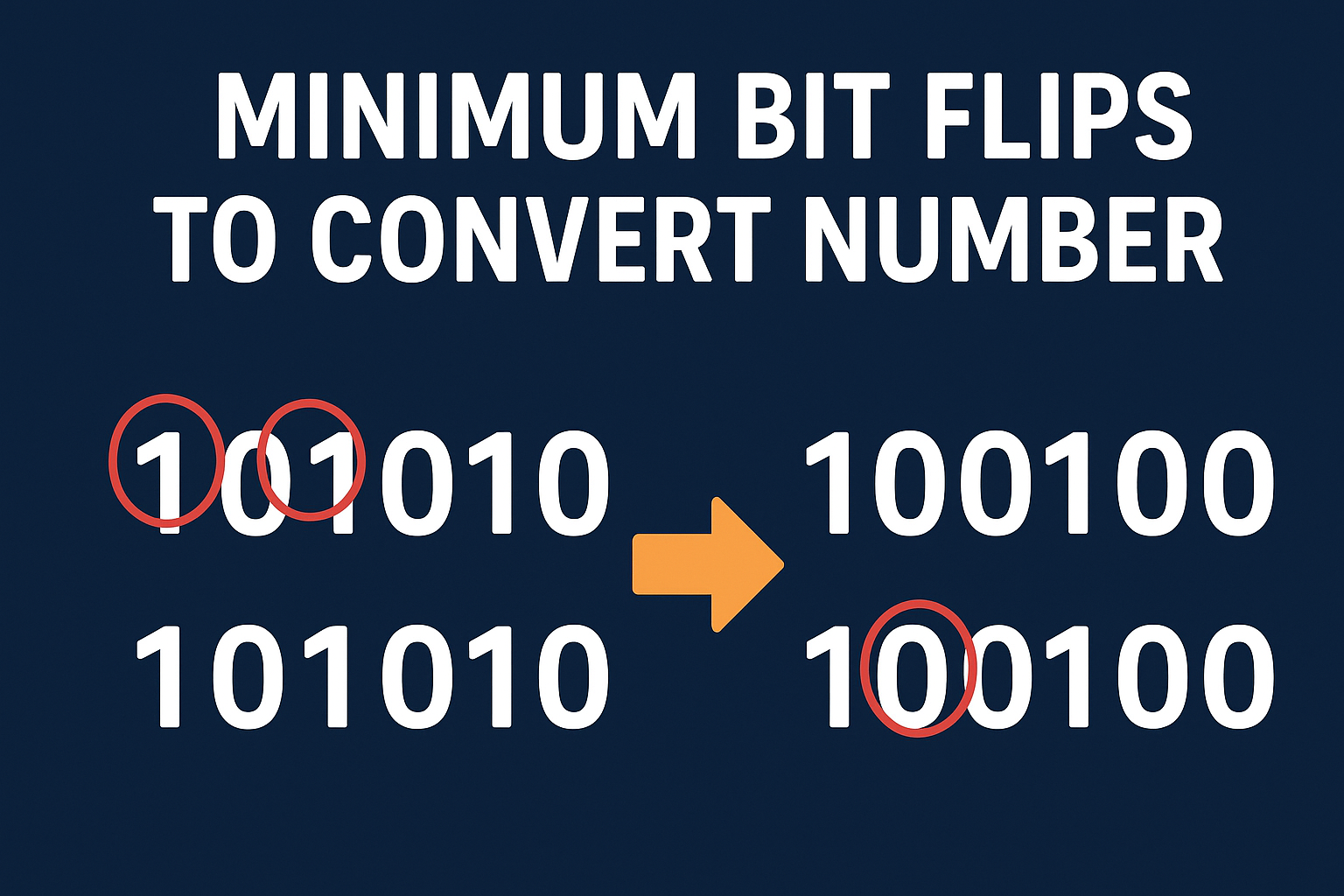
If you have two integers, finding the minimum bit flips means determining the positions where the bits differ.
Understanding the Problem
Problem Statement:
Given two integers start and goal, return the minimum number of bit flips required to convert start to goal.
Example
Input: start = 10, goal = 7
Binary of 10 → 1010
Binary of 7  → 0111
Comparing bit by bit:
1 0 1 0
0 1 1 1
↑ ↑   ↑
Different bits at positions 1, 2, and 4 → 3 flips needed
Approach
- Use XOR to identify different bits:
- XOR (
^) returns1for differing bits,0for same bits.
- XOR (
- Count set bits in the XOR result:
- The number of
1s = the number of bit flips needed.
- The number of
Step-by-Step Example
For start = 29 and goal = 15:
- XOR Operation:
29 (11101) 15 (01111) XOR → 10010 - Count set bits in 10010:
There are 2 set bits → 2 flips needed.
1. C++ Solution
#include <iostream>
using namespace std;

int minBitFlips(int start, int goal) {
    int xorValue = start ^ goal; // Step 1: XOR to find differing bits
    int count = 0;
    while (xorValue > 0) {
        count += xorValue & 1;  // Step 2: Count set bits
        xorValue >>= 1;
    }
    return count;
}

int main() {
    int start = 10, goal = 7;
    cout << "Minimum Bit Flips: " << minBitFlips(start, goal) << endl;
    return 0;
}
✅ Shortcut in C++ (GCC/Clang):
return __builtin_popcount(start ^ goal);
2. C Solution for Minimum Bit Flips to Convert Number
#include <stdio.h>

int minBitFlips(int start, int goal) {
    int xorValue = start ^ goal; // XOR to find differing bits
    int count = 0;
    while (xorValue > 0) {
        count += xorValue & 1;  // Count set bits
        xorValue >>= 1;
    }
    return count;
}

int main() {
    int start = 10, goal = 7;
    printf("Minimum Bit Flips: %d\n", minBitFlips(start, goal));
    return 0;
}
3. Java Solution for Minimum Bit Flips to Convert Number
public class Main {
    public static int minBitFlips(int start, int goal) {
        int xorValue = start ^ goal; // XOR to find differing bits
        int count = 0;
        while (xorValue > 0) {
            count += xorValue & 1; // Count set bits
            xorValue >>= 1;
        }
        return count;
    }

    public static void main(String[] args) {
        int start = 10, goal = 7;
        System.out.println("Minimum Bit Flips: " + minBitFlips(start, goal));
    }
}
✅ Shortcut in Java (Java 8+):
return Integer.bitCount(start ^ goal);
4. Python Solution for Minimum Bit Flips to Convert Number
def min_bit_flips(start, goal):
    xor_value = start ^ goal  # XOR to find differing bits
    count = 0
    while xor_value > 0:
        count += xor_value & 1  # Count set bits
        xor_value >>= 1
    return count

# Example
start = 10
goal = 7
print("Minimum Bit Flips:", min_bit_flips(start, goal))
✅ Shortcut in Python:
return bin(start ^ goal).count('1')
Time Complexity for All Solutions
- O(k), where
k= number of bits in the integer.
Real-World Applications
- Error Detection & Correction in data transmission.
- Cryptography and data encoding.
- Digital Circuit Design optimization.
Key Takeaways
- Use XOR to detect differences in bits.
- Count the number of
1s in the XOR result to get the flips. - This is a popular LeetCode problem for practicing bit manipulation.
FAQ for Minimum Bit Flips to Convert Number
Q1: Is this problem available on LeetCode?
Yes, it’s a well-known LeetCode problem often asked in coding interviews.
Q2: What’s the fastest approach?
The XOR + count set bits method is the fastest and most memory-efficient.
Q3: Can I solve this in one line in C++?
Yes, using __builtin_popcount(start ^ goal) in GCC/Clang.
You can also Visit other tutorials of Embedded Prep
- Multithreading in C++
- Multithreading Interview Questions
- Multithreading in Operating System
- Multithreading in Java
- POSIX Threads pthread Beginner’s Guide in C/C++
- Speed Up Code using Multithreading
- Limitations of Multithreading
- Common Issues in Multithreading
- Multithreading Program with One Thread for Addition and One for Multiplication
- Advantage of Multithreading
- Disadvantages of Multithreading
- Applications of Multithreading: How Multithreading Makes Modern Software Faster and Smarter”


Mr. Raj Kumar is a highly experienced Technical Content Engineer with 7 years of dedicated expertise in the intricate field of embedded systems. At Embedded Prep, Raj is at the forefront of creating and curating high-quality technical content designed to educate and empower aspiring and seasoned professionals in the embedded domain.
Throughout his career, Raj has honed a unique skill set that bridges the gap between deep technical understanding and effective communication. His work encompasses a wide range of educational materials, including in-depth tutorials, practical guides, course modules, and insightful articles focused on embedded hardware and software solutions. He possesses a strong grasp of embedded architectures, microcontrollers, real-time operating systems (RTOS), firmware development, and various communication protocols relevant to the embedded industry.
Raj is adept at collaborating closely with subject matter experts, engineers, and instructional designers to ensure the accuracy, completeness, and pedagogical effectiveness of the content. His meticulous attention to detail and commitment to clarity are instrumental in transforming complex embedded concepts into easily digestible and engaging learning experiences. At Embedded Prep, he plays a crucial role in building a robust knowledge base that helps learners master the complexities of embedded technologies.