Learn Input Drivers in Linux with a beginner-friendly guide covering input subsystem, event handling, keymaps, and real-world examples.
If you’re new to Linux kernel internals, but curious to understand input drivers in Linux, you’re in the right place. In this friendly, in‑depth article, we’ll walk through what input drivers are, why they matter, how they work, and how you can interact with them hands‑on. Think of this like sitting with a cup of coffee and breaking down a topic you know matters for systems engineering, embedded Linux work, or just deepening your OS skills.
1. What Are Input Drivers in Linux?
Input drivers in Linux are pieces of code inside the Linux kernel that let user input devices — like keyboards, mice, touchscreens, and game controllers — talk to your system. They translate physical actions (key presses, finger swipes, button clicks) into events the operating system and applications can understand.
In simple terms:
The input driver is the translator between hardware and Linux’s input system.
This includes devices that humans interact with directly or indirectly. The Linux input subsystem is clean and unified. It treats all input uniformly, which makes things like consistent event handling possible across different devices.
Because of this abstraction, many user programs, libraries, and desktop environments don’t have to worry about whether a device is USB, Bluetooth, or built‑in — the input driver handles that.
2. Why Input Drivers Matter in Linux
If input drivers didn’t exist, your Linux system would be blind and deaf to keyboard taps, mouse movements, touch gestures, and all other human interactions. They are critical at many levels:
- User interaction — Without them, Linux cannot accept input.
- Device support — Support for new hardware often means new or updated drivers.
- Embedded systems — If you’re building Linux images for embedded devices, you often have to add or tweak input drivers manually.
- Gaming and multimedia — High‑performance input handling is necessary for responsive applications.
The Linux Input Subsystem gives a uniform way to read events, which is powerful: a single application can read input events from many different devices without knowing how those devices work internally.
3. Key Components of the Linux Input Subsystem
To understand input drivers deeply, let’s break down the Linux input stack:
Input Core
The central part of the input subsystem that handles:
- Event queues
- Common device structures
- Interaction with user‑space via
/dev/input/eventX
Input Handlers
These convert events into meaningful actions. For example:
- Keyboard handler turns scancodes into key codes.
- Mouse handler turns movement into cursor position changes.
Input Devices
These are the actual pieces of hardware:
- Keyboards
- Mice
- Touchscreens
- Joysticks
- Sensors with human interaction
Input devices register with the system through a driver.
Linux uses a unified device class for input called evdev (event device), which exports devices as /dev/input/eventX nodes. Applications read from these nodes to get events.
4. How Input Devices Communicate with Linux
Input drivers operate at kernel level and transform raw hardware signals into the event system. The basic flow is:
- Hardware event – A physical key press, movement, or signal.
- Driver interrupt or polling – The driver either gets notified by the hardware (interrupt) or checks periodically (poll).
- Driver generates input event – The driver wraps the raw info into a Linux input event.
- Input core processes event – It queues and processes those events.
- User‑space application reads event – Through
evdev, the user space receives and reacts to the input.
Here’s a simplified visualization:
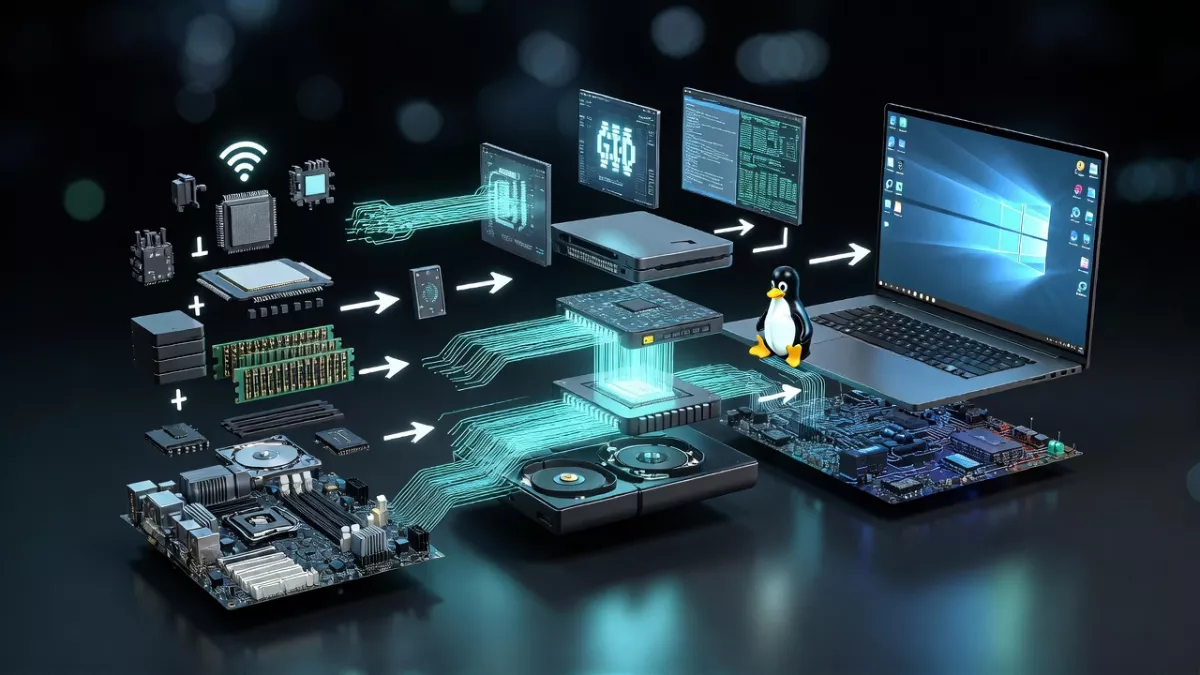
Hardware Device → Kernel Driver → Linux Input Subsystem → /dev/input → User App
If any part of that chain is broken, input won’t work properly.
5. The Role of Input Event Devices
Linux exposes input devices through the evdev interface:
/dev/input/event0
/dev/input/event1
...
Each device gets its own eventX node. These nodes allow input events to flow from kernel space to user space.
Developers use tools like:
evtestlibevdevudevadm
These tools let you view, debug, or grab events from input devices.
For example, evtest prints all events from devices in real time. It helps you understand what the kernel sees when you interact with hardware.
6. Anatomy of a Linux Input Driver
A Linux input driver generally includes:
Driver Structure
Each input driver has an entry that lists supported devices — usually identified by vendor ID, product ID, or bus type.
Probe Function
This runs when the hardware is detected. It initializes device hardware, allocates structures, and registers the device with the input core.
Event Handling Function
Called when hardware reports an event. It packages raw data into input events.
Interrupt or Poll Handler
Depending on the device, it either:
- Responds to hardware interrupts, or
- Polls the hardware regularly.
Teardown Function
Cleans up when the device is removed or the driver is unloaded.
All of this code lives in the kernel — either built in or as a loadable module.
7. Configuring Input Drivers: Device Tree and Udev
Modern Linux uses Device Tree and udev rules to configure input drivers.
Device Tree
On ARM and embedded boards, many input devices are described in the device tree (.dts). This description tells Linux:
- Which driver to use
- IRQs and GPIO lines
- Communication protocols (I2C, SPI)
Example snippet:
touchscreen@1a {
    compatible = "goodix,gt911";
    reg = <0x1a>;
    interrupts = <GTP_INT_GPIO IRQ_TYPE_EDGE_FALLING>;
    ...
};
This makes the kernel driver bind to the hardware automatically.
udev
udev is the device manager for Linux. It dynamically creates device nodes under /dev when hardware arrives. For input devices, udev populates:
/dev/input/by-id/
and
/dev/input/by-path/
udev rules can rename or assign persistent names to devices.
8. Writing a Simple Input Driver in Linux
Let’s walk through a basic input driver. I’ll keep it simple so you get the core idea.
This example is for a generic button on a custom embedded board.
Step 1: Required Headers
#include <linux/module.h>
#include <linux/input.h>
#include <linux/platform_device.h>
#include <linux/gpio.h>
#include <linux/interrupt.h>
Step 2: Driver Data Structure
struct button_drv_data {
    struct input_dev *input;
    int irq_number;
    int gpio_number;
};
Step 3: Interrupt Handler
static irqreturn_t button_isr(int irq, void *dev_id) {
    struct button_drv_data *data = dev_id;
    int value = gpio_get_value(data->gpio_number);

    input_report_key(data->input, BTN_0, value);
    input_sync(data->input);

    return IRQ_HANDLED;
}
Step 4: Probe Routine
static int button_probe(struct platform_device *pdev) {
    struct button_drv_data *data;
    int error;

    data = devm_kzalloc(&pdev->dev, sizeof(*data), GFP_KERNEL);
    data->input = devm_input_allocate_device(&pdev->dev);

    data->gpio_number = /* read from device tree */;
    data->irq_number = gpio_to_irq(data->gpio_number);

    input_set_drvdata(data->input, data);
    data->input->name = "Generic Button";

    input_set_capability(data->input, EV_KEY, BTN_0);

    error = input_register_device(data->input);

    request_irq(data->irq_number, button_isr, IRQF_TRIGGER_RISING | IRQF_TRIGGER_FALLING, "btn", data);
    return 0;
}
Step 5: Remove Routine
static int button_remove(struct platform_device *pdev) {
    free_irq(data->irq_number, data);
    return 0;
}
This driver:
- Allocates input device
- Registers button event
- Sets up an interrupt
- Generates
BTN_0events when the button changes state
9. Debugging Input Drivers
Debugging input drivers can be tricky, but tools make it easier:
1. dmesg
Check kernel messages:
dmesg | grep input
It shows driver loading and errors.
2. evtest
View live event stream:
sudo evtest /dev/input/eventX
You’ll see key codes, movement, etc.
3. udevadm
Check udev info:
udevadm info --attribute-walk /dev/input/eventX
This helps you verify device properties.
4. libinput‑debug
If you are using libinput (common in desktops):
libinput debug-events
This shows higher‑level, parsed data.
10. Use Cases: Keyboard, Mouse, Touchscreens, Gamepads
Keyboard Drivers
A keyboard driver handles key press codes and translates them into key events. The Linux input subsystem works with many types:
- USB keyboards
- Bluetooth keyboards
- Matrix keyboards in embedded devices
Thanks to the input core, all keyboards appear consistently in /dev/input.
Mouse and Pointer Devices
Mouse drivers take:
- X/Y movement
- Buttons
and convert them into standard pointer events.
Touchscreens
Touchscreens need more sophisticated drivers:
- Multi‑touch support
- Gestures
- Pressure
- Coordinates
Touch drivers often use protocols like MT and integrate with libinput.
Gamepad and Joystick Support
Game controllers generate multiple axes and buttons. Linux input drivers handle:
- Analog sticks
- Digital buttons
- POV hats
Game developers can read input events directly or through libraries like SDL.
11. Best Practices for Input Driver Development
Here are some practical tips:
Use Existing Helpers
The kernel has many helper functions for:
- Event reporting
- Device registration
- Polling and interrupt handling
Reuse them where possible.
Follow Linux Coding Style
Formatting and naming help others read your driver.
Keep Performance in Mind
Input drivers need to be responsive. Avoid slow code paths in interrupt context.
Use Device Tree
For embedded devices, always describe hardware in the device tree — no hardcoding.
Test With Tools
Make sure evtest and libinput show correct events.
12. Hands‑On: Real Work With Input Drivers
Let’s walk through a real‑world scenario: You are adding touchscreen support to a custom hardware board running Linux.
Step A: Identify Hardware
Check which controller is used (example: Goodix GT911).
Step B: Write Device Tree Entry
In your board device tree:
gt911@5d {
    compatible = "goodix,gt911";
    reg = <0x5d>;
    interrupt-parent = <&gpio1>;
    interrupts = <GTP_INT_GPIO IRQ_TYPE_EDGE_FALLING>;
    reset-gpios = <&gpio1 23 GPIO_ACTIVE_LOW>;
    touchscreen-size-x = <800>;
    touchscreen-size-y = <480>;
};
Step C: Check Kernel Driver
Make sure your kernel config includes:
CONFIG_TOUCHSCREEN_GOODIX
or build it as a module.
Step D: Boot and Verify
Once Linux boots:
ls /dev/input/
evtest
You should see a touchscreen device.
Step E: Test Interaction
Run:
evtest /dev/input/eventX
Touch the screen — you’ll see events with coordinates.
Linux Input Drivers Interview Questions and Answers
Basic Level (Round 1)
Q1: What are input drivers in Linux?
A: Input drivers are kernel modules that allow Linux to communicate with input devices like keyboards, mice, touchscreens, or game controllers. They convert raw hardware signals into events that the OS or applications can understand.
Q2: What is the Linux Input Subsystem?
A: The Linux Input Subsystem is a part of the kernel that handles input devices in a uniform way. It provides a standard interface (evdev) so that all applications can read input events without worrying about the underlying hardware.
Q3: What is evdev?
A: evdev (event device) is a kernel interface that exposes input devices as /dev/input/eventX. It allows user-space applications to read input events such as key presses, mouse movement, or touchscreen touches.
Q4: How does Linux differentiate between input devices?
A: Each device is registered with the input subsystem and assigned a unique /dev/input/eventX node. udev provides persistent naming (by-id or by-path) for devices. Drivers also specify device capabilities, like EV_KEY for keyboards or EV_ABS for touchscreens.
Q5: Name some types of input devices supported by Linux.
A:
- Keyboards (USB, Bluetooth, matrix)
- Mouse and touchpads
- Touchscreens (single and multi-touch)
- Gamepads and joysticks
- Sensors like buttons, proximity, or motion detectors
Q6: What are input events?
A: Input events are structures representing a change in device state, like a key pressed, mouse moved, or a touchscreen touched. They are defined by struct input_event in the kernel and passed to the user-space through /dev/input/eventX.
Q7: What is the role of udev with input devices?
A: udev dynamically creates device nodes in /dev when a device is plugged in. For input devices, it manages naming (by-id, by-path) and permissions, ensuring applications can access the correct input device consistently.
Q8: What is a device tree in Linux?
A: A device tree describes hardware to the Linux kernel, particularly on embedded ARM devices. Input devices are declared here with properties like IRQs, GPIO pins, and communication protocols (I2C, SPI).
Q9: What is the difference between an interrupt-driven input driver and a polling input driver?
A:
- Interrupt-driven: The hardware notifies the driver when an event occurs. Efficient for low-power devices.
- Polling: The driver regularly checks the hardware for events. Simple but may use more CPU and add latency.
Q10: How can you check which input devices are present in Linux?
A:
ls /dev/input/
Or use tools like cat /proc/bus/input/devices or evtest.
Intermediate Level (Round 2)
Q11: Explain the steps when an input device generates an event.
A:
- Hardware generates a signal (key press, touch).
- The input driver receives the signal via interrupt or polling.
- Driver translates it into a Linux input event (
struct input_event). - Input core queues the event and sends it to
/dev/input/eventX. - User-space applications read the event through evdev or libraries like libinput.
Q12: What is input_register_device()?
A: It’s a kernel function used by input drivers to register a device with the Linux input subsystem. After calling it, the device is visible in /dev/input.
Q13: What are input capabilities in Linux?
A: Input capabilities define what a device can do. They include event types (EV_KEY, EV_ABS, EV_REL), key codes, or axes. This helps applications understand the type of events a device can generate.
Q14: How do you debug input drivers in Linux?
A:
dmesg— Check kernel logs.evtest /dev/input/eventX— View events in real time.libinput debug-events— For higher-level parsed events.udevadm info— Check device attributes.
Q15: What is input_report_key()?
A: It’s a function in input drivers used to report key/button events to the input subsystem. For example, pressing a keyboard key triggers input_report_key(dev, KEY_A, 1).
Q16: What is input_sync()?
A: After reporting one or multiple events, input_sync() flushes the events to the input core. Without it, events might not reach user-space immediately.
Q17: Explain multi-touch support in Linux.
A: Multi-touch devices generate multiple absolute events (EV_ABS) for each finger. The Linux input subsystem uses slots to track touches, allowing applications to detect gestures like pinch, swipe, or zoom.
Q18: How does a touchscreen driver differ from a keyboard driver?
A:
- Touchscreen: Reports absolute coordinates (EV_ABS) and may support multi-touch.
- Keyboard: Reports discrete key presses (EV_KEY).
Both register events through the input subsystem, but touchscreens need more data handling for gestures.
Q19: Can you hot-plug input devices in Linux?
A: Yes, udev detects when devices are plugged/unplugged and creates or removes the corresponding /dev/input/eventX nodes. Drivers handle initialization dynamically using probe/remove functions.
Q20: How are custom input devices added in embedded Linux?
A:
- Define the hardware in Device Tree.
- Write or enable the kernel driver.
- Register the device with the input subsystem.
- Use
evtestor libinput to verify events.
Q21: What is the difference between EV_KEY and EV_REL?
A:
- EV_KEY: Discrete events like button presses (keyboard, mouse buttons).
- EV_REL: Relative events, like mouse movement or scroll wheel changes.
Q22: How do you handle debouncing in input drivers?
A: Debouncing ensures that a single button press isn’t registered multiple times. It can be handled:
- In hardware (capacitor-based)
- In software (delay logic inside ISR)
- Using kernel APIs like
input_set_capabilityand timing checks.
Q23: Explain the role of input_allocate_device()
A: Allocates and initializes a new struct input_dev in the kernel, which will later be registered with the input core.
Q24: How do you support multiple buttons or keys in one input driver?
A: Set capabilities for each key/button using input_set_capability(). Then report key events individually using input_report_key() followed by input_sync().
Q25: How do you test a Linux input driver on embedded hardware?
A:
- Build kernel module or enable driver in kernel.
- Boot the device.
- Use
/dev/input/eventXwithevtestor custom test apps. - Simulate hardware events (press buttons, touch screen).
- Monitor kernel logs for driver activity (
dmesg).
Q26: Explain input polling vs interrupt handling in drivers.
A:
- Polling: Driver reads hardware at regular intervals. Simple but may waste CPU cycles.
- Interrupt: Hardware triggers an interrupt when a change occurs. More efficient and faster response.
Q27: How does libinput relate to input drivers?
A: Libinput is a user-space library that reads /dev/input/eventX and provides a uniform interface for applications (GNOME, KDE). Drivers still exist in kernel space, but libinput abstracts event processing for desktops.
Q28: Can input drivers be implemented as kernel modules?
A: Yes, input drivers can be built-in or as loadable kernel modules (.ko). Modules can be loaded/unloaded at runtime using insmod or modprobe.
Q29: How do you debug a driver that doesn’t show any events?
A:
- Check kernel logs (
dmesg) for probe errors. - Verify device tree configuration.
- Ensure GPIOs/IRQs are correctly assigned.
- Test with a known working driver to rule out hardware issues.
Q30: How does the input subsystem interact with power management?
A: Drivers can suspend/resume devices using power management callbacks. This ensures input devices don’t consume power when idle but can wake the system (like pressing a key to wake a laptop).
Advanced Level Questions (Scenario-Based)
Q31: Scenario: Touchscreen shows wrong coordinates, what would you check?
A:
- Verify driver calibration and resolution.
- Check Device Tree properties (
touchscreen-size-x/y). - Inspect raw events using
evtest. - Check for firmware updates for the touchscreen.
Q32: Scenario: A new keyboard doesn’t work on embedded Linux. Steps?
A:
- Check if driver is loaded (
lsmod). - Check kernel logs (
dmesg). - Verify Device Tree or platform data.
- Use
evtestto see if events arrive. - Update driver or kernel config if needed.
Q33: Explain hot-plug handling in a USB mouse driver.
A: The driver has probe and remove functions. When the USB device is connected, the probe function initializes it and registers with input subsystem. On removal, the remove function frees resources and unregisters the device.
Q34: How do you implement multi-touch gestures in Linux?
A: Multi-touch drivers report multiple EV_ABS slots. Gestures like pinch, swipe, and rotate are interpreted in user-space (libinput, X11, Wayland) by reading multiple touch slots.
Q35: How to integrate a new I2C button controller as input device?
A:
- Define I2C bus and address in Device Tree.
- Write or adapt driver to read button states.
- Register buttons with input subsystem.
- Map events to EV_KEY codes and call
input_report_key().
Q36: How do you manage key repeat (auto-repeat) in Linux?
A: The input core can handle key repeat. Drivers report key press and release events. Auto-repeat is handled in the input core or user-space via X11 or libinput.
Q37: Difference between /dev/input/eventX and /dev/input/mouseX?
A:
/dev/input/eventX— Full, detailed event stream, including key, absolute, and relative events./dev/input/mouseX— Simplified, legacy interface for mouse movements and buttons only.
Q38: Can a driver report multiple device types?
A: Yes, for example a touchscreen can also have physical buttons. You can report EV_KEY and EV_ABS events from the same driver.
Q39: What kernel logs are most useful for input driver debugging?
A:
dmesgfor driver probe/init messages.printkstatements inside ISR or probe functions./proc/bus/input/devicesto verify device registration.
Q40: Best practices for writing input drivers?
A:
- Use existing input core helpers.
- Avoid long operations in interrupts.
- Follow kernel coding style.
- Use Device Tree, not hardcoded GPIOs.
- Test events with
evtestandlibinput. - Handle suspend/resume for power management.
FAQ: Input Drivers in Linux
1. What are input drivers in Linux?
Answer:
Input drivers are kernel-level modules that allow Linux to communicate with input devices like keyboards, mice, touchscreens, game controllers, and buttons. They translate raw hardware signals into events that applications and the OS can understand.
2. How do input drivers work in Linux?
Answer:
When a hardware device generates an input (e.g., key press or mouse movement), the input driver receives it via an interrupt or polling mechanism. The driver converts it into a standard event (struct input_event) and sends it to the input core. Applications read these events through /dev/input/eventX using evdev or libraries like libinput.
3. What is the Linux input subsystem?
Answer:
The Linux input subsystem is a kernel framework that unifies all input devices. It manages event queues, device registration, and communication with user-space. This uniform layer allows applications to handle keyboards, mice, touchscreens, and more without worrying about hardware details.
4. What is evdev and why is it important?
Answer:evdev (event device) is a Linux kernel interface that exposes input devices as /dev/input/eventX. It’s the standard way for applications to read input events. evdev ensures consistency, so developers don’t need to write separate code for each type of device.
5. How do I find all input devices on Linux?
Answer:
You can use:
ls /dev/input/
cat /proc/bus/input/devices
evtest
These commands list devices, details, and allow you to monitor real-time input events.
6. What is the role of udev in input drivers?
Answer:
udev dynamically creates device nodes when devices are connected and removes them when devices are disconnected. It ensures consistent naming (by-id or by-path) and sets proper permissions for user-space access.
7. How are input drivers configured in embedded Linux?
Answer:
In embedded Linux, input drivers are often configured through the Device Tree, which specifies IRQs, GPIOs, I2C/SPI addresses, and device capabilities. Drivers then register with the input subsystem using this information.
8. How can I debug input drivers?
Answer:
- Use
dmesgto check kernel messages. - Use
evtest /dev/input/eventXto view events in real-time. - Use
libinput debug-eventsfor parsed events. - Use
udevadm info --attribute-walk /dev/input/eventXto inspect device attributes.
9. What is the difference between EV_KEY and EV_REL?
Answer:
EV_KEY— Discrete key/button events like keyboard keys or mouse buttons.EV_REL— Relative movement events like mouse movement or scroll wheel changes.
10. Can I hot-plug input devices in Linux?
Answer:
Yes, Linux supports hot-plugging. udev detects newly connected devices, and the kernel driver’s probe function initializes them. Removal triggers the driver’s remove function, freeing resources.
11. How do touchscreen drivers work?
Answer:
Touchscreen drivers report absolute coordinates (EV_ABS) and may support multi-touch. Each touch is tracked in a slot, allowing gestures like pinch, swipe, and multi-finger taps. The input subsystem passes these events to applications via evdev.
12. What is input_report_key() and input_sync()?
Answer:
input_report_key()— Reports a key or button state to the input subsystem.input_sync()— Flushes events so they reach user-space immediately. These functions are essential in driver code for reporting input accurately.
13. How do I implement multi-button or multi-touch support?
Answer:
- Set device capabilities using
input_set_capability(). - For multiple buttons, report each with
input_report_key(). - For multi-touch, report each finger in a separate slot (EV_ABS) and call
input_sync().
14. How do I handle key debouncing?
Answer:
Debouncing ensures a single press isn’t registered multiple times. It can be handled:
- Hardware: Using capacitors or filters.
- Software: Adding timing checks in ISR or polling code.
- Kernel APIs: Using input core helpers to manage repeat events.
15. Can input drivers be loadable kernel modules?
Answer:
Yes, most input drivers can be built as loadable kernel modules (.ko). They can be inserted with insmod or modprobe and removed without rebooting. Built-in drivers are compiled directly into the kernel.
16. What tools help test input drivers?
Answer:
evtest— View events from/dev/input/eventX.libinput debug-events— Higher-level event stream for desktop environments.dmesg— Check kernel logs for driver messages.- Custom test scripts in Python or C using
libevdev.
17. How do I add support for a new input device in embedded Linux?
Answer:
- Define the hardware in the Device Tree.
- Write or enable the input driver in the kernel.
- Register the device using
input_register_device(). - Test using
evtestor libinput. - Debug with
dmesgif events do not appear.
18. How does Linux input subsystem handle power management?
Answer:
Input drivers can suspend devices when idle and resume them when needed. For example, a keyboard can wake a sleeping system. Drivers implement suspend/resume callbacks to manage power efficiently.
19. Difference between /dev/input/eventX and /dev/input/mouseX?
Answer:
/dev/input/eventX— Full event stream (key presses, absolute/relative events, multi-touch)./dev/input/mouseX— Simplified legacy mouse interface, mainly for relative movements and buttons.
20. How can I check Device Tree binding for an input device?
Answer:
Use the following commands:
dmesg | grep input
cat /proc/device-tree/
Or inspect /sys/class/input/ for registered devices and their properties.
Final Take
I wrote this guide to make Input Drivers in Linux clear, practical, and useful. You don’t need a PhD to understand Linux input, just curiosity and the right roadmap. Now you’ve got both.
If you want, I can also provide a downloadable PDF, code samples repository, or a video walk‑through for each step. Just ask!
Read More about Process : What is is Process
Read More about System Call in Linux : What is System call
Read More about IPC : What is IPC


Mr. Raj Kumar is a highly experienced Technical Content Engineer with 7 years of dedicated expertise in the intricate field of embedded systems. At Embedded Prep, Raj is at the forefront of creating and curating high-quality technical content designed to educate and empower aspiring and seasoned professionals in the embedded domain.
Throughout his career, Raj has honed a unique skill set that bridges the gap between deep technical understanding and effective communication. His work encompasses a wide range of educational materials, including in-depth tutorials, practical guides, course modules, and insightful articles focused on embedded hardware and software solutions. He possesses a strong grasp of embedded architectures, microcontrollers, real-time operating systems (RTOS), firmware development, and various communication protocols relevant to the embedded industry.
Raj is adept at collaborating closely with subject matter experts, engineers, and instructional designers to ensure the accuracy, completeness, and pedagogical effectiveness of the content. His meticulous attention to detail and commitment to clarity are instrumental in transforming complex embedded concepts into easily digestible and engaging learning experiences. At Embedded Prep, he plays a crucial role in building a robust knowledge base that helps learners master the complexities of embedded technologies.