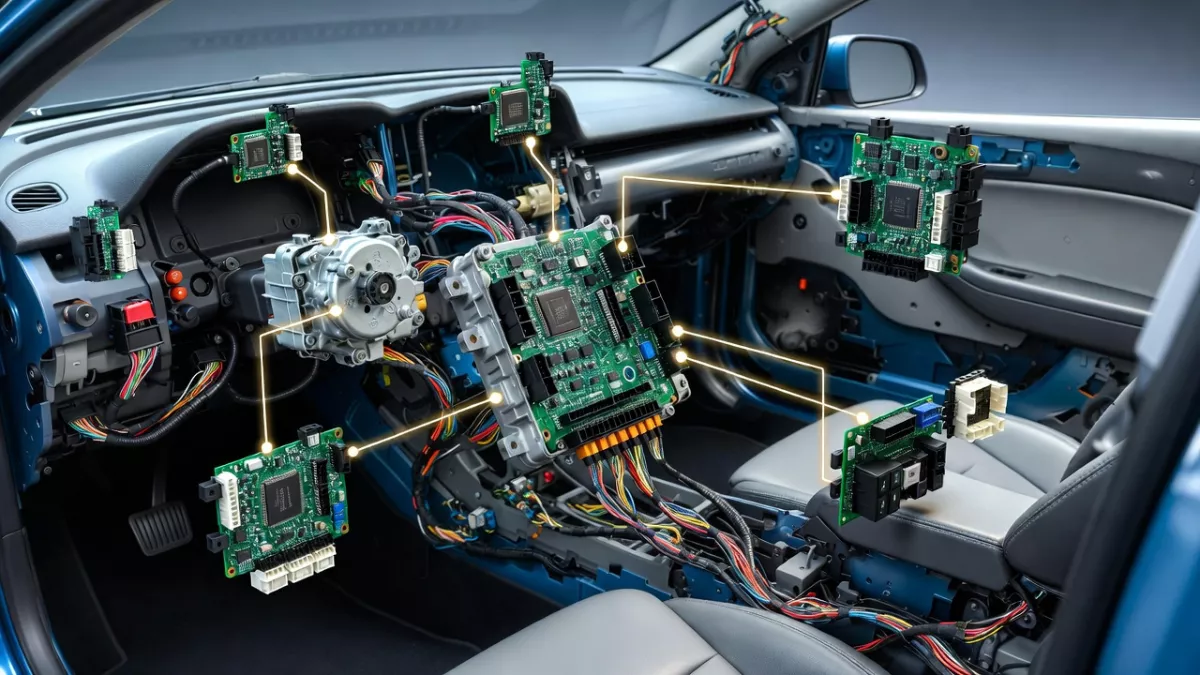
Master LIN Interview Questions with clear, real-world explanations. Learn LIN basics, automotive use cases, and interview-ready concepts explained simply.
If you are preparing for an automotive embedded interview, LIN Interview Questions almost always show up. Especially if the role involves body electronics, comfort systems, or low-cost ECUs. LIN looks simple on the surface, but interviewers use it to check whether you really understand communication fundamentals or just memorized definitions.
In this guide, I will walk you through LIN (Local Interconnect Network) from absolute basics to interview-level depth.
1. Basic LIN Concepts
- What is LIN (Local Interconnect Network)?
- Why was LIN developed?
- Where is LIN used in automobiles?
- What type of network topology does LIN use?
- Is LIN a master-slave or multi-master protocol?
- How many nodes can be connected in a LIN network?
- What is the maximum data rate of LIN?
- Is LIN synchronous or asynchronous?
- Is LIN half-duplex or full-duplex?
- What kind of physical layer does LIN use?
- What is the difference between LIN and UART?
- Why is LIN cheaper than CAN?
- Can LIN replace CAN?
- What are typical LIN applications?
- What is a LIN cluster?
2. LIN Architecture & Network Structure
- What are the main components of a LIN network?
- What is a LIN master node?
- What is a LIN slave node?
- Can a LIN network have more than one master?
- What is the role of the master in LIN communication?
- How does the master control communication?
- What happens if the LIN master fails?
- How is time synchronization handled in LIN?
- What is a LIN schedule table?
- Why is a schedule table needed?
3. LIN Frame Structure
- What is a LIN frame?
- What are the parts of a LIN frame?
- What is the purpose of the break field?
- What is the sync field in LIN?
- Why is the sync field value 0x55?
- What is a LIN identifier (ID)?
- How many bits are used for LIN ID?
- What are parity bits in LIN ID?
- How are parity bits calculated?
- What happens if the ID parity is wrong?
- What is the data field size in LIN?
- What is the checksum field?
- What is the difference between classic checksum and enhanced checksum?
- Which LIN versions support enhanced checksum?
- What happens if checksum validation fails?
4. LIN Communication & Timing
- How does LIN communication start?
- Who sends the header in LIN?
- Who sends the response in LIN?
- Can the master send data in LIN?
- Can a slave send data without master request?
- What is response time in LIN?
- What is the maximum response delay allowed?
- What is the inter-frame space in LIN?
- What happens if a slave does not respond?
- How is bus idle detected in LIN?
5. LIN Physical Layer
- What is the LIN physical layer voltage level?
- What is dominant and recessive state in LIN?
- What is the typical LIN bus voltage range?
- What is the role of the pull-up resistor in LIN?
- Where is the pull-up resistor located?
- Why does LIN use a single-wire bus?
- What type of transceiver is used in LIN?
- What happens if the LIN wire is shorted to ground?
- What happens if LIN is shorted to battery?
- How does LIN handle EMC and noise?
6. LIN Protocol Versions
- What are the different LIN protocol versions?
- What is the difference between LIN 1.x and LIN 2.x?
- What improvements were introduced in LIN 2.0?
- What is LIN 2.2?
- What is LIN 2.2A?
- Is LIN backward compatible?
- Which LIN version is most commonly used today?
7. LIN Identifiers & Message Types
- What is a protected identifier?
- How many different LIN message IDs are possible?
- What are unconditional frames?
- What are event-triggered frames?
- What are sporadic frames?
- What are diagnostic frames?
- What are reserved IDs in LIN?
- What is ID 0x3C used for?
- What is ID 0x3D used for?
- What is ID 0x3E used for?
- What is ID 0x3F used for?
8. LIN Diagnostics
- What is LIN diagnostics?
- How does LIN support diagnostics?
- What diagnostic protocol does LIN use?
- What is the purpose of the diagnostic master?
- What are master request frames?
- What are slave response frames?
- How many bytes are used in diagnostic frames?
- What is NAD in LIN?
- What is initial NAD?
- What is dynamic NAD assignment?
- What is configured NAD?
- What happens if two slaves have the same NAD?
9. LIN Error Handling
- What types of errors can occur in LIN?
- What is a checksum error?
- What is a parity error?
- What is a framing error?
- What is a bit error in LIN?
- How does LIN detect errors?
- Does LIN support error confinement like CAN?
- How does LIN recover from errors?
- What happens if a slave sends corrupted data?
- How does the master handle missing responses?
10. LIN Scheduling & Message Handling
- What is a LIN schedule table?
- How many schedule tables can a LIN master have?
- What is a normal schedule table?
- What is a diagnostic schedule table?
- What is a null schedule?
- How does the master switch schedule tables?
- What is frame slot time?
- How is slot time calculated?
- What happens if a frame exceeds its slot time?
- Can schedule tables be changed at runtime?
11. LIN vs Other Protocols
- Difference between LIN and CAN?
- Difference between LIN and I2C?
- Difference between LIN and SPI?
- Difference between LIN and FlexRay?
- Why not use CAN instead of LIN everywhere?
- When should LIN be preferred over CAN?
- Can LIN and CAN coexist in a vehicle?
- How do LIN and CAN communicate together?
12. LIN Hardware & Microcontroller Integration
- What peripherals are required to implement LIN?
- Can LIN be implemented using UART?
- What extra hardware is required besides UART?
- What is a LIN transceiver?
- What is sleep mode in LIN hardware?
- How is wake-up signal generated?
- How does a slave wake up from sleep?
- What is local wake-up?
- What is remote wake-up?
- How does the master detect wake-up?
- What happens to baud rate after wake-up?
13. LIN Software & Firmware Questions
- How is LIN implemented in firmware?
- What is LIN stack?
- What are the layers of LIN software?
- What is LIN API?
- How do you handle LIN interrupts?
- How do you handle timing in LIN software?
- How is checksum calculated in software?
- How is parity calculated?
- How do you test LIN communication?
- What tools are used for LIN debugging?
- What is LDF (LIN Description File)?
14. LIN Configuration & Files
- What is an LDF file?
- What information does LDF contain?
- How is LDF used in development?
- What is NCF in LIN?
- What is the role of LIN configuration tools?
- How does LDF help in diagnostics?
- Can LIN work without LDF?
- Who creates the LDF file?
15. Power Management & Sleep Modes
- Why is sleep mode important in LIN?
- How does LIN enter sleep mode?
- What is bus sleep command?
- What happens to the LIN bus during sleep?
- How much current does LIN consume in sleep?
- How is wake-up pattern detected?
- What is wake-up pulse width?
- What happens if noise triggers a false wake-up?
16. Advanced & Scenario-Based Questions
- What happens if two slaves respond at the same time?
- How do you prevent bus collision in LIN?
- What happens if baud rate mismatch occurs?
- How does auto-baud detection work?
- What happens if sync field is corrupted?
- How do you debug intermittent LIN failures?
- How do you design a robust LIN network?
- How do you handle EMI issues on LIN bus?
- What are real-world LIN failure cases?
- How do OEMs test LIN compliance?
- What is LIN conformance testing?
- How do you validate a LIN slave ECU?
- What interviewers expect from a LIN expert?
- Common mistakes engineers make with LIN?
17. Quick One-Line Interview Questions
- Is LIN deterministic?
- Does LIN support arbitration?
- Is CRC used in LIN?
- Is LIN multi-drop?
- Does LIN support broadcast?
- Can LIN run without pull-up?
- Is LIN open-drain?
- Is LIN point-to-point?
- Does LIN support encryption?
- Is LIN suitable for safety-critical systems?
Basic LIN Concepts interview Questions and Answer :
What is LIN (Local Interconnect Network)?
LIN stands for Local Interconnect Network. It is a low-cost serial communication protocol used mainly in automobiles for simple electronic control units (ECUs).
Think of LIN as a cheap and simple alternative to CAN for tasks that do not need high speed or high reliability.
LIN is used when:
- Data speed requirements are low
- Timing is relaxed
- Cost matters more than performance
In short, LIN connects small, simple ECUs that do basic jobs like switching, sensing, or controlling motors.
Why Was LIN Developed?
Before LIN existed, car manufacturers had two bad choices:
- Use CAN everywhere
- Reliable
- Fast
- But expensive for simple devices
- Use direct wiring
- Cheaper
- But heavy, messy, and hard to maintain
As cars added more features like power windows, mirror adjustment, seat control, and climate vents, wiring became a nightmare.
LIN was developed to:
- Reduce wiring complexity
- Reduce ECU cost
- Provide standardized communication
- Offload CAN from simple tasks
LIN was never meant to replace CAN. It was meant to support CAN.
Where Is LIN Used in Automobiles?
LIN is used mainly in body electronics and comfort systems.
Common LIN applications include:
- Power window switches
- Seat position motors
- Mirror adjustment
- Door lock modules
- Rain sensors
- Sunroof controllers
- HVAC flap motors
- Steering wheel buttons
These systems do not need fast data exchange. They need simple, predictable communication at low cost.
What Type of Network Topology Does LIN Use?
LIN uses a single-master, multiple-slave topology.
That means:
- One master node controls the network
- Multiple slave nodes respond when asked
There is no peer-to-peer communication in LIN.
The master decides:
- When communication happens
- Which slave can talk
- What data is sent
This design keeps LIN simple, deterministic, and cheap.
Is LIN a Master-Slave or Multi-Master Protocol?
LIN is strictly a master-slave protocol.
Only one master is allowed per LIN cluster.
Why this matters in interviews:
- CAN supports multi-master arbitration
- LIN does not
In LIN:
- Slaves never talk unless requested
- No collisions occur
- No arbitration logic is needed
This is one reason LIN hardware is much cheaper than CAN.
How Many Nodes Can Be Connected in a LIN Network?
A single LIN network, also called a LIN cluster, supports:
- 1 master
- Up to 16 slave nodes
So the total number of nodes is usually 17.
In real automotive designs:
- Often fewer than 16 slaves
- Keeps timing predictable
Interview tip: If asked for a number, say up to 16 slaves, then explain that practical limits are lower.
What Is the Maximum Data Rate of LIN?
The maximum data rate of LIN is 20 kbps.
Typical operating speeds:
- 9.6 kbps
- 10.4 kbps
- 19.2 kbps
Compared to CAN:
- CAN: up to 1 Mbps
- LIN: up to 20 kbps
This clearly shows LIN is not designed for speed. It is designed for cost and simplicity.
Is LIN Synchronous or Asynchronous?
LIN communication is asynchronous.
It is based on UART communication:
- Start bit
- Data bits
- Stop bit
However, LIN adds timing control using the master’s schedule table. So while the physical layer is asynchronous, the network behavior is tightly scheduled.
In interviews, a good answer is:
LIN uses asynchronous serial communication with master-controlled timing.
Is LIN Half-Duplex or Full-Duplex?
LIN is half-duplex.
That means:
- Data flows in only one direction at a time
- Either transmit or receive, not both
Since only one node talks at a time, half-duplex is enough and keeps hardware simple.
What Kind of Physical Layer Does LIN Use?
LIN uses a single-wire physical layer plus ground.
Key points:
- One data wire (LIN bus)
- One common ground
- Pull-up resistor to battery voltage
Voltage levels:
- Dominant (logic 0): near ground
- Recessive (logic 1): near battery voltage
This simple physical layer is another reason LIN is cheap and robust for short distances inside vehicles.
What Is the Difference Between LIN and UART?
This is a very common LIN interview question.
LIN is based on UART, but they are not the same.
UART:
- Point-to-point communication
- No addressing
- No scheduling
- No checksum rules
LIN:
- Uses UART framing
- Adds addressing (IDs)
- Uses master scheduling
- Includes checksum and error handling
In simple terms:
UART is a building block. LIN is a protocol built on top of UART.
Why Is LIN Cheaper Than CAN?
LIN is cheaper than CAN for several reasons:
- Simpler hardware
- No arbitration logic
- No differential signaling
- Single-wire bus
- Fewer components
- Lower wiring cost
- Lower software complexity
- No collision handling
- Fixed schedule
- Lower MCU requirements
- Works on small 8-bit microcontrollers
All these factors reduce BOM cost, which matters a lot in automotive mass production.
Can LIN Replace CAN?
No. LIN cannot replace CAN.
This is an important conceptual question.
LIN limitations:
- Very low speed
- No fault tolerance
- No redundancy
- Single master only
CAN advantages:
- High speed
- Robust error handling
- Multi-master support
- Used for safety-critical systems
Correct interview answer:
LIN complements CAN. It does not replace it.
What Are Typical LIN Applications?
Typical LIN applications focus on comfort, convenience, and simple control.
Examples:
- Window lift control
- Seat adjustment
- Mirror folding
- Interior lighting control
- Button panels
- Sensor data reporting
These systems tolerate:
- Millisecond delays
- Occasional retries
- Lower reliability compared to CAN
That makes LIN a perfect fit.
What Is a LIN Cluster?
A LIN cluster is a complete LIN network consisting of:
- One LIN master
- Multiple LIN slaves
- A single LIN bus
The master:
- Sends headers
- Controls timing
- Manages communication schedule
The slaves:
- Respond with data
- Perform actions when commanded
Each cluster typically handles one functional area like a door module or seat module.
Difference Between CAN and LIN
CAN (Controller Area Network) and LIN (Local Interconnect Network) are both automotive communication protocols, but they are designed for very different use cases.
1. Basic Purpose
CAN
- Used for critical, high-speed communication
- Handles real-time data like engine, braking, airbags, and ABS
LIN
- Used for simple, low-cost communication
- Handles comfort features like windows, mirrors, seats, climate knobs
2. Network Architecture
CAN
- Multi-master network
- Any node can start communication if the bus is free
LIN
- Single-master, multiple-slave
- Only the master initiates communication
This is one of the most important interview points.
3. Communication Speed
CAN
- High speed
- Up to 1 Mbps (Classic CAN)
LIN
- Low speed
- Maximum 20 kbps
4. Cost
CAN
- More expensive
- Requires CAN controller and CAN transceiver
LIN
- Very low cost
- Often uses UART + simple LIN transceiver
5. Wiring and Hardware
CAN
- Uses twisted pair (CAN_H, CAN_L)
- Better noise immunity
LIN
- Uses single wire + ground
- Less noise-resistant
6. Data Frame Size
CAN
- Up to 8 bytes (Classic CAN)
- (64 bytes in CAN FD)
LIN
- Up to 8 bytes
7. Error Handling
CAN
- Very strong error detection
- CRC, ACK, bit monitoring, error counters, fault confinement
LIN
- Basic error detection
- Checksum and parity bits only
8. Reliability
CAN
- Highly reliable
- Used in safety-critical systems
LIN
- Less reliable
- Not suitable for safety-critical tasks
9. Typical Applications
CAN
- Engine Control Unit (ECU)
- ABS
- Airbags
- Powertrain
- ADAS
LIN
- Power windows
- Door locks
- Seat adjustment
- Sunroof
- Climate control knobs
10. Wake-Up and Sleep
CAN
- More complex power management
LIN
- Simple sleep and wake-up
- Optimized for low power consumption
Quick Comparison Table
| Feature | CAN | LIN |
|---|---|---|
| Speed | Up to 1 Mbps | Up to 20 kbps |
| Architecture | Multi-master | Single-master |
| Wiring | Two wires (twisted pair) | Single wire |
| Cost | High | Very low |
| Error Handling | Strong | Basic |
| Reliability | High | Low |
| Use Case | Critical systems | Comfort features |
Interview One-Line Answer :
CAN is used for high-speed, safety-critical communication, while LIN is a low-cost, low-speed protocol used for simple body electronics.
Why Interviewers Love LIN Interview Questions
LIN interview questions are popular because they test:
- Communication fundamentals
- Automotive protocol understanding
- Cost vs performance trade-offs
- Real-world engineering thinking
LIN looks simple, but explaining why it exists shows maturity as an engineer.
How to Answer LIN Interview Questions Confidently
Here is a simple strategy:
- Start with purpose
- Explain design choice
- Compare with CAN
- Give real automotive examples
Do not just recite definitions. Show understanding.
Common Beginner Mistakes in LIN Interviews
Avoid these mistakes:
- Saying LIN is faster than CAN
- Calling LIN multi-master
- Confusing LIN with I2C
- Ignoring cost reasons
- Forgetting real applications
Interviewers notice these immediately.
Frequently Asked Questions (FAQs) : LIN Interview Questions
1. What is LIN and why is it used in cars?
LIN (Local Interconnect Network) is a low-cost communication protocol used in cars for simple control tasks like windows, mirrors, and seats. It reduces wiring and ECU cost while keeping communication reliable enough for comfort systems.
2. Is LIN faster or slower than CAN?
LIN is much slower than CAN. LIN supports up to 20 kbps, while CAN can go up to 1 Mbps. LIN is designed for low-speed, low-cost applications, not performance-critical systems.
3. Why do automotive manufacturers still use LIN?
Manufacturers use LIN because it is cheap, simple, and reliable enough for non-critical functions. Using CAN for every function would increase cost without real benefits for simple tasks.
4. Is LIN a master-slave protocol?
Yes, LIN is a strict master-slave protocol. There is only one master in a LIN network, and all slave nodes communicate only when the master requests data.
5. How many devices can be connected in a LIN network?
A LIN network, also called a LIN cluster, can support one master and up to 16 slave nodes. In real vehicles, the number is often lower to keep timing predictable.
6. What kind of applications use LIN in vehicles?
LIN is used in comfort and body electronics such as power windows, mirror control, seat adjustment, door locks, interior lighting, and HVAC flap control.
7. Is LIN communication synchronous or asynchronous?
LIN uses asynchronous serial communication based on UART. However, communication timing is controlled by the master using a predefined schedule.
8. Can LIN be used for safety-critical systems?
No. LIN is not suitable for safety-critical systems because it lacks redundancy, high speed, and advanced fault tolerance. CAN or FlexRay is used instead for safety-related functions.
9. What is the physical layer used by LIN?
LIN uses a single-wire physical layer with a pull-up resistor to battery voltage and a common ground. This simple design helps reduce wiring and hardware cost.
10. What is the difference between LIN and UART?
UART is a basic point-to-point serial communication method. LIN is a full communication protocol built on top of UART that adds addressing, scheduling, and error checking.
11. Why is LIN cheaper than CAN?
LIN is cheaper because it uses simpler hardware, single-wire communication, lower microcontroller requirements, and no bus arbitration logic. This reduces both component and wiring cost.
12. Can LIN replace CAN in automotive systems?
No. LIN cannot replace CAN. LIN is designed to support CAN by handling low-speed tasks, while CAN is used for high-speed and safety-critical communication.
13. What is a LIN cluster?
A LIN cluster is a complete LIN network consisting of one master node, multiple slave nodes, and a single LIN bus. Each cluster usually controls one functional area of a vehicle.
14. Why are LIN interview questions common in embedded interviews?
LIN interview questions are common because they test understanding of communication basics, automotive design trade-offs, and real-world system architecture, not just theoretical knowledge.
Read More : I2C Interview Questions & Answers


Mr. Raj Kumar is a highly experienced Technical Content Engineer with 7 years of dedicated expertise in the intricate field of embedded systems. At Embedded Prep, Raj is at the forefront of creating and curating high-quality technical content designed to educate and empower aspiring and seasoned professionals in the embedded domain.
Throughout his career, Raj has honed a unique skill set that bridges the gap between deep technical understanding and effective communication. His work encompasses a wide range of educational materials, including in-depth tutorials, practical guides, course modules, and insightful articles focused on embedded hardware and software solutions. He possesses a strong grasp of embedded architectures, microcontrollers, real-time operating systems (RTOS), firmware development, and various communication protocols relevant to the embedded industry.
Raj is adept at collaborating closely with subject matter experts, engineers, and instructional designers to ensure the accuracy, completeness, and pedagogical effectiveness of the content. His meticulous attention to detail and commitment to clarity are instrumental in transforming complex embedded concepts into easily digestible and engaging learning experiences. At Embedded Prep, he plays a crucial role in building a robust knowledge base that helps learners master the complexities of embedded technologies.