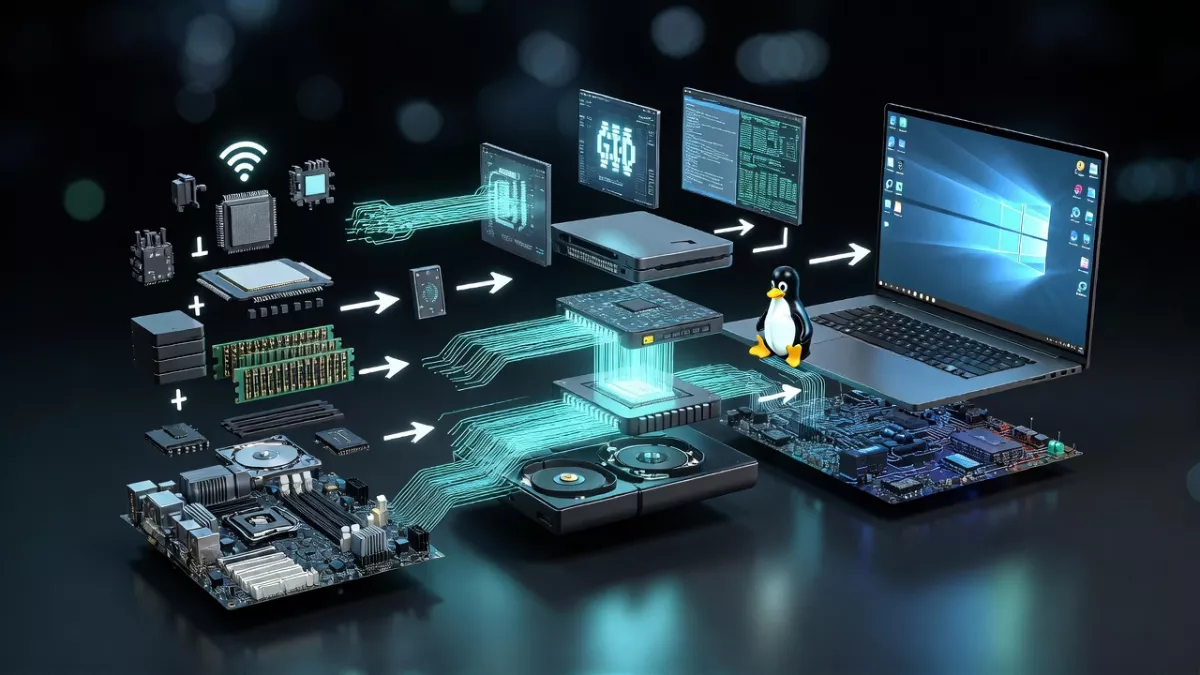
Have you ever stopped to think about what makes your computer tick? I’m not talking about the shiny screen or the clicking keyboard, but the deep-down, fundamental software that manages everything—from the Wi-Fi card connecting you to the internet to the USB port charging your phone. That foundational piece of software is the kernel, and it’s the undisputed boss of your operating system (OS).
But here’s a thought: If the kernel has to manage every single piece of hardware and every single function, wouldn’t it become absolutely enormous and hopelessly complicated? It would be like a single, massive piece of legislation trying to govern everything from international trade to what color you can paint your mailbox. That’s where the real magic comes in—the kernel modules.
Think of kernel modules as specialized, task-specific LEGO bricks that you can plug into your operating system’s kernel while the system is running.2 They are the way the kernel stays lean, mean, and incredibly flexible. Instead of trying to bake support for every single obscure printer or cutting-edge graphics card into the core software, the OS simply loads a dedicated module when it needs it, and unloads it when it’s done.
Let’s dive in and explore what these essential pieces of software are, why they are so important, and how they fundamentally shape the modern computing experience.
What Exactly IS a Kernel Module? (And Why Should You Care?)
In the world of computing, the kernel operates in kernel space—a highly protected area of memory where it has direct, unrestricted access to the computer’s hardware. Conversely, all the applications you use—your web browser, word processor, games—run in user space, where their access to hardware is mediated and restricted by the kernel. This separation is crucial for security and system stability. A crash in your web browser shouldn’t take down the entire OS, right?
A kernel module, sometimes called a Loadable Kernel Module (LKM) in Linux, is a block of code that can be dynamically loaded into and unloaded from the kernel on demand. It essentially extends the kernel’s functionality without requiring you to reboot the entire system or compile a new, monolithic kernel image.
The Big Picture: Why Dynamic Loading Matters
Imagine the alternative: a monolithic kernel. In this design, all drivers, all file system support (like for NTFS, FAT32, or ext4), and all network protocols would be built directly into the core kernel file.
- Massive Size: The kernel file would be huge, leading to longer boot times and consuming more precious RAM.
- Infrequent Updates: Every time you wanted to add support for a new piece of hardware, fix a bug, or add a feature, you’d have to compile a new kernel and reboot. That’s a massive headache.
- Security Risks: A bug in one small, obscure driver could potentially destabilize the entire system because all code is tightly integrated.
Kernel modules solve all of these problems elegantly. When you plug in a new USB drive, a module for the USB mass storage class is loaded. When you unplug it, that module can be safely unloaded, freeing up memory. This flexibility is the cornerstone of modern, stable, and highly adaptable operating systems like Linux, FreeBSD, and even to some extent, Windows.
The Three Main Roles of Kernel Modules
While the possibilities are endless, most kernel modules fall into one of three critical categories. Understanding these roles gives you a clear picture of how they power your machine.
1. Device Drivers (The Workhorses)
This is by far the most common use case. A device driver module is the translator between the operating system and a specific piece of hardware.7 It handles the low-level details of communicating with the hardware, allowing the kernel to simply send a high-level command (like “read data from the hard drive”) and let the driver worry about the technical specifics (like sending the correct sequence of electrical signals and interpreting the response).
- Examples: Drivers for your Wi-Fi card, Bluetooth adapter, graphics card, sound card, and disk controllers. Every time you buy a new peripheral, the OS needs a new kernel module to talk to it.
2. File Systems (The Organizers)
How does your computer know how to save and retrieve files on a hard drive or SSD? The answer is the file system. Different types of drives and different operating systems use various file systems (e.g., ext4 on Linux, NTFS on Windows, APFS on macOS).
Kernel modules allow your OS to handle these different file systems. When you connect a drive formatted with a file system your kernel doesn’t natively support, a module can be loaded to interpret and manage that specific file system structure.
- Examples: Modules that allow a Linux machine to read and write to an NTFS-formatted Windows drive, or modules for specialized network file systems like NFS or CIFS.
3. System Calls and Function Extensions (The Enhancers)
This category is about adding new core functionality to the kernel itself. The kernel provides a set of system calls that user-space programs use to request services (like opening a file or creating a process).
Sometimes, a developer needs to add a completely new function or modify how the kernel handles a certain task. They can implement this new logic as a kernel module. A very practical example is security and firewalling.
- Examples: Modules for implementing security frameworks (like SELinux or AppArmor), network filtering and firewalling functionality (like Netfilter/iptables in Linux), or new scheduling algorithms.
The Life Cycle of a Kernel Module: The Three Simple Steps
A kernel module has a surprisingly simple life cycle, which is key to its flexibility. There are just three main stages: initialization, normal operation, and cleanup.
Step 1: Initialization
When the kernel decides it needs a module—either during boot-up or when a piece of hardware is plugged in—it loads the module’s compiled binary code into.
This function is the module’s setup routine. It’s where the module:
- Registers itself with the kernel (e.g., “I’m the driver for the XYZ device”).
- Allocates any necessary memory or resources.
- Performs any initial hardware configuration.
If this function executes successfully, the module is officially “live” and integrated into the running kernel.
Step 2: Operation
Once initialized, the kernel module is simply part of the kernel . It sits quietly in the protected kernel space, waiting for the kernel or a user-space application to call upon its services. A driver module, for example, will wait for the kernel to say, “The user is trying to print this document; handle the data transfer to the printer.” The module then takes over, translating that request into the specific commands the hardware understands.
This phase is the module’s main job, where it executes its core logic, interacts with hardware, manages resources, and works to serve the requests coming from user applications through the kernel’s interfaces.
Step 3: Cleanup
When the module is no longer needed (e.g., the device it controls is unplugged, or the OS is shutting down), the kernel calls the module’s cleanup function, often named . This is the module’s chance to leave politely.
In this function, the module must:
- Un-register itself from the kernel’s list of active modules.
- Release any memory it allocated.
- Put the hardware it was controlling into a safe, idle state.
Once the function completes, the memory the module occupied can be reclaimed by the kernel, and the module effectively vanishes without requiring a system reboot. This is the dynamic part of Loadable Kernel Modules—the ability to appear and disappear while the system runs.
The Practical Side: Managing Kernel Modules
If you’re using a Linux-based system, you have direct tools for managing these powerful components. Even though the system mostly handles this automatically, knowing these tools is essential for troubleshooting and development.
Listing All Active Modules
You can see the current state of your kernel by listing all the modules that are loaded and active. This list can be surprisingly long, illustrating just how many specialized functions are currently running within your OS.
- Tool: The command (list modules).
- What it shows: The name of the module, its current size in memory, and a count of how many other modules currently depend on it. This dependency count is crucial—you can’t unload a module that another active module needs!
Loading a Module
In rare cases, you might need to manually load a module that the system hasn’t loaded automatically. This is usually done for testing or for a piece of hardware that wasn’t correctly detected at startup.
Unloading a Module
To remove a module from the running kernel and free up its resources, you use the unload command.
Why Kernel Modules are a Developer’s Best Friend
For the professional developer, kernel modules represent the ultimate access point to the core of the operating system.
1. Rapid Development and Testing
If you are writing a new device driver for an emerging piece of hardware, developing it as a kernel module is the only practical way. Imagine having to recompile and reboot your entire OS 100 times a day just to test a few lines of code in a driver! By using a module, the developer can:
- Load the module.
- Test the new code with the hardware.
- Unload the module.
- Make changes.
- Reload the module and test again—all without a single reboot.
2. Open Source and Community Contribution
In the world of Linux, the use of kernel modules has fostered an incredible level of innovation. Hardware manufacturers and independent developers can contribute new drivers to the community without having to submit their code for integration into the monolithic kernel source tree, which is a much longer and more complex process. This dynamic contribution model is one of the key reasons Linux is able to support such a vast array of hardware.
3. Customization and Hardening
For security-conscious environments, kernel modules allow system administrators to create highly customized and hardened systems.22 They can choose to compile only the absolute necessary functionality into the core kernel and leave everything else as modules. This means they can deliberately exclude any module that presents a potential security risk, ensuring the system has the smallest possible attack surface.
In essence, kernel modules empower developers to get closer to the hardware while maintaining the stability and security of the overall operating system.23
The Secret Life of Your Operating System: An Introduction to Kernel Modules
That was a comprehensive look at the basics! Now that you have a solid understanding of what kernel modules are and why they exist, let’s dive into the more technical, yet fascinating, aspects of how they work, how they are secured, and the potential pitfalls developers and administrators must consider.
Deep Dive into Kernel Modules: Development, Security, and Debugging
We established that kernel modules are the highly flexible, plug-and-play extensions that keep your operating system running efficiently. But how does this elegant system maintain stability and security when a third-party chunk of code is inserted directly into the most privileged part of the OS?
This is where the rubber meets the road. In this set, we’ll explore the tools and concepts developers use to create these modules, the crucial security considerations, and the complex process of debugging code that runs where no user program is allowed to tread.
The Developer’s Workshop: Building a Kernel Module
Creating a kernel module is very different from writing a standard user application. When you write a program that runs in user space, you have the full environment of the OS protecting you; if you crash, the kernel cleans up your mess. In kernel space, you are the OS. A single error can lead to a complete system crash—a dreaded “kernel panic.”
1. The Language of the Kernel
Almost all kernel modules are written in the C programming language. C is the language of choice because it offers direct memory manipulation and low-level control, which is necessary for interacting with hardware.
When developing a module, a programmer doesn’t link against the standard C library (like ) that user programs use. Why? Because the kernel can’t rely on libraries that themselves run in user space. Instead, the module uses specialized functions and data structures provided by the kernel itself.
2. Header Files and the Build System
To build a module, the developer needs access to the kernel header files. These files define all the interfaces, functions, and data structures a module needs to communicate with the rest of the kernel.
The build process is managed by a customized Makefile. This Makefile doesn’t just compile the C code; it tells the system how to integrate the compiled code with the existing kernel build infrastructure, ensuring the resulting module file (usually with a extension, for “Kernel Object”) is correctly formatted for dynamic loading.
3. Key Functions: The Entry and Exit Points
As we mentioned in Set 1, every module needs an entry and exit point, defined using macros:
| Macro | Purpose | Typical Function Name |
| Specifies the function to run when the module is loaded (initialization). | ||
| Specifies the function to run when the module is unloaded (cleanup). |
These functions are the only way a module’s code is first executed. Everything else the module does (handling interrupts, processing data) is triggered by the kernel calling functions that the module has previously registered.
4. Registering Interfaces: The Module’s Handshake
Once the module is loaded, it must register itself with the kernel to be useful. For example, a network card driver doesn’t just start sending packets. It registers a network interface with the kernel, saying, “I can handle traffic for the device.” The kernel then knows to direct all network-related requests for to that specific module.
This registration and de-registration process is the crucial handshake that allows the kernel to know what services each loaded module provides
Security Implications: The Double-Edged Sword
Because kernel modules execute in kernel space with the highest possible privileges, they represent a significant security risk if compromised or maliciously designed. This power is the kernel modules’ strength and their greatest vulnerability.
1. Rootkits and Malicious Modules
One of the most insidious types of malware is the kernel rootkit. A rootkit is designed to hide its presence and maintain privileged access. A kernel rootkit achieves this by acting as a malicious kernel module.
- Evasion: A malicious module can intercept system calls. For instance, when a user-space program asks the kernel for a list of running processes, the rootkit module can intercept that request and quietly remove its own process from the list before passing it back. This makes the malware invisible to standard security tools.
- Backdoors: It can install network filters or backdoor access points, giving a remote attacker persistent, high-level control over the entire system.
2. Kernel Module Signing (Trusted Modules)
To combat the risk of unauthorized or malicious modules, many modern operating systems, particularly Linux distributions, implement module signing (often related to Secure Boot).
- The Concept: Before a module is allowed to load, the kernel checks its digital signature. If the module isn’t signed by a trusted authority (like the OS vendor or the distribution’s key), the kernel refuses to load it.
- The Benefit: This security feature ensures that only modules verified by a trusted source can extend the kernel’s functionality, significantly mitigating the threat from unauthorized code like rootkits.
3. Taint Status: A Warning Flag
When things go wrong in the kernel, stability is paramount. The Linux kernel maintains a concept called taint status. If certain events happen—like loading an unsigned proprietary module, forcing an unload of a module that was still in use, or encountering a hardware error—the kernel is marked as “tainted.”
A tainted kernel is technically still operational, but the taint status is a huge warning sign. If a crash (a kernel panic) occurs on a tainted system, developers and support communities may not offer help, as the issue could be caused by the non-standard, possibly unstable, external module that caused the taint.
Debugging: Operating in the Dark
Debugging a user-space application is relatively easy: you can attach a debugger (like GDB), step through the code, inspect variables, and print messages to the terminal. Debugging a kernel module is a fundamentally more challenging task.
1. No Standard Output (The method)
A kernel module cannot simply use the standard C function to display information. relies on libraries and mechanisms that exist in user space.
Instead, kernel developers use the special function . This function writes messages into a dedicated kernel log buffer. User-space programs (like the utility in Linux) then read and display the contents of this buffer.
- The Challenge: messages are often asynchronous, meaning they might appear on your screen after the event they are describing. Furthermore, if the system has crashed, the log buffer might be incomplete or inaccessible.
2. The Inability to Step-Through
You cannot easily pause the entire operating system to step line-by-line through a kernel module like you would with a normal application. The kernel must keep running to service interrupts and maintain system state.
Advanced kernel debugging typically requires specialized hardware or virtual machine setups:
- KGDB (Kernel GNU Debugger): This is a kernel extension that allows a developer on one machine to debug the kernel running on a second machine (the “target”) via a serial cable or network connection. This setup is complex but allows for true breakpoint and step-through functionality.
- Virtual Machines: Debugging inside a VM is common, as a kernel panic in the guest OS doesn’t crash the host OS, making the environment safer for experimentation. Tools can often halt the entire virtual machine’s CPU for inspection.
3. The Dreaded Kernel Panic
The ultimate sign of a catastrophic failure in a kernel module is a kernel panic. This is when the kernel detects an internal error from which it cannot safely recover (e.g., trying to access an invalid memory address).
When a panic occurs, the kernel halts all operations, dumps diagnostic information (the stack trace) to the screen or a log file, and effectively freezes the system. Analyzing the stack trace is the primary method for tracking down which module and which function caused the fatal error.
The Big Picture: Future and Evolution of Kernel Modules
The design principles behind kernel modules—modularity, dynamic loading, and separation of concerns—remain crucial today, even as hardware evolves.
1. Device Tree and Module Parameters
Modern kernels have become even more sophisticated in how they interact with modules, particularly on embedded systems and ARM devices. The Device Tree is a structure that describes the non-discoverable hardware in a system. When the kernel boots, it reads the Device Tree and loads only the kernel modules corresponding to the hardware listed there, optimizing boot time and memory usage.
Furthermore, modules often accept parameters. Instead of recompiling a module every time you want to change a small setting (like a network card’s operating mode), you can pass a configuration value to the module when it is loaded. This adds another layer of dynamic flexibility.
2. eBPF: The Next Evolution of Extensibility
While traditional kernel modules involve writing and loading privileged C code, a newer, safer technology called eBPF (extended Berkeley Packet Filter) is revolutionizing kernel extensibility. eBPF allows developers to write small programs (often used for networking, tracing, and security) that run in a controlled, sandboxed virtual machine inside the kernel.
These eBPF programs are verified by the kernel’s internal checker before execution, ensuring they can never crash the kernel or execute infinite loops. While not a direct replacement for complex device drivers, eBPF is rapidly taking over many of the functions previously performed by simpler, custom-written kernel modules, offering a more secure and robust way to extend kernel functionality.
Conclusion: Mastering the Core
Kernel modules are the engineering backbone of modern operating systems, providing the critical balance between efficiency and adaptability. They offer developers the necessary power to interface directly with hardware, but this power comes with the high responsibility of security and stability.
Understanding how to build, secure, and debug these modules is the essential bridge between user applications and the physical hardware, making them a core concept for anyone serious about system administration, security, or operating system development.
Did this deep dive into the development and security aspects of kernel modules satisfy your need for the second set of information?


Mr. Raj Kumar is a highly experienced Technical Content Engineer with 7 years of dedicated expertise in the intricate field of embedded systems. At Embedded Prep, Raj is at the forefront of creating and curating high-quality technical content designed to educate and empower aspiring and seasoned professionals in the embedded domain.
Throughout his career, Raj has honed a unique skill set that bridges the gap between deep technical understanding and effective communication. His work encompasses a wide range of educational materials, including in-depth tutorials, practical guides, course modules, and insightful articles focused on embedded hardware and software solutions. He possesses a strong grasp of embedded architectures, microcontrollers, real-time operating systems (RTOS), firmware development, and various communication protocols relevant to the embedded industry.
Raj is adept at collaborating closely with subject matter experts, engineers, and instructional designers to ensure the accuracy, completeness, and pedagogical effectiveness of the content. His meticulous attention to detail and commitment to clarity are instrumental in transforming complex embedded concepts into easily digestible and engaging learning experiences. At Embedded Prep, he plays a crucial role in building a robust knowledge base that helps learners master the complexities of embedded technologies.